1. What is the name of the bay where the town of Red Lake is located?
A. Big Bay
B. East Bay
C. Deep Bay
D. Howey Bay
2. The stream that creates a rapids at the end of Trout Bay is called what?
A. Douglas Creek
B. Trout Creek
C. West End Creek
D. Chukuni River
3. When boating westward from the town, the long point with the fire-fighting base is called what?
A. The Point of No Return
B. Long Point
C. Forestry Point
D. Cape Point
4. The first big body of water west of town is commonly called what?
A. Big Bay
B. The Stretch
C. East Bay
D. Bay With No End
5. On the north side of that first big body of water is Red Lake's largest island. What is it?
A. White Horse Island
B. Fisher Island
C. McKenzie Island
D. Wolf Island
6. The stream that forms the outlet of Red Lake is called what?
A. English River
B. Douglas Creek
C. Parker Creek
D. Chukuni River
7. What stream forms the main inlet to Red Lake?
A. Chukuni River
B. Douglas Creek
C. Parker Creek
D. English River
8. Besides great fishing, what is Red Lake most known for?
A. Sunsets
B. Gold
C. Old Hudson Bay trading post
D. Woodland caribou
9. What is the closest approximate population of Red Lake?
A. 10,000
B. 6,000
C. 4,000
D. 2,000
10. Which community is not part of Red Lake Municipality?
A. Ear Falls
B. Cochenour
C. Madsen
D. Balmertown
11. Which fish species is not found in Red Lake?
A. Muskellunge
B. Smallmouth bass
C. Tulibee
D. Channel catfish
12. Which is an invasive species of Red Lake?
A. Emerald shiner
B. Rainbow smelt
C. Rock bass
D. Rusty crayfish
13. Red Lake has how many traffic lights?
A. Three
B. Two
C. One
D. Zero
14. What is the name of the provincial park west of Red Lake?
A. Pakwash Provincial Park
B. Quetico Provincial Park
C. Wabakimi Provincial Park
D. Woodland Caribou Provincial Park
15. If a person portages a canoe north from Pipestone Bay what river system does he enter?
A. Chukuni River
B. Mississippi River
C. Churchill River
D. Bloodvein River
Answers:
1. D
2. A
3. C
4. B
5. C
6. D
7. A
8. B
9. C
10. A
11. D
12. B
13. C
14. D
15. D
Click to go back to our website
Click to see the latest on the blog
Sunday, February 28, 2016


Thursday, February 25, 2016
Does this look really tasty to you?


Nothing makes a better late-winter snack to a whitetail than this stuff -- beard lichens or as most of us know it, Old Man's Beard.
Sometime in the past few billion years, algae and fungi made a deal. It was a "you scratch my back and I'll scratch yours," kind of pact. It probably goes right back to the time of the cyanobacteria that made the stromatolites which we talked about two postings ago. We can surmise that because cyanobacteria horned-in on the deal too. It went like this, algae and cyanobacteria photosynthesize but freeze while fungi don't photosynthesize but, at least some of them, don't freeze. In the words of Rick in Casablanca, "I think this is the beginning of a beautiful friendship."
Algae and fungi may have been the first to create symbiosis which was so popular it became the basis for life on Earth. Algae created food and fungi protected the algae and they called their partnership Lichens. It was pure chemistry and, speaking of chemistry, the lichens started making their own chemical concoctions, things like acids, that could crumble the rocks they were clinging to and helped keep competing vegetation away as well as predators.
Fast forward to just mere thousands of years ago and First Nation peoples, who must have had a ball trying out various "plants" for things, discovered that Old Man's Beard contained usnic acid. OK, maybe they didn't call it usnic acid back then but what they did know was Old Man's Beard was a great thing to use as a poultice on cuts and wounds. If you did so the wound didn't become infected. Today, we know that the beard contains usnic acid which is anti-bacterial.
Old Man's Beard is an example of an arboreal or tree lichen. There are many more species on the ground. According to my "bible" on the subject: Lichens of the North Woods by Joe Walewski, there are 700 species of lichens in these parts.
One of the most noticeable is the grey Reindeer Lichen (better known in our area as caribou lichen) which covers large areas of rock in the Boreal Forest, including all around Red Lake. Woodland caribou have evolved to eat this stuff and in fact, depend on it and arboreal lichens in the winter.
Caribou, and deer, have four-chambered stomachs which must have something to do with their ability to eat the lichens while humans cannot. Some thoughtful First Nation's person must have considered this and, according to my book, discovered that he could safely consume the three-fourths-digested lichens that were now in the fourth chamber of the caribou's stomach.
Like I say, I think they had a lot fun trying out things back then.
Reindeer lichen is one of the faster-growing lichens and lives for 30-50 years. By contrast Yellow Map Lichens can live for 4,500 years!
Click to go back to our website
Click to see the latest on the blog
Tuesday, February 23, 2016
Next step in our continuous improvements
 |
| Brenda and Tommy Cieplik in Lund SSV, now with auto bilge pump |
In just the past few years we have installed the world's best septic system -- the EcoFlo biofilter -- that sends all our waste water through tanks of peat moss before it is released back into the ground. It is light years ahead of conventional gravel-sand systems and far exceeds all requirements.
We also have the world's best water filtration plant, sending delicious, crystal-clear water to every tap and cabin in camp. Our water treatment plant has a triple-backup system to ensure all our water not only meets health standards but far, far exceeds it. It ranks with the world's finest bottled water.
Years ago we converted our entire fleet of outboard motors to quiet, powerful-yet-excellent-trolling, 20 h.p. four-stroke Hondas, and in a special nod to our older customers, made sure all of these were electric-start. No more yanking starting ropes. You just push a button.
We also added dock-assists at every dock in camp. These uprights look something like a swim ladder and give you something to hold onto when getting in and out of the boats. They are positioned so you can use the boat seat as a step while having both hands on the uprights. They have been universally welcomed, including by younger guests.
We also have been switching our boats from the conventional Lund models to the new SSV types that have double walk-throughs and floors throughout. (Even our older boats have floors in the bows.)
This year we will add something to every boat that I suspect will be hailed by all -- automatic bilge pumps. Any time it rains the bilge pump will come on automatically and pump the boat dry. Will anybody feel nostalgic at not needing to bail the boat with the scoop any more? I didn't think so!
Click to go back to our website
Click to see the latest on the blog
Saturday, February 20, 2016
We are turning the corner on winter
 |
| Evening scene in Nolalu, near Thunder Bay |
The weather has turned unseasonably warm, going above freezing and raining. No one likes this. We would rather it was below freezing than watch our 30 inches of snow and our snow-packed roads turn into slop.
The scene is now set for a condition that will greatly benefit timber, or grey, wolves. Tomorrow the mercury is going to recede to about -12 C and a sturdy crust will form atop the snow. In previous years we have seen this crust become so strong it would support the weight of a human. It will very likely support wolves who spread their modest weight on four fairly-wide paws. Deer and moose, however, will plunge through.
The advantage will go to the predator.
Click to go back to our website
Click to see the latest on the blog
Wednesday, February 17, 2016
More August-caught fish
 |
| Jason Williams with a beautifully-spotted big northern pike |
 |
| Kyle Kelley's 38-inch pike shows a chain pattern |
 |
| Davis Beyer with one heck of a walleye from last August |
We are a fishing camp, that's for sure, but we are more than that too. And by "we" I mean more than just Brenda and me. It includes our guests, friends and neighbours. We are all about fishing but then we are also all about history of the area, nature, environmental stewardship and living in harmony with the outdoors. The blog tries to reflect this diversity.
There are nearly 1,000 blog postings here, the majority of them about fishing. If you do a search for walleye or northern pike in the little search window at the top left, you will come up with hundreds of articles. To the best of our ability, we don't keep posting the same thing year after year but just if there is something new to report. All the information is still there, you must just call up what you want.
Click to go back to our website
Click to see the latest on the blog
Monday, February 15, 2016
Stromatolites made life as we now know it
 |
| Bob Leis with book and sample of Red Lake stromatolite at camp |
And incredibly, some of the first stromatolites to appear on Earth, a long, long time ago, were right at Bow Narrows Camp at the west end of Red Lake, Ontario!
The entire story is chronicled in a new book: Stomatolites: Ancient, Beautiful and Earth-Altering by Bob Leis and Bruce Stinchcomb with illustrations by Terry McKee.
Bob came to camp last summer to check out the Red Lake stromatolites which at 2.925 billion years old, are among the oldest in the world.
Let's start at the beginning, that is, the beginning of the Earth, 4.6 billion years ago. The brand new planet was nothing like it is today. Geologists call the first 800 million years the Hadean Era. Hadean as in Hades. The Earth's crust was molten, volcanoes everywhere and bombarded by lots of meteors.
The atmosphere was composed of carbon dioxide and methane. Temperatures were extreme and there was no life.
After 800 million years things had cooled down enough that the liquid rock turned solid and was largely covered by water. And right away, at least in geologic terms, life began and started what is called the Archean Era which lasted until 2.5 billion years ago.
The very first life is thought to have been single-celled bacteria that did not need oxygen. But before long, again in geologic terms, cyanobacteria appeared. These were photosynthetic and are the organisms that would eventually create our breathable atmosphere and left the mostly-trace fossils that we call stromatolites.
The cyanobacteria formed dense mats in shallow areas of water. As they continued to grow they calcified and trapped sediments in layers that became stromatolites.
A byproduct of photosynthesis is the production of free oxygen and for the first two billion years that cyanobacteria created free oxygen it was gobbled up by iron molecules to create iron oxides -- hematite and magnetite. This was laid down in layers called Banded Iron Formations. Those formations are what we mine today. So, along with thanking stromatolites for the air we breathe, thank them also for the steel that is the backbone of our modern civilization!
Once all the iron had been bonded with oxygen, the free oxygen went into the atmosphere and this began the Proterozoic Period 2.5 billion years ago to 500 million years ago. Then stromatolites declined because invertebrates and vertebrates evolved and ate them!
Stromatolites are still forming today but they are rare compared to ancient times.
Incidentally, the stromatolites that can be seen on the shores of Red Lake, right in front of Cabin 10 and all the way to Trout Bay, are among the oldest in the Canadian Shield. There is a photo of a sample from camp in the book.
If you have never heard of stromatolites and the role they played in life on Earth it is probably because their existence wasn't totally accepted until about 1960 although they were first discovered in the late 1800s. It just seemed unfathomable that life could have started so quickly, so long ago.
You can buy Stromatolites: Ancient, Beautiful and Earth-Altering at Amazon.com. It is published by Schiffer Publishing Ltd.
I got my copy directly from Bob Leis who hails from Northern Wisconsin. He autographed it with "Remember that pond scum rules!"
It is a beautiful book, full of photographs of stromatolites including polished specimens, and diagrams that help explain the whole history. I highly recommend it.
Click to go back to our website
Click to see the latest on the blog
Friday, February 12, 2016
Consider a later-season pike fishing trip
 |
| Fred Polich caught and released this 40+incher in early August last year |
 |
| Many Bow Narrows anglers are catching their personal bests on pike now |
 |
| August is a tremendous time to target big northern pike |
We have noticed that both walleye and northern pike go into a feeding frenzy about the time it is noticeable that the days are getting shorter, around the first week of August, and then continue that binge right through to September. I think the fish realize that summer is almost over and they better stock-up while the pickings are good.
Too many people, I feel, only consider walleye fishing on their trip. You can certainly catch them late in the season here, especially right in the narrows where camp is located. But we catch lots of walleye almost all the time so there isn't that much difference.
Northern pike, however, could be at their absolute best in August. Here's why: our pike are at their most active when the water is warm. Red Lake is at its warmest in July and cools off throughout August. That cool-down moves the walleye from the shallows to deeper water. Small walleye are a major prey item for huge pike. So as the month of August progresses, there are increasingly fewer walleye in the shallows where the pike like to hang out and as a result they are hungry and easier to catch.
To understand this, we must first shatter a stereotype that seems to be set in cement in the minds of so many anglers. This is the myth of fish going to deeper water in the summer when the lake is at its warmest. Wrong! Not at our camp at least. Red Lake is a deep-water lake. We have bays that are so deep they never warm up and they keep the rest of the lake from ever getting too warm. Our fish crave warm water. Fortunately, we also have shallow bays where the water does get warmer and these are the places stuffed with fish, right until the water turns cold again, then the fish actually go out to the deep spots because the water is warmer there.
I understand that other lakes are not like this. Shallow lakes in other places just get too warm in the summer and the fish either move to deeper water or turn lethargic. Not Red Lake! OK?
Virtually nothing changes in walleye and northern pike fishing until about the first week of August. They are all in the shallows and we do great fishing for them. Then we start to get some cool nights and the walleye begin to migrate. We still do great but we begin to do better in the narrows and mid-depth areas that might be staging grounds before they go to their deepest spots in September.
The pike, however, really like hanging in the weed beds and are discovering they have fewer walleye to pick on. This makes them more vulnerable to angling. This is also the time to pull out the larger lures, things that could imitate small walleye like Suicks and six-inch Spro as well as surface baits like the Zara Spook and the Live Target Walking Frog.
Toward the end of August we can begin to catch pike on dead bait again and this technique is especially good in September when the water is at its coolest.
I can say with confidence that I have never seen so many big pike in Red Lake as there are right now. We had so many of our long-time guests tell us last summer that they caught their personal bests, all above 40 inches and many in the mid-40s. We have even got them over 50 inches in recent years.
The anglers boating these monsters are getting them throughout the season while spending the majority of their time fishing for walleye. I suspect they would even do better if they spent the majority of their time casting for pike and came in August.
Click to go back to our website
Click to see the latest on the blog
Tuesday, February 9, 2016
Deep snow is starting to become a problem
 |
| Deer using our driveway watch the neighbour |
 |
| Our home's big propane tank is about buried |
 |
| Cork and I aren't the only ones walking the road |
That's good for some things and bad for others. It's good for keeping the ground from freezing. During my daily snowshoe walk with Cork the end of my walking stick comes up muddy when I plunge it down through the snow in low areas -- unfrozen even though the temperature is dropping to -20 C to -30 C at night (-4 F to -20 F)
The snow depth is beginning to restrict the movements of deer. They now must leap rather than walk and that takes a lot more energy. Whenever possible, they stick to traveling beneath conifers where the snow depth is less or they simply take to the road.
The deer could be in serious trouble since we haven't even started the time period when we typically get the most snow. That is March when we could get as much snow as the rest of the year combined.
The deep snow is also insulating the lakes resulting in less ice than normal. That's bad for snowmobiling but should be good come spring. We might be in for an early ice-out.
Click to go back to our website
Click to see the latest on the blog
Saturday, February 6, 2016
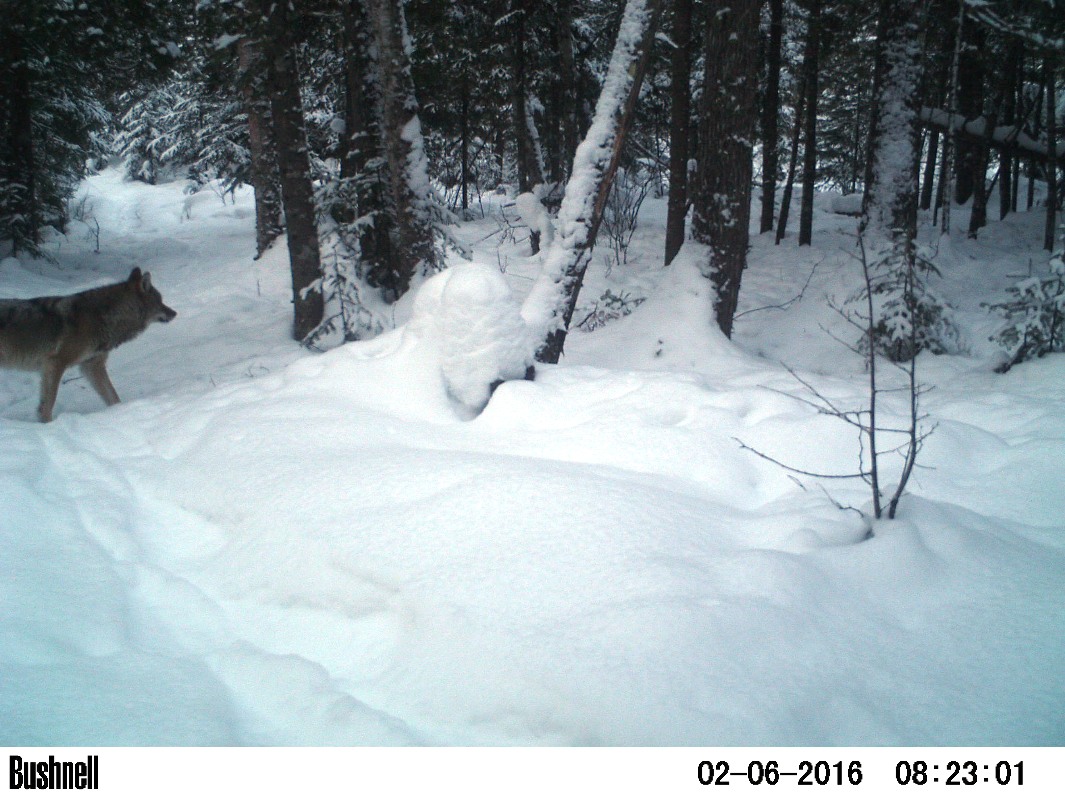
Today's timber wolf photos


 |
| For size comparison, 75-pound Cork in same place as second photo |
This shot came from my oldest trail camera but one which always seems to be in the right place at the right time. It's about 500 meters from our house here in Nolalu.
I'm pretty sure that this is the same animal we saw from our front window two or three weeks ago. He was trotting through the deep snow fairly easily and seemed destined right for our neighbour's across the road. He got about half way across our field when he changed his mind and came back to our bush. I at first feared that he had intended to go after the neighbour's dogs but on further inspection of tracks in the field I realized he was just following a deer.
Nolalu seems to be a wonderful place for wolves. I get photos of them regularly on my trail cameras which are just placed on our own 65 acres. There seem to be many more wolves here than at our camp on Red Lake. The reason is almost certainly that there is a high population of whitetail deer in Nolalu while Red Lake is still one of the few places with almost nothing but moose.
Wolves prey on moose, that's for sure, but the bigger moose are much harder for them to kill. It definitely takes a pack of wolves to bring down a moose and I suspect it is pretty risky business. One clip from a big hoof and a wolf is probably done for.
Deer are much easier. This wolf seems to be hunting by himself and as the photos show, he is not lacking for food. Check out that muscular neck in the first photo in particular.
This is a big fellow, twice the size of Cork, our 75-pound chocolate Labrador. Could he weigh 150 pounds? I can't tell but I do know that wolves are always lighter than you would expect, a function of having zero fat on their bodies.
The question often arises about safety when around these big canines. I have never personally known anybody who was either attacked or threatened by a wolf. They are almost supernatural in their ability to avoid people.
It is true that they can be a threat to dogs. About once a decade, it seems to me, there will be a rash of wolves killing dogs here in Nolalu. Eventually the offending wolves are seen and shot and it always seems to be just two individuals, a male and a female. That probably indicates the dog-killing has something to do with reproductive behaviour, but reproduction occurs every year and not the dog-killing so I don't really know what is going on.
Wolves are pretty single-minded. They want ungulates -- deer and/or moose.
In deer territory there are obviously far more wolves and when deer expand into traditional moose territory the resulting increase in predators means more moose are killed than normal.
It's a double whammy for the poor moose. The deer also bring with them a fatal parasite called brainworm that devastates moose populations.
Click to go back to our website
Click to see the latest on the blog
Friday, February 5, 2016
Camp boats in evening
 |
| Ciepliks photo of Pipestone Bay |
seeking fish, seeking solitude, seeking grace.
Now they come flying back, racing the darkness
leaving widening Vs behind them
watched by the Evening Star
The lake and the sky meld together
The boats skim the heavens as easily as the water
They give wide berths to islands of dark matter
and search the horizon for silver openings,
trails that lead them vaguely onward
The path flows narrower and narrower
twisting through a blackness that crowds in everywhere but ahead
Suddenly there springs the lights of camp
A mother calling her children in.
They have made it home.
 |
| Vic Fazekas photo of Bow Narrows camp |
Click to go back to our website
Click to see the latest on the blog
Tuesday, February 2, 2016
What happens to fish after line breaks?
 |
| My brother, Bill Baughman, removes a hook that was caught deep in a pike's mouth |
Probably not, at least if it was a northern pike, according to a study by a researcher at Carleton University in Ontario.
Chris Pullen placed crankbaits that had two sets of treble hooks in the mouths of northern pike and then monitored them to see if and when they were able to get rid of the lures.
On half the lures he pinched down the barbs. He also placed the lures in the backs of the mouths of half the fish and in the front on the rest.
Lures with the pinched down barbs came out in just 24 hours. Lures with barbed hooks took longer but surprisingly fish that were hooked deep in the mouth shed the lures quicker than the ones hooked in the front. That could be the case, he speculated, because the fish just aren't bothered by the front-hooked lures so much and don''t try to get rid of them as fast.
The results could easily be different for other species, he noted. Northern pike are a hardy group, better able to withstand stresses that might kill other fish.
When it comes to pinching down barbs, my advice is to always do it on lures with more than one treble hook. The fish do not seem to get away during the fight and it makes removing the hooks way easier once you get them into the boat. It also makes it easier to take the hooks out of yourself, always a big danger in lures with multiple trebles.
For lures with a single treble or with just single hooks, I would suggest not pinching down the barb unless you must do so for legal reasons. These are pretty easy to remove from the fish and they rarely hook you.
Thanks to Bow Narrows angler Tommy Cieplik of the famous Cieplik videos found on this blog for bringing this study to our attention.
Click to go back to our website
Click to see the latest on the blog
Monday, February 1, 2016
Last call for people with reservations to pay deposits
It has been a month and a half now since I wrote and e-mailed groups with reservations asking them to secure them with deposits.
There are still several that I have not heard from.
I will call them this week and if I still can't get a response, those cabins will be put back on the Availability list.
Click to go back to our website
Click to see the latest on the blog
There are still several that I have not heard from.
I will call them this week and if I still can't get a response, those cabins will be put back on the Availability list.
Click to go back to our website
Click to see the latest on the blog
Sunday, January 31, 2016
You never know what might be on the line
 |
| Jeff Kinzenbaw with redhorse sucker |
 |
| Rob Kinzenbaw with blue walleye |
Mostly, you catch northern pike and walleye. Then, you reel up and think, "What the heck is this?"
In the photos above, Bow Narrows angler Jeff Kinzenbaw shows off a beautiful-if-odd redhorse sucker. You see some that are very large, like 10 pounds, but for some reason we only catch the smaller ones.
Brother Rob Kinzenbaw noticed something unusual about a nice-size walleye that he boated. It was blue rather than golden-yellow. It is, in fact, the blue-morph walleye, also called the blue walleye which is a colour variation of the species.
Walleye and perch both can show this color variation. A researcher in Wisconsin is studying this phenomenon which seems to becoming more common all over the North. See Dr. Wayne Shaefer's blog. He is with the University of Wisconsin-Washington County.
You might catch a "walleye" with a camo look to it and lacking white on the tips of its fins. That would be a sauger, actually not a walleye at all but because of its similarity in looks counts as part of your walleye limit.
And, of course, you might hook a lake trout. These can be anywhere during the first few weeks of the season when the water is cold. You'll know it's a lake trout when you wonder if you have hooked some sort of submarine. They are extremely powerful.
I mentioned perch, of course, which are all over the shallow water bays. In our family we always strive to catch the "P trifecta": pike, perch and pickerel (aka walleye). Incidentally, we have a 10-inch minimum size limit on bringing perch to the fish house for cleaning.
There's another fish that can be really perplexing and I'm going to relate an actual story from two of our fishermen to show how mysterious it can be.
These two guys were fishing in Golden Arm, a long narrow bay about four miles from camp, and had done well on walleye and pike when it was lunch time. Since they had taken bag lunches from the lodge, they just let their walleye jigs tipped with worms dangle while they munched on their sandwiches. There was a fair wind blowing the boat right down the bay. One of the rod tips started twitching and the angler dropped his sandwich and set the hook. Nothing. Then the other guy did the same thing with the same result. Perch? Probably not because they were right in the middle of the bay -- too deep for perch. They baited-up again, let their lines out, and no sooner did they resume their lunch than it happened again. So they baited-up another time. Then the whole thing happened again only this time they let the fish "take it" for a few seconds before setting the hook and they both latched onto something a lot bigger than a perch, that was for sure. They started cranking their catches in when each lost their fish. So they baited again and right away, both hooked up to fish. This time they played the fish more gently and got them all the way to the boat. When they netted them they were flabbergasted. "What the heck?"
The fish they had boated had small heads, big bodies, were covered in large silver scales, and had large fins. They also had tiny mouths.
They were whitefish!
The anglers correctly reasoned that they didn't hook the fish at first because their mouths were so small and also that by horsing-in the fish the first couple of attempts they had ripped the soft mouths and the fish had gotten away.
So there's another unusual species: whitefish.
And then there's the tulibee. It looks almost identical to the whitefish except its mouth goes straight ahead while the whitefish have a mouth that is longer on the top and shorter on the bottom, making it look like they have a nose.
Redhorse suckers aren't the only type of suckers you might run into. There is also the white sucker which is mostly silver with a darker back.
If you drop a hook and a worm around any of the dock cribs at camp you will immediately come up with a rockbass. It looks kind of like a crappie with a red eye.
The strangest fish you might encounter, however, has got to be the ling, also called about twenty other names but burbot might be the most common. It seems to be half catfish and half eel. It also has the surprising habit of wrapping around your arm when you try to remove the hooks. This scares the bejeebers out of newcomers to the species and they fling it away which is too bad because it is absolutely delicious. Tastes like lobster.
Rarest of all to catch but which occasionally make an appearance are smallmouth bass and musky.
Finally, there is a tiny fish that you might hook accidentally that isn't a fish at all but rather a minnow. It is the emerald shiner which is commonly four-to-six inches in length. I mention this because for the last few years at camp you can encounter schools of this big-water minnow that are so dense you cannot help but hook one if you cast among them.
They are currently at astonishing levels. I've seen schools that measured twenty feet in width by a half-mile in length and I have no idea how deep in the water they went. You only find them in the big bays, like Pipestone, Trout, Potato Island basin, etc. Fish love them.
Click to go back to our website
Click to see the latest on the blog
Friday, January 29, 2016
This is one incredible lake trout!
 |
| Kenny Bock of Iowa caught and released this lake trout while ice fishing on Gullrock |
It was Good Old RL02-4178, that is, it had been tagged by the Ministry of Natural Resources and Forests and its tag number was RL02-4178. It was a female and she is well known to MNRF fish and wildlife personnel.
Red Lake biologist Toby Braithwaite said they have been tracking the movements of Number 4178 since 2012 when she and 24 other lake trout had sonic tags surgically implanted in them.
Although lake trout have always been caught by winter fishermen on Gullrock, it was generally believed that they moved upstream to the deeper waters of Red Lake as soon as the water began to warm in the spring.
Number 4178's sonic tag has shown that she spends most of the summer in Gullrock and only begins to head west in late July. Finally, in October, she makes a sprint to Pipestone Bay to spawn and then zooms back to Gullrock covering more than 31 miles in a single day!
 | |
| Red Lake trout at Dorion hatchery. |
Biologist Braithwaite notes fishes' ages are determined by taking a ray from a pectoral fin (one of the fins on the side near the head) and examining it through a microscope. The ray shows rings like a tree.
Back in 2002 it was determined that Red Lake's lake trout were in jeopardy and a program was begun to restock the lake using its own fish.
Each fall the MNRF stays at Bow Narrows Camp while lake trout are caught and their eggs and milt taken before the fish are returned back to the lake. These eggs are taken to the MNRF fish hatchery in Dorion and are brought back as fingerlings 18 months later. More than 500,000 fish have now been stocked in this fashion.
There will be 85,000 yearlings and 50,000 fry released this year.
The 2015 egg collection was the largest ever and the fish researchers hope to release 178,000 yearlings in 2017.
Adult fish that are caught by the MNRF during the fall spawning project have little yellow tags attached to them, just like Number 4178. If you catch a fish with such a tag, write down the number or take a photo of it before releasing the fish. Fishing regulations require that all lake trout must be released on the spot.
In addition, however, make a careful inspection of the fins of the fish. All of the stocked fish will be missing a fin since the hatchery personnel clip a different fin each year. You should report tag numbers either to the MNRF or to us at camp who can relay the information to Braithwaite and his fellow researchers. A report of a trout with a clipped fin would also be welcomed since it signals that the stocked fish are surviving. If you could also get a length on the fish, that would be helpful because when combined with the information on which fin was clipped, it would tell the researchers when the fish was stocked.
Braithwaite says the latest assessments show lake trout are now spawning in the Potato Island basin and the Trout Bay areas in greater abundance but seem to still be declining in Pipestone Bay.
 |
| Hatchery personnel clip fins of anesthetized trout. Toby Braithwaite photos |
Click to go back to our website
Click to see the latest on the blog
Subscribe to:
Posts (Atom)