Tuesday, March 20, 2012

On my first trip to Canada can I catch fish like this?

Red Lake walleye
Red Lake northern pike
Absolutely!
Ed Dziubinski, top, and Franz Stockmann may be seasoned Bow Narrows Camp anglers but you don't have to be experts like these to have a whale of a time catching fish up here.
In fact the newer you are to the experience the bigger the adventure it will be. There is nothing like the thrill of trying something new in a place where the scenery leaves you awestruck at every turn.
The key, and I think everyone will agree on this, is attitude. If you approach the whole trip from the time you leave home with the confidence that you are going to have fun, then that is exactly what is going to happen!
If you are new to fishing or at least to this kind of fishing, then the best way to start is by reading back through the blogs and getting some idea of the techniques and tackle used.
Once you are up here, for goodness sake, ask questions! Ask me, ask our outside staffer Ben, ask the other guests. I can guarantee you that we all will help. Sometimes it's just a demonstration on something as simple as how fast to reel that makes all the difference.
Newcomers just about always do exceptionally well as long as they aren't afraid to ask questions.
In fact, it is people at the other end of the spectrum -- know-it-all-experts -- who don't do well.
The reason is they won't, or can't, learn anything new. Yet, the fishing on every lake is different from every other lake. The real expert knows this and if he is fishing a water body for the first time, guess what? He asks a lot of questions! And listens. And observes.
What if you've never driven an outboard motor before? We'll show you. All of our outboards are electric-start. You just push a button. So you don't need to be super-strong.
Won't you get lost? Nope. First of all, at Bow Narrows Camp, you can catch tons of fish literally within sight of the place. You don't need to go far. You can if you want but you don't need to just to catch fish.
We give you a great map that not only shows the water but features on the shore, all navigation aids like buoys and markers, and all hazards such as shallow water.
Camp is located in a long narrows with dead-end bays on the sides. Think of the narrows as main street and the bays as side streets. The narrows is marked with navigation aids like red and green buoys, markers on shore and even little beacons. The markers all lead right back to camp!
By the end of your second day you will totally understand the lake.
What if you've never cleaned a fish? Doesn't matter! We clean all your fish for you as part of our regular service. You put your fish in a wet burlap bag that we provide and bring the bag to the fish cleaning house. We do the rest.
The mystery and fun of discovering new things, seeing new places, checking out new animals and meeting new people await you. You are going to have a blast!

Click to go back to our website
Click to see the latest on the blog

Saturday, March 17, 2012

Fishing strategies vary with daily conditions


You wake up to a glorious morning with the sun peeking through the trees. Wow! What a day!
The eagles are calling as they soar over the narrows in front of camp. Wood thrushes are playing their buzzy flutes in the woods behind the cabin.
You sip a cup of coffee on the porch and contemplate the only decision you need to make today. Where should we go fishing?
Waiting to see what the morning brings is the best way to approach this, admittedly minor, dilemma. Is it rainy or sunny? Is it windy and if so what direction is the wind? Is it going to be hot or cold?
If the conditions look favourable, maybe this is a day in which you would like to make a shore lunch, cook your fish out on the rocks. Or maybe you would like to take a bag lunch and go farther from camp than you usually venture.
If it is going to be cool and/or rainy you might want to do just the opposite, fish nearer camp and plan on coming in for lunch to warm up. Maybe even have a nap later in the glow from the woodstove.
One strategy is to head out on the bigger bays during days with light winds and fish the closer-in bays and narrows during windy times.
You should always be flexible on whatever you decide. Conditions change as the day goes on and the alert and wise angler adapts his plans to whatever happens.
You do the best and enjoy life the most when you realize you are a part of Nature and just "go with the flow."
(Photo by Troy and Jane Bechtel.)
Click to go back to our website
Click to see the latest on the blog

Tuesday, March 13, 2012

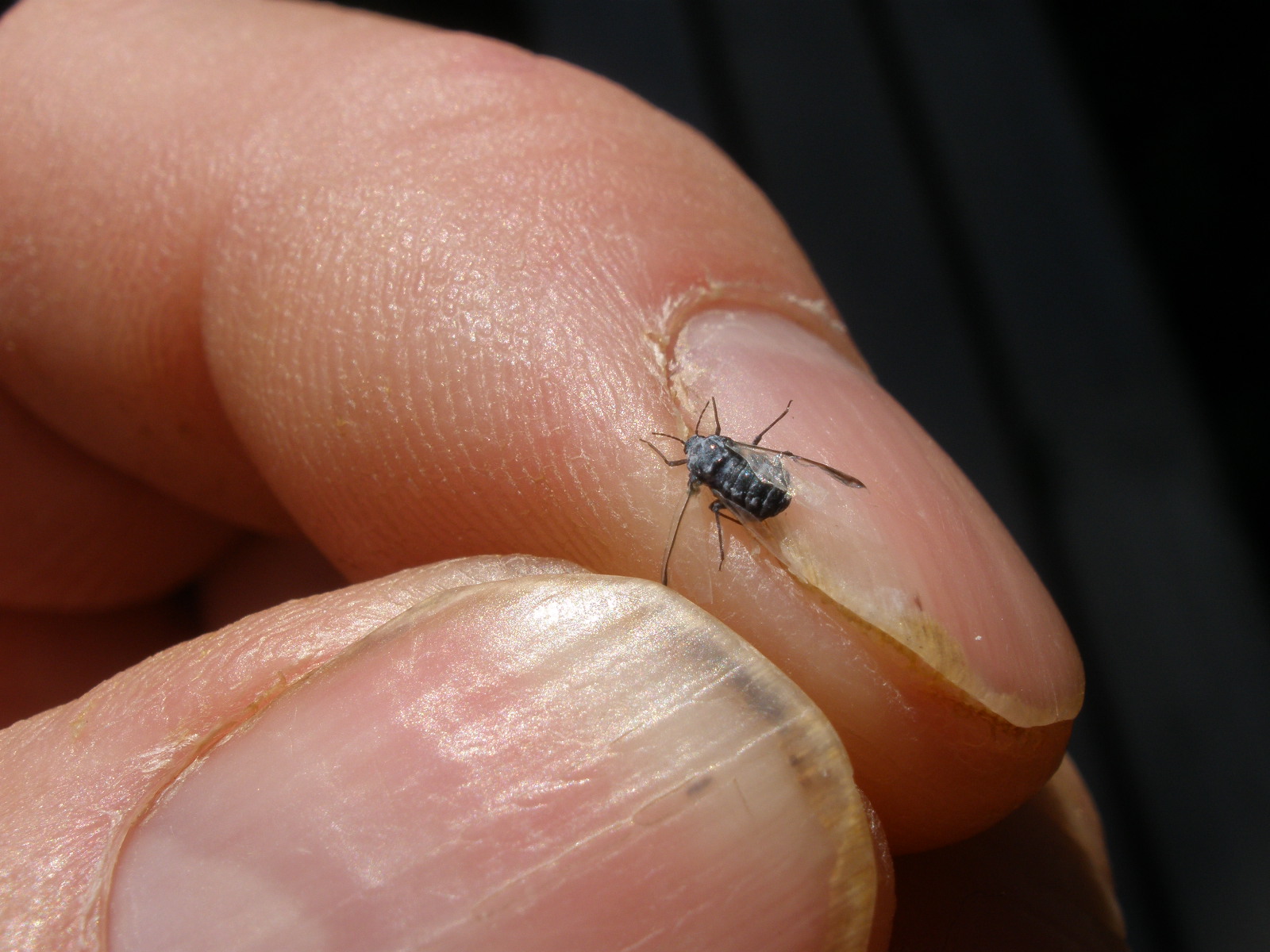
Gulls catch tiny blue flies in air, then migrate

fly eaten by gulls
blue fly eaten by gulls
Every fall, about the first week of September, an incredible sight takes place right over Bow Narrows Camp on Red Lake, Ontario.
The sky above the southern half of camp is filled with gulls, seemingly both herring and ring-billed gulls. They twist and turn, silently, flying back and forth, about tree-top level but right over our lawn on the edge of the lake.
It took me years to figure out what they were doing. They are catching small, blue flies that only appear at this time. These flies are almost invisible from the ground, are poor fliers and basically just hover. Whatever they are, the gulls are bonkers for them. I've never seen gulls go for insects on the wing other than this.
The flies must be exceptionally nutritious. The gulls always forsake eating fish guts when the flies are out. Incredibly, there will be no gulls on our fish gut rock -- the rocky island where we dump the innards each day. We will drive our boat carrying the fish gut pails right beneath the bug-catching gulls and none of the birds will follow us.
As soon as the flies are gone, so are the gulls, at least, it would seem, the resident gulls.
They seem to eat the flies as a way of stocking-up on energy for migration.
For the rest of the fall there are but few gulls at the fish gut rock and these seem to be newcomers. They don't, for instance, seem to recognize what our boat is doing as it heads toward the rock. In the summer the boat is swarmed by the resident gulls.
If anybody has any information about the identity of the flies, I would appreciate your telling me.
I can't find any mention of such behaviour in my bird books or on-line. Please send me an e-mail at fish@bownarrows.com or leave a comment on the blog.

Click to go back to our website
Click to see the latest on the blog

Sunday, March 11, 2012

Wow! What a difference two weeks make!


Top two photos are at 2 p.m. today. The temperature hit 18 C or about 60 F at our house in Nolalu. That would be typical of late April or early May, not early March!
As you can see from the photo of the road, most of the two feet of snow that Sam and I were struggling through in the bottom two photos two weeks ago is gone.
Click to go back to our website
Click to see the latest on the blog
Saturday, March 10, 2012

Will 2012 ice-out on Red Lake, ON be a record?

Boat scene Bow Narrows Camp
It won't be too long and the scene above will be a reality again on Red Lake.
Just like the rest of North America, Northwestern Ontario has experienced one of the warmest winters in history. I would say our winter has been more like what central Wisconsin usually gets.
As a result, ice thickness on the lakes, including Red Lake, is far less than normal, probably less than two feet compared to the usual three feet.
The ice itself is a beautiful blue colour, the best kind to support weight and also the best kind to melt. Its dark hue readily absorbs the sun's rays. The worst for melting is slushy white ice. Although this ice isn't very strong as far as weight bearing goes, it is the hardest to melt since it reflects light.
There was very little snow until just recently. Most areas have received 1-2 feet of snow in the last couple of weeks. That snowfall would normally delay ice-out were it not for the temperatures we're getting. It is supposed to be 8-12 C every day for the next week. If these warm temperatures are accompanied by wind, which is likely, the snow is going to be history.
The record ice-out on Red Lake is April 20, tied in 2010. The historical average is May 8.
Climate change has meant we can throw historical data out the window. It is possible this year that we could beat the record by weeks.
If that does indeed happen, how will it affect fishing?
Most species of fish and wildlife use a combination of factors in their behaviour mechanisms. For spring spawners such as northern pike and walleye, both the photoperiod (the length of daylight) plus the water temperature comes into play in deciding when to spawn.
We have seen early spawns right after early breakups in the past but would this happen if ice-out is a month earlier than normal? I don't know. The eggs in the fish may not be developed enough for spawning to take place that soon and the photo period is also not right.
My guess is that spawning time can vary by a couple of weeks but not a month.
The other critical factor is the weather after spawning takes place. It seems the best scenario is for a fairly rapid water warming such as happens in early, warm springs. We're seeing the benefits of such seasons right now with the explosion of walleye on Red Lake that started from great spawns years ago.
Walleye fishing this year stands to be spectacular. We will be reaping the harvest of those previous early-season great spawns which this year will mean tons of fish in the best-eating 16-18 inch lengths as well as lots in the mid-20s. Early season walleye fishing at the west end of Red Lake is also the best when the water warms which should be the case in 2012.
I know our early-season pike fishermen would rather have a late ice-out. They like to have the pike still gathered around their spawning sites and entice them with dead bait. If we have an extra-early ice-out this year our first couple of weeks of fishing may more resemble early June fishing which, by the way, is also excellent for pike. However, fishermen mostly use artificials rather than bait at that time. It's just going to take a change in techniques this year.
For the most part an early ice-out is good news for fish. It can give them more time for growing, gives the young a headstart on preparing for the next winter and lets the water weeds grow better and longer. Basically everything is more productive.
It would also be a godsend for Brenda and me and our staff. We always have a ton of work to accomplish before we open for the season.
Click to go back to our website
Click to see the latest on the blog

Friday, March 9, 2012

Guests can get e-mail at camp this summer

This will be received as wonderful news by some and terrible news by others. Our guests will be able to get e-mail at camp for the first time this summer!
We will have a laptop computer available in the lodge for people to receive and send e-mails. There will be a $1 per session fee (we'll just keep a log book with the computer).
Guests can continue to use the camp telephone as well. That costs $3 per call. Yes, just $3, even to the States!
We have some guests who for years have dearly wanted to get e-mail while on their vacation. Others were ecstatic that they could neither get e-mail nor cell phone service.
As far as we know, you still will not be able to use your cell phone. A project last summer that should have made that possible failed and we still have no explanation for the problem.
Click to go back to our website
Click to see the latest on the blog

Tuesday, March 6, 2012

Fishing products company moves back to U.S.

clear fluorocarbon InvisaSwivel
Knot2Kinky leader wire
Here's something you don't see every day, a company moving its operation back to North America!
Aquateko, the fishing products company that we wrote about last winter that makes a clear fluorocarbon swivel called InvisaSwivel, has moved its operations from Taiwan to Florida.
The reason, says its owner, Keith Kessler, in a news release, is the firm can improve the quality of its products.
Besides InvisaSwivel, the firm also makes a unique titanium leader material called Knot2Kinky that should be ideal for catching northern pike along with other sharp-toothed fishes.
This wire leader is stretchable and does not kink, allowing anglers to tie it onto their lures just like you would fishing line. Its small diameter could also go undetected by spooky walleyes. If so, then walleye anglers could also boat the northern pike that have been cutting off their lures when fished with plain fishing line all these years.
Aquateko has a web page dedicated to the best knots for its InvisaSwivel and Knot2Kinky wire.
There's more good news to the Aquateko story. The company's products are now produced in Jacksonville, Florida, in a center for adults with developmental and intellectual disabilities.

Click to go back to our website
Click to see the latest on the blog

Sunday, March 4, 2012

Nature lessons learned from a tree stand


"You can observe a lot, just by watching," Yogi Berra is reported to have quipped.
He was right. I learned a couple of things about foxes by watching them this past fall while hunting deer from a tree stand.
On the first occasion, I had been watching a doe feeding about 30 yards in front of me for quite some time when I heard something coming through the leaves. It was a red fox just trotting along and it was going to go past the deer on its way toward me.
The fox never stopped to look at the deer and the deer never even turned its head to look at the fox which passed quite close to her.
It occurred to me then that fox-deer interactions are pretty common. The deer could tell from the sound that it was a fox coming and the fox could tell from the smell that there was a deer off to the side. No big deal.
But then the fox came right to where I had walked an hour or so before. When it hit my scent it instantly whirled and sped away as fast as it could fly. To my astonishment, so did the deer. Apparently the deer knows the difference between the sound of a fox trotting and a fox fleeing.
Two weeks later, again in a tree stand about 100 yards from the first location, I heard something coming quickly through the leaves. It was another red fox and it was coming right toward the ladder stand. I expected it to respond to my scent like the other fox and vamoose. And sure enough, when the fox hit my scent it put on the brakes but after a moment's hesitation, ran right under the stand and beyond.
A few seconds later, I found out why. There was another fox on its tail and this one, when it hit my scent trail, did a 180 and fled back to where it had come.
I knew right away what had happened. The first fox used my scent to "rub" the second fox off its trail. Foxes are afraid of humans but the first fox was more afraid of the second fox than it was of me.
I could almost imagine the first fox saying, "Hey, there's a much bigger fox coming behind me. Wait and shoot him!"
I didn't realize how territorial foxes were until I found a dead fox one time right after a fresh snow. The only tracks in the snow were fox tracks and there weren't very many of them. I was a trapper at the time so I kept the fox and skinned it, carefully, wearing gloves because it seemed it must have died of a disease.
The skinning process, however, revealed four puncture wounds in the jugular. Another fox had killed it.
Foxes aren't always loners though. We had two that were more or less together here this fall. One fox was always about a hundred yards ahead of the other.
Click to go back to our website
Click to see the latest on the blog

Friday, March 2, 2012

'New' DUI border rule may signal more changes

The Minneapolis StarTribune has run a story (Canada eases entry rules for some offenders) that states there has been a relaxing at the Canadian border that would allow Americans and other foreign nationals with minor criminality, such as a single DUI (Driving Under the Influence), to enter Canada.
That would be big news, to anglers and hunters who have been turned back from coming to Canada for a single mistake and to the Canadian tourism industry.
In looking at the "new rule;" however, it seems that the only thing that has actually changed is one cost. Under the former system, a person with a single DUI that had occurred less than 10 years ago could pay $200 for a Temporary Resident's Permit. This would allow the person to cross the border one time only. Ten years after the offence, he could resume crossing the border and without any costs.
Under the "new rule" the cost for the TRP is waived but the permit is still a one-time only proposition.
There are some other avenues that people with a single DUI or other offence can hurry the process. I suggest you visit this NOTO website for the details. Nature and Outdoor Tourism Ontario is the organization that represents outdoor tourism operators across Ontario.
Although this recent change is very minor, it is being called an interim measure. In other words, it would appear other changes could be coming in the future.
The big problem is that admissibility to Canada is always at the discretion of a single border officer. If regulations can be used to prevent admitting someone with a single DUI that is less than 10 years old, then there will be some officers who will do that, at their discretion. Other officers, also using their discretion, will admit them. And that is exactly what has been happening. Travelers with a single DUI never new for sure if they would be admitted or turned away. In some instances they were turned away but drove to another crossing where they were allowed in or waited half a day for a shift change and then tried crossing the border again, this time successfully.
The scuttlebut among lodge owners is that there may be a single border officer at the International Falls-Fort Frances crossing who has turned away more Americans for DUIs than at any other border crossing between the two countries. In other words, this officer's discretion is to ALWAYS refuse visitors with a single DUI less than 10 years old. He or she never issues a TRP.
There is nothing in the new ruling that will change that, as far as I can see.
Click to go back to our website
Click to see the latest on the blog

Wednesday, February 29, 2012

Single-hook Mepps work great, easy to remove

Mepps with single hooks
The treble hooks have been replaced with single siwash hooks on these Mepps Spinners used by one of our anglers and shown to me last summer.
They hook the fish just as well and are far easier to remove from the fish.
The key when replacing treble hooks on any lure is to use a much larger siwash hook. The siwash hooks have an open eye that can be closed with pliers over the spinners' wire ring.
Fish caught on a single hook are less likely to "spit the hook." They can't use their tongue, for instance, to push against the other two hooks as with a treble.
Such Mepps spinners are deadly northern pike lures on Red Lake. You can either fish them plain or dress them as shown with plastic or Gulp tails.
For walleyes you can hang live bait on the Mepps' single hook.
Incidentally, these are some great colour combinations: silver, brass, red-and-white, and black-and-white.
Click to go back to our website
Click to see the latest on the blog

Sunday, February 26, 2012

The stunning reality of keeping big fish


This tub of fish in our fish cleaning hut last summer caught my eye as just about the perfect size walleye and northern pike to keep.
The walleye are about 17 inches in length and the pike are about 26 inches. Incidentally, a 17-inch walleye will easily feed one person and a 26-inch pike will feed at least two.
Ontario fishing regulations for Zone Four, which includes Red Lake, allow anglers to only have one walleye over 18 inches in their daily or possession limit. They cannot have any pike 27.6-35.4 inches and can only have one pike larger than 35.4 inches.
If you want to ensure there are fish for the future, you should release ALL walleye over 18 inches and northern pike over 27 inches.
Why? These are the big spawners, the brood stock.
But isn't it more ethical to let the small fish go and keep fewer, bigger fish?
Nope, and here's the reason. It's just a matter of mathematics.
Let's take the example of walleye. Let's say Angler A has a conservation licence that allows him to keep two walleye, one of which could be over 18 inches. So he maximizes his legal catch by keeping one 17-inch walleye and one 26-incher. His buddy, Angler B, however, keeps two 17-inch walleye.
And to make it easy, let's say the year was 2000.
Walleye produce 26,000 eggs per pound of body weight. A 26-inch female (just about all big fish are females) will weigh about six pounds and therefore will produce 156,000 eggs.
But by the next spring, 2001, she is also an inch bigger. (Walleye grow about two inches a year until they get quite large, then slow down to about an inch, also about a pound, a year.) So in 2001, had she been released, she would have produced 182,000 eggs, 208,000 in 2002, 234,000 in 2003, 260,000 in 2004, 286,000 in 2005 and 312,000 in 2006. She is now 32 inches long, 12 pounds. That is typically about as big as walleye get although some grow larger. We have caught a few 34-inch, 14-pound walleye.
She stops getting longer but she keeps producing eggs for another four years at which point she is about 20 years old and dies of natural causes.
So, had she been released by Angler A in the year 2000, she would have produced 2,730,000 eggs by 2010.
What effect did Angler B's choice have?
His 17-inch walleye that he kept instead of a big one, would have spawned for the first time in 2001. Walleye don't spawn until they are 18 inches. But they grow about two inches a year at first so his 17 incher will have grown to 19 inches in 2001 and would weigh about 2 1/2 pounds. It would produce 67,730 eggs in 2001. In 2002 it would be 21 inches and weigh about three pounds and would produce 78,000 eggs. In 2003 it would be 23 inches and weigh 3.5 pounds and produce 91,000 eggs. In 2004 it will be 25 inches and weigh five pounds and produce 130,000 eggs. Now that she is getting older, her growth slows down to one inch a year so in 2005 she is 26 inches and six pounds and produces 156,000 eggs. Then 182,000 in 2006, 208,000 in 2007, 234,000 in 2008, 260,000 in 2009 and 286,000 in 2010.
Her total for the same 10 years is 1,692,730.
Angler A's decision to keep a big fish meant there were 1,037,270 fewer potential fish in the lake over the next decade! More than a million!

Not all eggs survive, of course, and the fertility of old fish drops a little bit in their last years, but you get the picture. Keeping big fish is just about the worst thing you can do for conservation and the future of fishing.
Incidentally, northern pike aren't nearly as prolific as walleye. They produce 9,000 eggs per pound.

Click to go back to our website
Click to see the latest on the blog

Friday, February 24, 2012

Sam shows his first baseman's stretch


Sam is not allowed in the kitchen at camp and he never breaks this rule. Sometimes, however, he stretches it a bit.
As this photo clearly shows, his hind feet are securely on the carpet. So, technically, he is still in the dining room.
Click to go back to our website
Click to see the latest on the blog

Tuesday, February 21, 2012

How does a Pileated Woodpecker find food?

pileated woodpecker hole
Check out a morning's work from a pileated woodpecker behind our home in Nolalu, ON.
It neatly carved out a sizeable portion of the base of a live balsam fir tree, apparently looking for carpenter ants inside. There were indeed some ant tunnels at the most interior of this excavation.
Conventional wisdom is that woodpeckers can hear the bugs moving inside the tree or under the bark. In this case, the ant tunnels were several inches inside. So, did the woodpecker hear them through all that wood?
And are carpenter ants active enough in the winter for a woodpecker to hear them crunching wood or otherwise making sound?
Click to go back to our website
Click to see the latest on the blog

Thursday, February 16, 2012

Fishing, spirituality and us


"Spirituality can refer to an ultimate or alleged immaterial reality, an inner path enabling a person to discover the essence of his/her being; or the deepest values and meanings by which people live. Spiritual practices, including meditation, prayer and contemplation, are intended to develop an individual's inner life; spiritual experiences includes that of connectedness with a larger reality, yielding a more comprehensive self; with other individuals or the human community; with nature or the cosmos; or with the divine realm. Spirituality is often experienced as a source of inspiration or orientation in life. It can encompass belief in immaterial realities or experiences of the immanent or transcendent nature of the world". -- Wikipedia

For most of us, fishing is a spiritual experience.

We cast our line out on the wind, the line billowing like a spider's web, the lure following an arc with our rod at one end and a small patch of water beside a lily pad at the other. In the two seconds it takes to reach its destination, we hear a gull cry overhead; we smell the smoke of a forest fire 30 miles away; we feel the boat rock beneath our feet from a wave; we feel the wind against our cheek and the spray from the wet line hitting the eye of our rod landing on our hand. Our eyes see rings from minnows ripple the surface of the lake and the lip of the lily pad flutter in the wind. We see the reflection of the lure on the water a moment before it lands with a splash, minnows and whirligig beetles scattering away from the impact.
We are aware of all that, and more, in just a blink of time.
We are not thinking of yesterday. We are not thinking of tomorrow.
We are only alive right NOW, in this moment.
And that is just the cast.

The lure sinks; we quickly reel in the slack of the line and feel the pull of the lure as it manoeuvres through the density of the water. We see the flash of the brass side of the spoon, then the white paint on the other and then the rhythm between the two. A water weed -- a musky cabbage -- is in the path of the lure! We instinctively lift our rod tip to bring the lure to the surface and swing the tip to the side, making the lure change direction and avoid the weed.
Then we drop the rod tip, slow the retrieve and the image of the lure fades into the depths.
It's our sense of feeling now that guides us; the pull on the line, the slight oscillations interpreting the wobbling of the lure down below. We intuitively know the lure is in deeper water so we slow the retrieve even more, letting the spoon be pulled by gravity nearer the bottom. We envision what it must look like down there: the alternating flash of the spoon in the water made murky by the waves striking the soil on the bottom of the lake. The weeds are sparse here. The lure is weaving like a lost minnow in a panic.
Then there is a strike! The pull on the line is immense, the drag on the reel sounds like a violin. The line is heading toward deeper water, taken there by a creature whose domain we have now joined. Weeds shoot high in the air, flipped there by our line. Water striders run across the lake's surface to get out of the way of the commotion. We reel; the fish pulls against the drag, back and forth until its muscles are tired. Our muscles are tired too but not as much as the fish's. It comes to the net and we lift it aboard.
We can see the panic in its eyes. It tries to swim again but it is now on the bottom of the boat.
Our only thought is to quickly get the hook loose and release the fish back to the water. We already have a fish to eat. No one needs to tell us it would be wrong to keep more than we need.
We feel it with our entire being.
The fish is magnificent, a sleek design that took millions of years to perfect. The mosaic of scales are covered with alternating spots. We see its lateral line that lets the fish feel movement in the water, something like a bat's sonar sees in the dark.
It flares its gill plate and we see the layers of red filaments beneath. This is how a fish can extract oxygen from its atmosphere, just like our lungs do above the surface.
The hook is loose so we lower the fish over the side of the boat and hold it upright in the water while it breathes again and takes stock of its surroundings. It waves its tail and we take it as a sign. We let go and the fish pauses a second, then flips its tail and disappears.
We feel happy and serene. We are thankful for the fish and its world -- it's our world too. We lived there for a moment and we respectfully left it as we found it.
Our self feels replenished.

According to legend, the Buddha was asked if he was a god.
"No," he said, "I am awake."

When we fish, we are awake. We are attuned to the environment, to the world, to the reverence and wonder of life.

If that isn't spirituality, I don't know what is.

Click to go back to our website
Click to see the latest on the blog

Sunday, February 12, 2012

Great photos, great weather, great times

Walleye on Red Lake, Ontario
Northern pike on Red Lake, Ontario
Matt Andrews holds a couple of beautiful fish for the camera of his father, John, last May while fishing at camp.
John's great photos exhibit things that make an ordinary photo into an exemplary one.
If you notice, even though it was a sunny day he used fill flash. This takes out the deep shadows on the subject such as below the bill of the cap while leaving just enough to show depth and detail.
He also took the photos along the shoreline, not out in the middle of the lake. The grasses and shoreline angle from one corner of the frame into the distance in the opposite corner. Things that go diagonally in a photograph create depth. It's also just more interesting to see the habitat where they were fishing.
The fact Matt is wearing a red shirt in the top photo is also a plus. When the subject wears a bright colour it quickly becomes the focus of your attention and just livens up a scene. The glove does the same thing in the second photo.
Matt and John were at camp the first week of the season last year and as you can see, the weather was beautiful. I don't remember exactly but normal daytime highs are about 65F in late-May.
May is our spring. Trees will just be budding out, wild flowers will be sprouting. Birds are migrating north. It's a great time to be outside. And it's also a great time to fish.

Click to go back to our website
Click to see the latest on the blogLink

Saturday, February 11, 2012

New openings for June, July and August

If you have been waiting for an opening to come fishing at Bow Narrows Camp next summer, you should check out our Availability listing. There are several cabins now available in peak-demand times such as June, July and August.
We're in the process of making available cabins that were reserved by people last summer but which we have not been able to contact or who changed their plans and never informed us. I wrote them all letters in December, sent them e-mails if I had their e-mail addresses and left messages on their answering machines. If I still get no response, I take them out of our reservation book.
Just about everybody with reservations have now secured them with deposits. If you still haven't done so, you need to contact us by telephone immediately, even if it is just to tell us the deposits will be coming later. Call us at 807-475-7246. If we are not here, make sure you leave a message. We will absolutely check our answering machine and call you back.
You can e-mail but if you haven't heard back from us in a day or two, call as well. E-mails don't always get through. Spam filters erroneously pick them off at the Internet Service Provider, etc.
The same holds true for people wishing to make new reservations. Fill out our request form for information on the Contact/Reservations page of our website or send us a personal e-mail to fish@bownarrows.com. If you don't get a response in a day or two, call us. Nothing is surer than talking to a real person.
Click to go back to our website
Click to see the latest on the blog

Thursday, February 9, 2012

Ruffed grouse play circus acrobats

Ruffed grouse feeding in birch trees
White birch catkins
Every evening, all over Northern Ontario, this scene plays out: roly-poly ruffed grouse walk a tightwire in the tops of birch trees.
How these chunky gamebirds that weigh a couple of pounds can keep their balance on tiny little twigs high in the sky is amazing.
Even landing up there is a bit of a trick. Grouse, or partridge as they are known in Northwestern Ontario, aren't the most agile of fliers. They are more guided rockets than songbirds.
What lures them to perform their death-defying act are white birch catkins. These clumps of seeds remain on the birches until spring.
Other winter foods of the grouse are wild rose hips (seed pods), berries and seeds of just about any kind.
In the summer partridge eat lots of green leaves, like clover, bugs and just about anything, it seems.
Spruce grouse eat spruce needles! Talk about a never-ending supply of food!
Ruffed grouse only spend about 30 minutes getting their late-evening birch snack, then they plummet down into the snow -- if there's enough of it on the ground -- burrow in and spend the night where it's much warmer than above the snow.
This year there is precious little snow anywhere in Northern Ontario. So, the grouse have no choice but to fluff-up and sit on the ground or in a tree like a balsam that is a thick mass of branches.
Fortunately, it also hasn't been very cold most of this winter.
Click to go back to our website
Click to see the latest on the blog

Tuesday, February 7, 2012

Don't miss Busters Barbecue in Vermilion Bay

There was a great show about Busters Barbecue in Vermilion Bay on the Food Network last week.
This restaurant is located right on Hwy 17, perhaps a mile west of the intersection with Hwy 105 or the Red Lake Road. It's near Famous Bobby's tackle shop.
Busters Barbecue is the only award-winning restaurant on the entire continent-wide TransCanada Highway, known as Hwy. 17 in Ontario.
It has won international competitions for its unique blueberry BBQ sauce for the past 10 years.
The restaurant serves Kansas City-style ribs, slow-smoked Texas-style brisket, Canadian pulled pork and southern smoked chicken.
Besides eating many mouth-watering meals in the restaurant, you can also visit their website and order their unique blueberry BBQ sauce. They also have their recipes on-line.
If you like barbecue, you better check this place out.

Click to go back to our website
Click to see the latest on the blog

Sunday, February 5, 2012

Lynx family pays us a visit

Canada lynx
Canada lynx
Canada lynx
Canada lynx
What a thrill this morning as I was working on some ice fishing lures at the kitchen table to see a family of at least four Canada lynx.
I fortunately had my pocket Olympus FE-340 camera within reach and started clicking away.
All the lynxes in the photos are young ones, probably three-quarters grown. They grow to about 40 inches in length and I would say these were about 30 inches. A mature lynx weights about 20 pounds.
I got a good look at three of the small cats and just had a glimpse of a fourth animal farther back in the bush. It was likely a parent as the adults and the young stick together until the young ones reach adulthood.
I've seen these lynx families a few times as they have crossed highways in Northern Ontario.
This is the first time I have ever gotten a photo!
The rear legs of lynxes seem higher than their front ones, making it look like they are going downhill.
Note the "snowshoes" they have for paws. These furry feet make them twice as good as their more southerly cousin, the bobcat, at staying on top of the snow.
Lynxes eat almost nothing but snowshoe or varying hares which sport their own snowshoe equipment.
The hares do have one advantage; they turn almost completely white in the winter. Only the tips of their ears are black.
Lynxes hunt strictly by sight; so, if the hare remains motionless its camouflage might keep it safe. It would take nerves of steel, however, to have a group of predators like this with their massive hooked claws walking within a few feet of you and not bolting.
This family was obviously hunting. They were spread out, probably 30 feet apart, and were combing the edge of the treeline, around the bases of balsam fir trees and through alders -- right where "bunnies" like to hang out.
There have been lots of hares around the last couple of years. Their numbers go in 11-year cycles, the same as do the lynx.
Actually, many things in Nature have an 11-year cycle such as extreme forest fire years. Not surprisingly, there is also an 11-year cycle to the sun. That cycle is peaking this year.
Click to go back to our website
Click to see the latest on the blog

Friday, February 3, 2012

Anglers with the "golden" touch for walleye

Larry Pons
Jason Pons
I wrote awhile back about qualities I believe are possessed by all great fishermen. They include: adaptability, releasing large fish, sharing knowledge and appreciating Nature.
The father-son team of Larry (top) and Jason Pons, both from Texas, fills the bill on all counts but is especially outstanding on the third quality, sharing of knowledge.
For years they would leave at camp an album full of snapshots like the ones above and on the back of each photo would tell where each fish was caught.
If you asked, they would tell you how they caught it, at what time of day, and anything else you wanted to know.
I've seen them invite other Bow Narrows' anglers to follow them and do just about anything to help them out.
Aren't they worried this will mean fewer fish for themselves? It wouldn't seem so. I think they are so good at catching walleye that they are always totally confident of getting them, under just about any circumstance.
They're not the only Bow Narrows group of anglers like this. There are many others. But they are certainly the best at helping other people get the knack.
Excellent walleye fishermen have what seems an almost supernatural feel for their craft, and I think that is literally what it is, a "feel." It's as if their fishing line and rods were extensions of their nerves.
Walleyes don't always whack a bait, many times they "mouth" it, or oh, so gently suck in the worm or leech. The feeling 50 feet up the line is just about lost, probably a vague sensation that the line is just a wee bit heavier. Set the hook and you're onto a walleye. Hesitate a second and there is nothing there.
And then there are times when setting the hook too early is the wrong thing to do. You must wait a second or two before the bait is in the walleye's mouth. But by three seconds, they are gone. There are infinite variations.
It's the kind of thing that comes with experience but even then also requires intuition.
I think true experts at walleye fishing aren't totally in the boat; their minds are down on the bottom of the lake. It's a Zen kind of thing.
Click to go back to our website
Click to see the latest on the blog