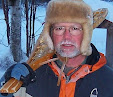
The predicted high for today is only 5 C!
Yesterday we had to delay taking guests out of camp for 45 minutes while we waited for the sun to raise the thermometer to above freezing. It was quite windy and I feared driving the boat in below-freezing temps could lead to spray turning to ice on the windshield.
These are cold days.
Some forecasts are even including the S word for today (snow).
Mostly though the weather has been pleasant since we opened for fishing a week ago. There was only one rainy day. The rest of the week was sunny and although the temperatures were a little below seasonal were still enjoyable.
I didn't hear anybody complaining about the weather last week. Probably because they were doing very well with the fish.
Our first-week pike experts did their usual thing by catching loads of humungous northern pike on dead bait. The largest I heard about was a 46-inch pike that weighed 22 pounds. It was caught and released by Dave Myers. Way to go, Dave!
Virtually everybody caught a 40+-inch fish.
There were nothing but big walleyes caught which is typical for this time of year. We don't get the eating-size fish until the water warms up. Most walleyes were caught on dead bait (half a ciscoe) or on crankbaits. For some reason live bait didn't work as well.
There were also many lake trout caught and released. We are catching more and more lake trout each season. The average size trout was 32 inches but we also are catching small ones again, including one 24-incher caught and released by angler Boyce Privett.
I forget who it was in Joe Overman's group that also hooked a giant 42-inch trout that they figured weighed in excess of 30 pounds. If it wasn't Joe then it was Fred Specht or Dee Hall.
Click to go back to our website: www.bownarrows.com
Click to see the latest on the blog: www.bownarrows.blogspot.com
Sunday, May 31, 2009


Tuesday, May 26, 2009
What's happened so far


We flew into camp aboard Viking Outposts' Beaver floatplane on May 12.
The only ice in the lake that day was at the east end where Red Lake was located. It broke up entirely two days later on May 14.
The weather immediately turned cold, windy and wet.
On Friday, May 15, we received 12 inches of snow. It was one of the largest single-day snowfalls of the winter!
Desite the snow staffer Joe Cox and I took a fishing boat to town on Saturday, May 16, and got our big boat Lickety Split.
Temperatures were very cold, far below freezing at night and not much warmer in the day.
However, when our first guests arrived May 22 they must have brought the warm weather with them because it has been quite seasonal since then. Other than a little rain yesterday our fishermen have not had any inclement weather.
Click to go back to our website: www.bownarrows.com
Click to see the latest on the blog: www.bownarrows.blogspot.com
The only ice in the lake that day was at the east end where Red Lake was located. It broke up entirely two days later on May 14.
The weather immediately turned cold, windy and wet.
On Friday, May 15, we received 12 inches of snow. It was one of the largest single-day snowfalls of the winter!
Desite the snow staffer Joe Cox and I took a fishing boat to town on Saturday, May 16, and got our big boat Lickety Split.
Temperatures were very cold, far below freezing at night and not much warmer in the day.
However, when our first guests arrived May 22 they must have brought the warm weather with them because it has been quite seasonal since then. Other than a little rain yesterday our fishermen have not had any inclement weather.
Click to go back to our website: www.bownarrows.com
Click to see the latest on the blog: www.bownarrows.blogspot.com
Monday, May 25, 2009
We're on the air again, sort of
It's been a couple of weeks since our last post. We are into camp now and our first guests arrived Friday.
Fish of all species are biting well. We've already had many giant northern pike, lake trout and walleyes caught.
Only one of our two telephone systems is working.
If you need to call us, call 807-727-2730. Our other number, 727-0439, is currently not working.
If sendiung e-mail, please keep messages very short and do not include any graphic material. We must download this over a radio telephone and it's like the slowest version of dial-up imaginable.
We're working on improving communications but it will be awhile before we're finished.
Click to go back to our website: www.bownarrows.com
Click to see the latest on the blog: www.bownarrows.blogspot.com
Fish of all species are biting well. We've already had many giant northern pike, lake trout and walleyes caught.
Only one of our two telephone systems is working.
If you need to call us, call 807-727-2730. Our other number, 727-0439, is currently not working.
If sendiung e-mail, please keep messages very short and do not include any graphic material. We must download this over a radio telephone and it's like the slowest version of dial-up imaginable.
We're working on improving communications but it will be awhile before we're finished.
Click to go back to our website: www.bownarrows.com
Click to see the latest on the blog: www.bownarrows.blogspot.com
Friday, May 8, 2009
Take care to measure northern pike accurately


As we wait these last days for the ice to breakup in Red Lake, it's a good time to remind everyone about the importance of accurately measuring the northern pike they catch.
Under Ontario fishing regulations it is illegal to possess any northern pike that is 27.5 to 35.4 inches in length.
This measurement is made by placing the nose of the fish at one end of the ruler (provided in your boat) and then pinching the rays of the tail which makes it longer.
You should also be aware that a pike will lengthen a bit once it dies. For this reason we advise not keeping any northern pike larger than 26.5 inches which is one inch shorter than the legal limit.
For conservation reasons we also advise releasing all pike larger than the slot size unless you intend to have them mounted by a taxidermist. These big fish are almost all females and constitute the breeding stock of the lake.
It is a myth that really big fish no longer reproduce. In truth they continue reproducing until they die. This myth do doubt comes from the fact that the number of eggs per pound of fish decreases as the fish nears the end of its life. However, a big fish still produces more total eggs than does a smaller fish.
Incidentally, the slot size was chosen because it represents two-thirds of the reproductive pike in any Ontario lake. This is so not only because these fish are prime breeders but also because there are more of them compared to larger fish.
So here's a test: can you keep a fish that is exactly 27.5 inches?
No! A fish at the start of the slot size is just as illegal as one right in the middle.
Can you keep a fish that is 35.5 inches long? Yes, but would you stake your life that you've measured it this accurately? If you're wrong by 1/10 of an inch you will be fined!
Also, it is a bad idea to keep big fish to eat. By doing so you are not only hurting the fish population, you are also consuming a top predator that has lived a long time and so has accumulated more environmental toxins than young fish have. This is true whether you are fishing in a pristine Ontario fishing lake, in the ocean or in your local river.
It's a better choice to grab a photo and let it go. It will be even bigger next year and maybe the next time you meet it will be at the end of your kids or grandkids' fishing rod!
Thursday, May 7, 2009
Ice is nearly out in narrows in front of camp
Hugh Carlson of Viking Island Lodge and Outposts flew over camp yesterday and could see the narrows is now clearing of ice. Thanks for the update, Hugh!
Enid Carlson published a couple of views of camp from Hugh's plane on her blog today. Click on the link to see these pix.
We are delaying until Tuesday flying into camp on the hope that just possibly the ice will be gone from the rest of the lake by then and we can take the Lickety Split.
If there's still ice in the way for this 20-mile trip we'll see if the Viking planes can ferry us over the ice from town to camp.
Click to go back to our website
Click to see the latest on the blog
Enid Carlson published a couple of views of camp from Hugh's plane on her blog today. Click on the link to see these pix.
We are delaying until Tuesday flying into camp on the hope that just possibly the ice will be gone from the rest of the lake by then and we can take the Lickety Split.
If there's still ice in the way for this 20-mile trip we'll see if the Viking planes can ferry us over the ice from town to camp.
Click to go back to our website
Click to see the latest on the blog
Tuesday, May 5, 2009
Skookum indicates Red Lake ice-out next Tuesday
I learned today that the ice left Skookum Bay on Red Lake today.
My late father, Don Baughman, who spent many a year waiting for the ice to break up in Red Lake, always said that seven days after Skookum Bay was clear, the ice will break up on the rest of the lake. If that holds true this year then ice-out would be next Tuesday, May 12.
Enid Carlson of Viking Outposts notes on her blog today that husband Hugh drilled a hole on Howey Bay today and there were just 13 inches of candled ice!
Melting conditions have been great the last few days and are supposed to continue tomorrow but then a three-day cold snap is forecast.
There are mixed predictions on tomorrow's weather too. One weather service calls for a thunderstorm which would be death to the remainder of the ice and the other simply calls for light rain which wouldn't have as much effect.
Click to go back to our website
Click to see the latest on the blog
My late father, Don Baughman, who spent many a year waiting for the ice to break up in Red Lake, always said that seven days after Skookum Bay was clear, the ice will break up on the rest of the lake. If that holds true this year then ice-out would be next Tuesday, May 12.
Enid Carlson of Viking Outposts notes on her blog today that husband Hugh drilled a hole on Howey Bay today and there were just 13 inches of candled ice!
Melting conditions have been great the last few days and are supposed to continue tomorrow but then a three-day cold snap is forecast.
There are mixed predictions on tomorrow's weather too. One weather service calls for a thunderstorm which would be death to the remainder of the ice and the other simply calls for light rain which wouldn't have as much effect.
Click to go back to our website
Click to see the latest on the blog
Monday, May 4, 2009
We supply required on-boat safety equipment

Bow Narrows Camp fishing packages include a boat and motor for each two fishermen and also the safety equipment required by law for each boat.
This includes a life vest for each person, bailing device, two paddles, emergency flashlight, a sound-signalling device and a 15-metre buoyant heaving line.
By far the most important of these items is the life vest. If you are wearing your life vest you will be safe in almost every boating situation. However the world's best life vest is useless if you aren't wearing it.
I always wear a life vest, so does our family and so does our staff. Ontario Ministry of Natural Resources conservation officers and all other Ministry of Natural Resources personnel wear them. So do all police officers. So do most of our experienced guests including long-time angler Kim Gross, above.
Even though we provide comfortable life vests for each person we still recommend that you bring your own for the reason that you can find one that fits your physique the best and is the most comfortable for you. There are many varieties to choose from including ones that have mesh backs and shoulders for ventilation, models with handy pockets and C02-operated ones that self-inflate if you end up in the water.
The next two critical pieces of boating equipment are the bailing device and the paddles.
We place a bailing scoop made from a bleach jug in each boat. This allows you to bail a lot of water in a hurry if you need to and also to empty the boat each time it rains.
The paddles let you manoeuvre your boat even if something happens to the outboard engine.
The flashlight in your boat kit is meant for emergencies, not ordinary use. You should never be on the water after dark but if it does happen you can use the emergency flashlight to signal help and warn other boaters of your presence.
This year our boats will have new wind-up flashlights that do not need batteries.
The sound signal device in the kit is a pealess whistle. A whistle carries farther than the human voice.
The final piece of equipment, the 15-metre buoyant heaving line is the kind of thing our friend Bob Moninger who owns a cabin near camp would call "mouse milk." This is meant to be a line that you could throw to someone who was in the water. Why you wouldn't just motor over to the person or paddle to him is a mystery. And if you wanted to actually throw a rope to someone, I would think you could untie the 3/8-inch floating rope from the anchor and use that quicker than you could open the safety kit and get out this useless wad of 1/4-inch spring-like heaving line. But it's required by law so there it is.
Anyway, the person in the water should be bobbing safely around in his life vest that he wisely always wears. He could then just swim back over to the boat.
New this year is all of our boating safety equipment will be contained in a waterproof Sealine dry bag clipped to one of the boat braces. In the past this stuff was in an orange jar that would frequently open and let water into the contents.
Saturday, May 2, 2009
Red Lake ice-out "probably" two weeks away


It's all up to the weather.
Will the next couple of weeks finally turn above normal and finish off the ice in Red Lake or will it stay unseasonally cool and delay the process?
Brenda and I, our dog Sam, and our staffers: Ben, Jenn, Emilie and Joe, are chomping at the bit to get into camp and get to work.
For sure it looks like we will see if our good friends at Viking Outposts can fly us from the Chukuni River in town to the narrows in front of camp as soon as the ice is clear in those places. This usually lets us get into camp a week before the ice goes out in the rest of the lake. Our hope is we will be able to do this next weekend.
We are so fortunate that Bow Narrows Camp is located in an area of the lake where the current melts the ice early, just as it does at the river in town.
There have been times where we were able to get into camp three weeks before ice-out in the main lake.
Last year, however, it ended up being only a few days advantage. If I remember correctly we were able to fly into camp on a Wednesday and our first guests arrived two days later, on Friday. Then a big wind came up on Saturday and smashed the ice out of the lake.
Hugh Carlson of Viking Outposts, phoned us at camp Saturday night to say he could see from the air that we should be able to get to town by boat if we favored the north shore which was clear.
On Sunday, staffer Mike Biloski and I took one of our fishing boats back to town to get our cabin cruiser, Lickety Split. We had to skirt a few ice sheets but made the trip OK. Ice sheets continued floating around the lake for about a week after that.
This shows how unpredictable ice-out can be.
Red Lake Publicity Board thoughtfully is posting a list of recent ice-out dates in its May newsletter.
They were: May 17, 2008; May 5, 2007; April 23, 2006; April 21, 2005 (a record); May 9, 2004.
From a camp operator's point of view, we need a couple of weeks ahead of guests arriving to get camp into shape for the upcoming season.
Docks always need rebuilding, firewood needs cut, boats need put in the water and cabins need maintenance before we settle in to the routine of fishermen coming and going every week.
The photos above are from our trip into camp last May.
We took off from the Chukuni River and as you can see Pipestone Bay was frozen shore-to-shore. So was the rest of the lake. It looked then like it could be weeks before it would clear.
But the narrows in front of camp was open and JB from Viking Outposts was able to land Viking's Beaver aircraft easily at our dock.
This year Bow Narrows Camp isn't opening until May 23, one week after walleye season opens May 16. After last year's experience with the late ice-out and with walleye season opening one day earlier than last year (it's always the third Saturday in May) we just felt it was better to be safe than sorry.
So when will ice-out come this year? No one can say but it looks possible that it will occur sometime in the next two weeks, or in other words, before the regular walleye opener May 16.
It just depends on the weather.
Click to go back to our website
Click to see the latest on the blog
Thursday, April 30, 2009
Remember, everybody needs a passport

New border-crossing rules go into effect this June.
Everybody now needs a passport.
Make sure everyone in your group knows about the new rules.
Monday, April 27, 2009
Dan's favorite lures for northern pike fishing

My favorite fish is the northern pike. I like to fish for them and I prefer them for eating over all other species, even walleye.
And although I know you can catch pike by trolling and dead-baiting I much prefer to cast.
Casting by itself is a fun and challenging exercise. You have to develop the skill to accurately plop your lure right next to stumps and rocks and into holes in weedbeds and do this in all sorts of wind conditions.
So when I say these are my favorite lures, you'll know that the only way I fish them is by casting.
At the upper left is the Blue Fox Vibrax spinner. I like the #5 in this. Best colors are the red, orange and silver.
Next to it is the Mepps Long Cast Spinner. I like the #5 and the #4. The same colors are good in this as the Blue Fox but I also like the fire tiger color shown and the blue-bodied spinner with silver and red blade. Although I like the Mepps Long Cast because it sinks the deepest, the other Mepps models are also excellent, again in the same sizes as mentioned.
Then there is the Len Thompson Five of Diamonds. For sure you want this exact color scheme: yellow with red diamonds but also the nickel, brass and nickel-and-blue patterns. Most importantly, you want these in the 1/2-ounce size.
These spoons are made in Canada and can be hard to find in the States although I see Cabelas sells them. I would highly recommend stopping at Bobbys Sport Shop in Vermilion Bay at the corner of Highway 17 and Highway 105 to buy these spoons. They always have a marvelous selection.
Speaking of spoons, the Johnson Silver Minnow is the ultimate in weedless spoons. If you have the weed guard adjusted correctly it will come through just about anything. However, be warned that you must have a trailer of some sort on the hook for this lure to work effectively. I would suggest 3 and 4-inch plastic twister tails in various colors and also an old time favorite -- pork rind trimmed to about three inches.
Make sure you keep the single hook on this lure ultra sharp. My favorite is the gold spoon but you also want the silver and I've done well with some of the painted options too, especially the red-and-white.
To the right of the Johnson is the Acme Little Cleo. This is a wonderful spoon, especially in the nickel, gold, rainbow trout and fire tiger patterns. You absolutely want the size to be 2/5 ounce.
Finally, there's the old reliable leadhead jig. For pike you want both the same 1/4 ounce size you would use for walleyes to be used on clear, calm days and the 3/8 ounce size for all other times.
Use a single 3-inch plastic twister tail on the 1/4 ounce jig and a 4-inch single or double twister tail on the 3/8 ounce. Bring a dozen different colors of twister tails. It's amazing what a difference changing the color of the tail makes throughout the day.
And that's all the lures I use for pike. You'll notice there are no stick baits or crank baits on the list. Lots of our guests use them almost exclusively but I don't. I just find they have too many sets of hooks to extract every time I catch a fish, are too light to cast accurately and cost too much.
You've probably already noticed that none of the sizes of the lures I've named here are large.
Don't I want to catch big fish? Yes, that's why I use the sizes mentioned here. Big lures tend to catch nothing but little fish on Red Lake. See Lighten Up.
Click to go back to our website
Click to see the latest on the blog
Pink Lady Slipper orchids rare spring bloomers

If you are coming to camp in late May or June you might be lucky enough to spot a Pink Lady Slipper Orchid growing on the shores around Red Lake.
These rare, beautiful flowers are also known as Moccasin Flowers.
They are great to photograph but care must be taken not to disturb them as they are disappearing from most areas of the world and need to be left alone.
If you do spot one, look carefully around the flower for the distinctive leaves of other plants that may not yet be flowering. This will allow you to pick a route that won't harm other orchids before getting a picture.
Usually you find just a few orchids at any one site.
Click to go back to our website
Click to see the latest on the blog
Saturday, April 25, 2009
Great photos come from more than just fish

This summer when we are at camp we could all take a tip from a great group of anglers that generously provide me with their photos each year.
This is the Lehmann-Olaskowitz-Heneise-Jeffery-etc. group (Sorry if I don't mention everybody).
These guys always get some unusual shots that the rest of us never think to take, like this photo of two River Jewelwing damselflies (I think).
Just as there is more to a fishing trip than just catching fish, our photos should be of more than just people holding lunkers.
It's great to look back the next winter at shots of fishing lures that have taken a beating, flowers that graced the edge of a waterway, scenery that changes with the light conditions, boats skimming across the waves, itsy-bitsy fish that somehow got on our hooks, strange fish like suckers and tulibees, action photos of fishing rather than after the fact, critter shots of all the birds and animals we encounter, scenes around the little town of Red Lake, the boat trip to camp, inside the cabin and the lodge and of course, most importantly, photos of our buddies and families.
Friday, April 24, 2009
Summer birds are here, we just need ice to melt

Signs of warm weather are everywhere but summer itself seems to be coming at glacial speed.
Every day brings a new species of birds from down south.
A few robins have actually been here for a couple of weeks. The first robin is always a bittersweet sight. It's a sign of spring but robins always get snowed on several times.
There are flocks of robins here now but also a lot of other summer birds as well. A wave of yellow-shafted flickers landed today. I've also seen and heard song sparrows, ruby-crowned kinglets, yellow-bellied sapsuckers, sandpipers, red-winged blackbirds, killdeer, all species of ducks and geese, eagles and even a great blue heron.
The water birds are crowding around wet spots in fields, ditches, creeks and rivers. The lakes are all still frozen tight.
The lakes are melting both from the top and the bottom. Daytime temperatures are only about 10 C (50F) with some days colder and most nights below freezing. About once a week we get rain which turns to snow but luckily there has been no significant accumulation for more than a week.
People who are still drilling holes through the ice report the ice structure is changing. It's starting to "candle" which is what it does before it breaks apart. That's the good news. The bad news is there is still 20+ inches of it out there. Still the days are long now and the melting process is accelerating.
Barring a tropical heat wave, it still looks like ice-out on Red Lake will be approximately May 16 or a week later than normal.
Monday, April 20, 2009
Encouraging report on Red Lake ice
Check out yesterday's (Sunday, April 19) blog of Enid Carlson, from Viking Island Lodge and Outposts for some encouragement on spring ice-out on Red Lake.
Last week's beautiful weather really did a number on the ice of Red Lake.
The same cannot be said down here near Thunder Bay.
We got six more inches of snow last night in Nolalu and it may continue snowing for another day.
That will set back spring ice-out in this area for many days if not a week or more.
Click to go back to our website
Click to see the latest on the blog
Last week's beautiful weather really did a number on the ice of Red Lake.
The same cannot be said down here near Thunder Bay.
We got six more inches of snow last night in Nolalu and it may continue snowing for another day.
That will set back spring ice-out in this area for many days if not a week or more.
Click to go back to our website
Click to see the latest on the blog
Try Berkley Gulp Alive minnow grubs for walleye


Berkley Gulp Alive 3-inch leeches and nightcrawlers were a hit with Red Lake, Ontario, walleye fishermen last year and I would suggest this year anglers also try the Berkley Gulp Alive minnow grubs in the 3-inch size.
These should be fished on 1/4-ounce leadhead jigs.
I feel confident they would catch fish as you can also catch walleye with the same jig rigged with nothing other than 3-inch plastic twister tails. The main problem with plastic-only twisters is the fish pick up and drop the bait lightning fast. For this reason most anglers have always added some live bait to the jigs with plastic tails.
With the scent-enhanced Gulp Alive, they should hold it long enough for you to set the hook.
If you aren't familiar with Gulp Alive it's the bait that comes in a jar, not a package.
Of course you should rig the Berkley minnow grub by skewering it through the end, just like the plastic tails.
Do not use a steel leader when fishing with jigs for walleyes as this spooks most fish. The exception is when you are fishing in weeds in which case you can use a 12-pound ultrathin wire leader. In this kind of cover the walleyes don't seem to see the leader like they do out in open water. By using the ultrathin leader you are able to land a lot of the pike that also hang out in these spots.
Speaking of pike, you might want to try the four-inch Berkley Gulp Alive swimming mullets on either 1/4-ounce or 3/8-ounce jigs. Pike love jigs and the smell on the Gulp Alive might trigger even more strikes than using similar-size plastic tails.
One problem with the Berkley baits is they don't come is as many colors as do plastic tails.
I would suggest pearl white minnow grubs for walleyes as well as the chartreuse and any of the colors for the swimming mullets for pike.
Sunday, April 19, 2009
Long-range forecast for above-normal summer
Brenda says I'm driving her crazy with my analyzing the spring weather, trying to get a bead on ice-out time. When the ice goes out, she says, it's out. Until then the lake is frozen.
Hah! If only it was that simple!
OK, it may be that simple but what fun is that? Besides, I'm itching to get into camp, get things ready, get firewood cut, docks fixed, etc. before the first fishermen arrive.
So my ears perk up every time I hear or read any weather news.
Weather expert and climatologist Graham Saunders who writes a weekly weather column in the Thunder Bay newspaper, the Chronicle Journal, thinks the lake ice will go off earlier than normal this year! His reasoning is the snow has mostly melted and last week was a great one for melting with temperatures in the teens.
----------HERE'S A BREAKING REPORT!
After first making this post an old friend, JP Fraser, e-mailed me to say a flock of white pelicans was seen at Amethyst Harbor on Thunder Bay of Lake Superior today. That's great news because white pelicans need open water to feed so there must be an ice-free patch somewhere.
----------
Another bit of heartening news comes from Environment Canada's three-month long range forecast. It predicts above-normal temperatures for the period April-May-June.
So why am I not cheered by this?
Because I'm looking out the window at snow falling. The temperature is a hair above freezing and we're supposed to have below-normal temperatures the rest of the week.
My best guess for ice-out on Red Lake is still May 16 which is opening week for most camps. The average ice-out for Red Lake is May 8 so, I'm guessing it will be a week later than average.
We are actually opening one week later, May 23, just to be safe.
If those above-normal temperatures are coming they better do it soon.
Click to go back to our website
Click to see the latest on the blog
Hah! If only it was that simple!
OK, it may be that simple but what fun is that? Besides, I'm itching to get into camp, get things ready, get firewood cut, docks fixed, etc. before the first fishermen arrive.
So my ears perk up every time I hear or read any weather news.
Weather expert and climatologist Graham Saunders who writes a weekly weather column in the Thunder Bay newspaper, the Chronicle Journal, thinks the lake ice will go off earlier than normal this year! His reasoning is the snow has mostly melted and last week was a great one for melting with temperatures in the teens.
----------HERE'S A BREAKING REPORT!
After first making this post an old friend, JP Fraser, e-mailed me to say a flock of white pelicans was seen at Amethyst Harbor on Thunder Bay of Lake Superior today. That's great news because white pelicans need open water to feed so there must be an ice-free patch somewhere.
----------
Another bit of heartening news comes from Environment Canada's three-month long range forecast. It predicts above-normal temperatures for the period April-May-June.
So why am I not cheered by this?
Because I'm looking out the window at snow falling. The temperature is a hair above freezing and we're supposed to have below-normal temperatures the rest of the week.
My best guess for ice-out on Red Lake is still May 16 which is opening week for most camps. The average ice-out for Red Lake is May 8 so, I'm guessing it will be a week later than average.
We are actually opening one week later, May 23, just to be safe.
If those above-normal temperatures are coming they better do it soon.
Click to go back to our website
Click to see the latest on the blog
Is climate change harming loon populations?


Red Lake must have one of the most abundant loon populations in the world but I'm afraid an effect of climate change could be harming them.
These beautiful and inspiring birds can be found nesting literally at every turn in the lake. Nesting loons are highly territorial and will claim all the water in sight as their own. So as soon as you go around the corner (and out of sight of one pair) there is another pair doing the same thing.
Loons are probably the oldest species of birds in the world. Fossils have proven there were loons on earth during the Cretaceous Period, the age of the dinosaurs.
Unlike most other birds, loons have solid bones. This could be a result of their being on the first step of the bird evolutionary ladder. It also lets them sink better than other birds and to dive deeper.
Loon also have the least amount of wing area for their body length. They fly at speeds of up to 90 mph and take off and land exactly as an airplane does -- into the wind.
They truly are a wonder and their incredible calls, from tremulos to wolf-like howls, are the real call of the wild. In fact, the word loon is Norwegian meaning "wild, sad cry."
It would be heartbreaking to see them decline so I hope I'm being a pessimist when I say I see something happening with the weather that is detrimental to loons.
For about the past five years now we've been getting all of our rain in incredible downpours rather than longer rain periods that might last several days as in the past. This is especially true in June, when the loons are nesting.
The result of getting 2-4 inches of rain in a single night instead of over a period of a week is that most of it runs off into the lake before it can be absorbed by the ground. This makes the lake level rise and rise rapidly.
Loons cannot walk on land. Their feet are placed too far back on their bodies. Their feet are almost on either side of their tails. It's one of the reasons they are such great swimmers. It's as if their feet were propellars.
To build a nest a loon stacks water weeds in a pile in shallow water until it is about a foot higher than water level. The loon can push its way on its belly up to the nest which is never more than one loon's-body-length away from the water.
They build their nests in May and traditionally this is the high water period of the year. After all the snow has just melted and drained into the lake. From that point on the water level should continually go down and should be at its lowest just before freeze-up.
The loon usually lays one to three eggs and the pair, which mate for life, takes turns sitting on the nest for about a month before the eggs hatch.
It is during this one-month incubation period that things have been going wrong the last five years or so.
The problem is the heavy spring storms raise the water level and flood their nests. I don't believe one per cent of Red Lake's loons have successfully fledged in five years.
Although most bird species will re-nest if their first nest is destroyed, my observation is that most loons do not re-nest and of the few that do most do not successfully raise young.
So what does this have to do with climate change?
The predictions (and I would have to say "observations" these days) of climatologists is that global warming causes ever-more drastic weather events -- in this case, cloudburst rain storms.
Incidentally, if you don't believe in climate change and don't see it occurring right now it's probably because you don't live in Canada. The effects of climate change are more pronounced the farther north you go. For instance, there's hardly a thing happening in the southern U.S. while the Arctic sea ice and glaciers are disappearing rapidly.
Five years of big storms, of course, are only evidence of weather, not climate. Climate is measured over many decades. So hopefully things will improve in the coming years for the loons.
Fortunately there are still plenty of them on Red Lake. They are a long-lived bird, both individually and obviously, as a species. I just wish they would get a break from the weather and successfully fledge a new crop.
Friday, April 17, 2009
How to help make the boat trip out to camp

In a little more than a month from now we will make our first trip of the season with guests to Bow Narrows Camp, 20 miles by water from the town of Red Lake.
Our cabin cruiser, the Lickety Split, can make this journey with 9 passengers in as little as 35 minutes in favorable weather.
It's a beautiful journey, past islands, through narrows, and alongside of ducks and loons. We sometimes encounter moose, deer and black bear swimming from island to island.
There are several things you can do to help make this trip from the parking lot in Red Lake to your cabin at camp go as smooth as possible.
You will already have been given a pickup time to meet the Lickety Split in Red Lake. If everything is working according to plan, and the wind and waves allow us to travel at normal cruising speed, each round-trip takes 90 minutes, including loading-unloading.
When you reach the parking lot, back your vehicle up to the dock and unload onto the large wagon waiting there. Take the wagon to the end of the dock and off-load your luggage and fishing gear, leaving the wagon -- and a travel lane on the dock -- clear for guests leaving camp. This will let us quickly unload the boat and take on your gear.
Dan will show you a designated parking spot.
After a quick goodbye to the departing guests, we will be on our way to camp.
Unless your group is exactly eight or nine people, there will likely be more than your party aboard the boat. All the luggage is going to be placed in the same place in the boat; so, make sure you can easily identify yours when we get to camp. (Some duct tape and a marker are great for this.) This is especially true for cases of refreshments.
We will form a human-chain to relay the luggage into the hold of the boat.
Once at camp, a couple of our staff usually form the chain inside the boat while the guests make up the chain on the dock. This lets them sort the luggage as it comes off the boat.
Then the next group's luggage is put on the boat for the outgoing trip and we're off again.
It's a real help to all of us if none of the luggage items weighs more than 40-50 pounds. This includes coolers.
Another helpful tip is not to have lots of loose items like shoes and flashlights. Stick them all in a duffel bag or packsack brought just for this purpose.
We don't place a weight limit on you like the fly-in camps do but obviously, weight is a consideration. The boat can only carry so much of it. We just ask you to use your head. Don't bring heavy items if you can avoid it.
A good rule of thumb is if each person has one duffel bag or suitcase, one tackle box, a couple of cases of refreshments and a rod case.
Speaking of refreshments, please bring beer and soft drinks in cans, not bottles, as they are much lighter. Liquor and wine, of course, usually only come in bottles so there's no other way of bringing those.
If coming on the Housekeeping Plan, you can avoid the necessity of back-breaking coolers by buying your groceries in Red Lake instead of hauling them all the way from home. Believe it or not Red Lake has a modern supermarket with virtually the same items you have available in your stores, including fresh produce, probably from the same sources as in your home town.
The prices at Sobeys Supermarket in Red Lake are comparable to at home, especially when converted to American dollars. You may also be able to bring a smaller vehicle or fewer vehicles on the trip if you don't need space for grocery coolers. You can either buy your groceries just before catching the boat to camp or if staying the night in Red Lake, buy them the previous night and have them stored at the store.
If you do buy food at Sobeys in Red Lake, ask to have it packed in cardboard boxes. This is done all the time at the store and it allows us to pack your food into the boat without anything becoming damaged.
Wednesday, April 15, 2009
How to convert Celsius to Fahrenheit; don't
Since we're on a weather bent, I thought I would pass on this gem of weather-related trivia.
In Canada, we measure temperatures in Celsius, much to the confusion of our American friends and guests.
We often hear them at camp trying to remember the formula on how to make the conversion to Fahrenheit as they look at the day's weather forecast.
(To convert Celsius to Fahrenheit, you multiply the temperature in Celsius by 9/5 and add 32.)
Who are you, Einstein?
Can you multiply a number by 9/5 in your head?
If you can then why are you wasting your time thinking about the weather? You should be a mathematician or a statistician or even a bookie.
I overheard one of our guests point out one time that it's meaningless to go through complex calculations just to precisely estimate the temperature.
This little poem tells you all you need to know about Celsius, he said.
Zero's freezing.
Ten is not.
20's warm.
30's hot.
Click to go back to our website
Click to see the latest on the blog
In Canada, we measure temperatures in Celsius, much to the confusion of our American friends and guests.
We often hear them at camp trying to remember the formula on how to make the conversion to Fahrenheit as they look at the day's weather forecast.
(To convert Celsius to Fahrenheit, you multiply the temperature in Celsius by 9/5 and add 32.)
Who are you, Einstein?
Can you multiply a number by 9/5 in your head?
If you can then why are you wasting your time thinking about the weather? You should be a mathematician or a statistician or even a bookie.
I overheard one of our guests point out one time that it's meaningless to go through complex calculations just to precisely estimate the temperature.
This little poem tells you all you need to know about Celsius, he said.
Zero's freezing.
Ten is not.
20's warm.
30's hot.
Click to go back to our website
Click to see the latest on the blog
Tuesday, April 14, 2009
Beautiful spring weather across Northwest Ontario


All regions of Northwestern Ontario are getting beautiful spring weather now.
Daytime temperatures are as high as the low teens Celsius (50s F) and in Red Lake, at least, there are supposed to be some nights ahead where it doesn't go below freezing.
This is great news for the spring thaw but alas, there is a long way to go.
Hugh Carlson of Viking Island Lodge and Outposts said on the radio today that there is at least 32 inches of ice on the lakes.
So when will spring breakup occur?
No one can tell yet but since it is now April 14 and there is 32 inches of ice out there it's guaranteed not to be an early-record which, for Red Lake was April 22.
Hugh was optimistic that it would be gone by the start of walleye season, May 16.
All that matters is the weather from now until then.
Meanwhile, as you can see in the photos, some people (like Brenda) are catching some rays by breaking out the lawn chairs and putting their feet up on snowdrifts.
Click to go back to our website
Click to see the latest on the blog
Subscribe to:
Posts (Atom)