Tuesday, November 10, 2015

These lures really had northern pike hopping


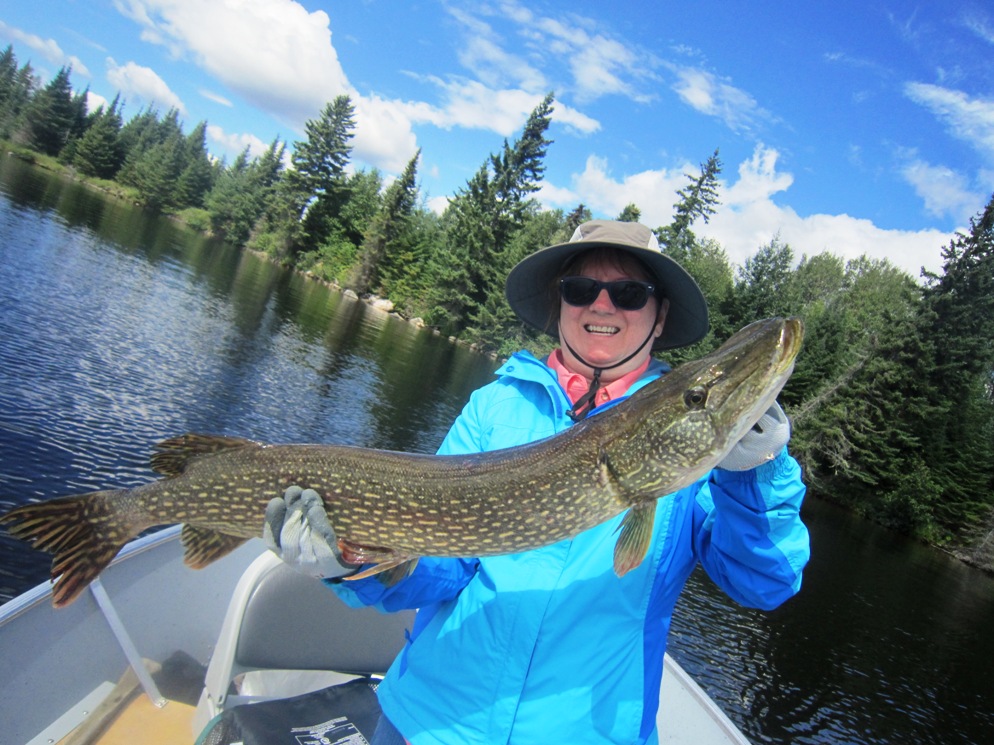
I'm not sure what Chad Haughenberry used to catch and release his monster northern pike in early June, top, or what Jim Zabloudil, bottom, used in late August but surface baits worked great throughout the season
From Day One last year in May until the final group left camp in September, anyone who tried hard-bodied surface lures for northern pike were astounded at how well they worked.
In fact, I would say there were many times when these plugs more commonly thought of as better suited for bass outperformed more traditional spoons and spinners. And they are a whole lot more thrilling.
At the very least, a pike will swirl or "boil" at the surface lures. But they also frequently come sailing completely out of the water, tail-walk or even do flips. It is a blast.
Walking Frog is example of hard-bodied surface lure
From the start, I should define "hard-bodied" surface lure. I mean just that: lures that are made of hard materials, like wood, hard-plastic or fiberglass. They are meant to either stay on the surface as they are retrieved or to dunk under when given a jerk and then float immediately back up.
Since a lot of these baits are frog imitations, it's important to differentiate them from a common bass bait -- the rubber frog. The rubber frog does not hold a candle to its hard-bodied cousin when it comes to pike.
Rubber frogs not so good
Take the manufacturer Live Target, for example. The Live Target Walking Frog with two treble hooks, works night-and-day better than the Live Target soft or rubber frog. Incidentally, the name Walking Frog comes from the fact that this lure "walks the dog" which means it zigzags as well as hops up out of the water when retrieved. The "walks the dog" action seems to be essential for triggering pike strikes. Rubber frogs or poppers simply move forward with each tug of the line. This doesn't interest pike as much.
The Zara Spook is another walk-the-dog standout. Although the one shown here is in the frog pattern, other colors and patterns that work include those that mimic shiners and perch or even plain black.
Other companies offer similar lures. As long as they "walk the dog" or zigzag on retrieve, they will produce.
Zara Spook in frog pattern. Other colours and patterns work great also
Here's how to fish with these baits. Cast the lure toward any structure, reel up a bit but with still about a foot of slack line out, give your rod tip a small jerk. The bait will move one to two feet about 45 degrees off line. Reel up all but a foot again and repeat. The bait moves 45 degrees in the other direction. You can do this in a continuous manner so that the lure goes left, right, left, right, all the way back to the boat without a pause. Or you can do it several times, take a slight break, and resume.
You only need to move your rod tip 16 inches when you give each jerk and you do not need to change the position of your rod. In other words, you don't need to jerk left to make the lure go left, then jerk right to make the lure go right. You just always jerk the rod in the same direction and the lure does the rest. You can jerk too hard and too light. Just watch the bait. Is it zig zagging a foot or two each time?
So why are fish so interested in this? The action obviously imitates something on the surface that is in distress. It might be a frog, but it could just as easily be a fish.
One of my favourite surface baits is a small, silver lure with Bill Dance's name on it. I'm sure fish think it is a dying shiner minnow.
Baby Suick in frog pattern
Suick, the famous musky plug maker, also makes a smaller floating lure that works wonders on pike. When the angler gives it a pull, it dives under the water with an exaggerated wiggle and then goes back to the surface. We've all seen injured fish, like perch, do the same thing. They try to go down but cannot.
You might think any floating lure, such as floating Rapala, would accomplish the same thing but they are not nearly as successful as the above-mentioned lure. The Suick has a kind of unpredictable movement as compared to the totally predictable wiggle of the floating Rapala.
Suicks come in gigantic sizes for musky, but you don't want those. Try the 4 1/2-inch model. Ditto for the Zara Spook and the Walking Frog. These work great, don't break your arm to cast and provide the action with little more than a flick of the wrist.
They absolutely work the best when the water is calm or nearly so. I'm sure that is when the fish can see the lures' erratic behaviour the best.
A non-floating surface lure -- boy does that sound like an oxymoron -- that will also work with a little chop is the buzz bait. It's not to be confused with the similar-looking spinner bait. Although made of metal, the buzz bait is designed to rise to the surface when retrieved steadily. Its metal spinner chops through the surface, making a buzzing sound. Some buzz baits have a little rudder that the propeller strikes on each revolution, adding to the noise. Others simply make the sound by the propeller chopping the water and air.
Booyah buzz bait
I note that a lot of anglers are misinformed about where to use these surface baits. They seem to think they are only to be fished near weed beds. That probably comes from the fact that so many of them are frog imitations. In reality, they can be used anywhere there might be pike including boulders, rock cliffs, logs, etc.
I think some fishermen also see the lures as a novelty, not a mainstay for northern pike. If they give them a serious try next summer, their attitude may change.
Take my own experience from last summer. During our Family Week when only my family is at camp (the first week of July) I went fishing with my grandson, Raven. We were casting spoons and spinners for pike and doing so-so in the early afternoon when the wind dropped. I switched to a Zara Spook and went back to the same area we had just covered. I literally had a strike or a fish on every cast.
Click to go back to our website 
Click to see the latest on the blog

Friday, November 6, 2015

'The bite' and an extraordinary fishing family

Josh with his 25-inch walleye

Nathan and Josh with Nathan's 25-incher

Josh with dad Scott's 29-inch walleye
I was working down at the boathouse after supper last August and was trying to be as quiet as possible so I didn't disturb the Manni family who were fishing off their dock nearby, just like they do every evening.
Scott and Amy Manni have been coming to our camp for a few years now along with their sons Nathan and Josh and Amy's dad -- the boys' grandfather -- Tom.
Every once in awhile I would hear a splash as they netted or released a fish and sometimes one of the boys would run a keeper-walleye over to the fish house. I think I bumped into Josh as he was on one of those latter errands.
"How's fishing off the dock tonight, Josh?" I asked.
I wasn't expecting the depth of his reply which revealed reams about this extraordinary fishing family.
"The bite tonight didn't start until 8 o'clock," said Josh. "We've got 12 so far. The bite the first night we were here started at 6 o'clock and we got a lot more."
I did a double-take. I'm not sure of Josh's age but he is a young guy and here he was using terms like "the bite."
When you talk about "the bite" it means you are cognizant of the fact that walleyes have spells when you can catch them and other periods when you cannot. It also means you possess the most important quality any angler can have -- patience.
The Manni family had been fishing off the dock this particular evening without success at first but had stuck with it because they knew that sooner or later, "the bite" would begin. And they were correct.
The Mannis use slip-bobbers and leeches, the primo method for fishing from shore. They are a quiet group, another indication of their fishing expertise. You could be sitting on the porch of your cabin right next to them all week and never even notice that they were rhythmically catching and releasing lots of fish every night.
I noticed that their bobbers were only a few feet from the dock. Last year they were casting them farther out and even anchored their boats sometimes about a cast's length from shore.
I asked Scott about that later. He said yes, for some reason, the best spot this time was indeed right beside the end of the floating dock, likely only in eight feet of water.
There probably were fish in those other places this year too, he said, but for some reason they would come to this one spot on shore whenever they fed.
So, they had obviously tried their bobbers in the other locations this year and then picked up the pattern of the fish biting mostly near the dock.
Contrast this entire scenario -- experimenting on micro-locations and waiting for the bite -- with so many other anglers who give any spot a single try and sometimes won't even drop a line unless they can first "see" the fish on the fishfinders.
The Mannis don't spend the entire day sitting on lawn chairs on the dock, just the evenings. The rest of the time they are out on the lake back-trolling more or less like other people. But even out there they are experimenting -- and learning-- watching their fishfinders and "feeling" the bottom with their sinkers.
Before long this year Scott saw a pattern that no one else at camp had found -- the biggest walleyes, the 25-29-inchers, preferred an aggressive presentation of the spinner and leech. He sped up his trolling speed and caught some of the biggest walleye of the year.
The Mannis are one of only two groups at our camp who do much dock fishing. Both catch more fish off the dock then most people do out in their boats. Both fish off the docks either in the early morning or after supper. The other group uses tiny jigs with bits of worm.
Watching Josh and his brother, Nate, it is pretty obvious that these boys have done a lot of fishing already. I would suspect they have just about grown up with a fishing rod in their hands.
It makes me think about our youngest son, also named Josh. He might be the best angler in our family. He just seems to have an instinct for it. Could that have come from the fact that his first fishing trip took place hours  before  he was born? For a fact. When Brenda was nine months pregnant we and another family had gone ice fishing on Hazelwood Lake, near Thunder Bay. We had walked out on the ice about half a mile, caught some fish, including some nice walleye, just at dark and had taken them back to our house for supper. Right after the Camerons went home, Brenda announced we had best go to the hospital. Josh was born soon thereafter.
To this day Josh's favourite type of fishing is ice fishing.


Click to go back to our website
Click to see the latest on the blog

Sunday, November 1, 2015

Lake trout project truly spectacular this fall

Jerime Williams, above, and brother Jason, below, caught and released these beautiful, chubby, lake trout this past July while fishing near Bow Narrows Camp. The fish are likely 7-10 years old and are proof that lake trout are making a comeback in the lake.
The Ministry of Natural Resources and Forestry's project to restore the lake trout in Red Lake exceeded all expectations this fall.
This program, which began about 10 years ago, collects eggs and milt from lake trout in Red Lake and then transports them to an MNRF fish hatchery at Dorion, near Thunder Bay. There the eggs are developed and the fish raised to fingerlings that are transplanted back into Red Lake 18 months later.
The goal has been to gather about 340,000 eggs but due to the scarcity of wild fish in Red Lake and other factors, that target has seldom been met.
This fall the program succeeded in sending over 500,000 eggs to the hatchery!
There were so many, says project leader biologist Toby Braithwaite, that the hatchery cannot raise them all to fingerling size (4-6 inches) and therefore a bunch of the smaller fry or eyed-up eggs will likely be sent back to Red Lake this winter to be transplanted through the ice.
The MNRF group stays with us at Bow Narrows Camp while they catch the wild trout, strip them of eggs and then release the fish back into the lake.
Brenda and I have always been impressed at the hard work and dedication of this group. They are absolutely outstanding. The weather is usually cold, windy and even snowing but that doesn't faze them one bit. They are out there each day, setting and hauling-in nets and racing back to camp with fish every half-hour. The fish are separated into pens tied to our front dock, according to sex and where they were caught. The researchers carefully create families of trout which they can monitor in the future to see which succeeds the best. These may be families of strictly Pipestone Bay fish, non-Pipestone fish, or crosses between the two.
All the adult fish are tagged before release. At the hatchery, the fingerlings are fin-clipped before they are sent back to Red Lake so that they can be identified in the future. Our anglers are asked to take careful note of any trout they catch to see if they are missing any fins as well as report any tag numbers.
The fin clips are the most important because it means the transplanted fish are surviving to adulthood.
None of our anglers has reported a fin clip so far but then they virtually never look for it either. However, at least two of the fish caught by the trout study group this fall did have clipped fins.
The spawning project by the MNRF will end in two more years when Red Lake fish that have been raised to adults in the hatchery as brood stock will be used for egg-gathering instead of catching the wild fish each fall.
The trout project began when Red Lake's world-class lake trout fishery drastically nosedived in about the year 2000. Preliminary research found about the only fish left in the lake were in Pipestone Bay where it was also found they were unsuccessful at spawning. See New Direction for possible reasons for the decline.
This year the MNRF crews found lake trout spawning in other bays besides Pipestone, areas that the researchers know the eggs will survive. So this is great news and shows the lake trout population is making a comeback.
Ontario fishing regulations require all lake trout in the Red Lake-Gullrock water system to be released. Not many anglers fish for them these days but the ones who do are finding success.
Witness the photos at the top of this blog, taken this July. These fish are young -- probably 7-10 years old -- and are the picture of vibrant spawners.
Mostly we catch lake trout by accident the first week or two of the season while trolling crank baits for northern pike or walleye.
When fishing specifically for lake trout, such as in deep water in the summer, regulations require anglers to use lures with single barbless hooks and to not use any organic bait, either live or dead.

Click to go back to our website
Click to see the latest on the blog

Tuesday, October 20, 2015

Eagle's eye view of the camp

Docks are clustered here. Pipestone Bay visible top right.

Lodge is partly obscured by trees.

Cabins 10 and 9 can be seen clearly

Looking west beyond Cabin 10   

Even further west. Trout Bay is at upper left.
We're often asked if we pull out our docks for the winter. As the first photo taken from Mike's mountain shows, we just pull them over to the boathouse-Cabin 3 area. The ice in this area just melts in place come spring compared to moving in a sheet the way it does from the lodge to Cabin 10.
The photos start at the north end of camp and sweep southwest.

Monday, October 19, 2015

His timing was just a bit off

Pat, the amorous partridge, thought he had done everything right. He couldn't have looked better and was strutting his stuff for a fine-looking chick here in the yard. But all she did was give him the cold shoulder. What was wrong?
Just one thing. Mating season is in the spring and this picture was taken yesterday. He was six months early.
It would seem the male ruffed grouse's mating instinct is triggered just by the photo period. The length of daylight in the fall is the same as in the spring. Not only do the males put on their courting display in the fall but some actually drum as well, all for naught.
And what about the females?  They're more complicated.
Click to go back to our website
Click to see the latest on the blog

Sunday, October 18, 2015

Panorama of camp from hill top

Click on photos to see in panorama view
We're putting camp to bed for the winter now. I climbed up Mike's Mountain, across from camp, today to see if I could get all of camp in one photo.
Second view

Tuesday, October 6, 2015

Four-year roofing project completed

Cabin 3 was the second-largest roof
There were times when I didn't think I would ever say this, but our massive re-roofing project is done! We have now stripped the roofs of every building in camp and installed new 25 year shingles.
I wish I had kept track of the number of shingle bundles over the four years we worked on this project but judging by the 90 that we did this season, the total was probably 360 to 400.
The second-largest roof and the oldest was Cabin 3, completed in late August. A portion of this building was built by original Bow Narrows owner Bill Stupack in the 1930s.
The largest roof, of course, was the lodge, which I believe we completed two years ago.
Other than Cabin 3, buildings done this season were Cabins 4 and 6, the generator building, the fish house, the water plant, the recycling building and the water plant. And oh yeah, we also re-roofed the porch on Cabin 9 which had been damaged by a falling tree.
The total weight of the shingles we laid over those four years would have been 25,000 pounds!
That sounds like a lot but we also removed probably three or four times that much weight in old rolled roofing.
Whew! I'm glad we're finished.
Click to go back to our website
 Click to see the latest on the blog

Saturday, October 3, 2015

It was the summer of the big pike

Charles Howard, 41-inch
Terry Leonard, 37-inch
Sue Nosko 39-inch
There will be a lot more pictures to come, once I get home and can transfer some of the photos our anglers e-mailed me to my computer, but here are the first few showing the extraordinary season it was this past year for big, big northern pike.
Many long-time anglers landed their personal bests this year. I must have heard a dozen people say "Today was the best fishing day of my life." It was truly spectacular. Not only were there a lot of long pike hooked, but they were extra thick as well. Thirty-plus-inch fish liked to warp your rod. Pike anglers had a blast.
Early-on in the season we did very well on bigger lures, and by bigger I mean up to six-inch plugs like the Spro and Suick. But as summer came on the big lures faded in popularity and the regular two-inch spoons and spinners like Mepps #4 and #5 seemed to produce the best.
Throughout the year, anybody who tried top-water baits like the six-inch Zara Spook and the Live Target Walking Frog, were thrilled to find that northern pike won't hesitate to take to the air. Lots of them become completely airborne. In one case, the very first pike a dyed-in-the-wool walleye angler caught when he tentatively tried the Walking Frog was a 36-inch fish that came completely out of the water and inhaled the frog when it came back down.
Later in the summer and in the fall, buzz baits along with spoons and again, the topwater lures, provided great action.
I'll let Pete, one of our last fishermen who just had a fantastic afternoon on pike after spending days coaxing reluctant walleye to bite, sum it up: "I drove hundreds of miles and spent a thousand dollars. I don't want to sit in the boat and just do this all day (here he pretends to hold a rod in his hand and gently jig it up and down. I want action!"
He and his group tried buzz baits and spoons and soon had giant pike somersaulting through the air and doing back flips. And get this, they also caught two muskies.
Click to go back to our website
Click to see the latest on the blog

2016 availability now on-line

If you click on the 2016 Reservation Availability button on the right side of the page, you should now be able to see what's currently available for cabins next year.

Click to go back to our website
Click to see the latest on the blog

Thursday, September 24, 2015

Why no blogs?

A bunch of reasons: no connectivity,  no time, idiotic computer system (8.1).
We lost our old phone system last year and this year have only had our cell to connect with the Internet. If others at camp are using the system, even the phone, everything slows down. I have one hour of possibility to write on the blog. That's at 8 p.m. which is my first chance to sit down all day. Unfortunately it is also the staff's chance to call home or send emails or surf the net. By 9 p.m. the guests are back from fishing and are on the phone or need things.
Another factor has been the disappearance of digital cameras, replaced by cell phones. Instead of letting me use an SD card from a camera to share a photo of a big fish or a moose, people now e-mail me the photo after they get home. It takes such a long time to download the photo on our pittance of a cell signal that it ends up taking my whole time. I will use all these photos once I get back home. Thanks to all for sending them.
I will also say goodbye to Windows and get a Mac. I'm thoroughly finished with 8.1.
I've more time from this point forward and will do my best to post things.


Friday, August 28, 2015

Personal bests caught today


Moose Club members Bob Preuss and Earl Vorpagel got their personal bests on pike today. Bob got a 45-incher and Earl landed a 32-incher. Both big fish were released.

Monday, August 3, 2015

Telephone, e-mail working again

A major telephone outage that began Friday evening and lasted through the weekend was corrected this morning. We were unable to receive calls or e-mail during that time. Everything is back today.

Wednesday, July 29, 2015

The sounds of no silence


A heron lands in the stillness of an early camp morning
What a difference a day makes.
The one I’m talking about started out with a worker at Red Lake Marine, the place where we tie up our boat, taking out his boom box and playing tunes while he worked on some new docks. I happened to be there waiting for a truck to deliver our new beds. I knew the beds were on the truck; I just didn’t know when they would be delivered and so ended up waiting the entire day.
“You da man! (boom di boom, boom, boom)
“You my main man! (BOOM)
“Been scratchin’ for a livin’, don’t wanna see my baby pout
“When the sun’s getting high, you know what I’m talkin’ ‘bout
“Got an itch in my stomach and I just got to get it out
“So I head out for a sub and soon you all hear me shout
“You da man!’ (boom di boom, boom, boom)
“You my main man! (BOOM)

“Give me mine on flatbread, give me olives, give me cheese
“Give me lots of cold cuts, could I have some peppers please?
“Then stick it in the oven, wrap it up at your ease
“You da Earl of Sandwich, I praise you on my knees
“You da man! (boom di boom, boom, boom)
“You my main man! (BOOM)

Now I’ve got to apologize right here to this worker for not doing a better job at describing the strength of the bass on his boom box. I mean: (boom di boom, boom, boom) is really pathetic. It doesn’t illustrate how your cheeks pulsed inwards and your eyeballs were driven back into their sockets. And (BOOM) doesn’t show how the air was knocked from your gut like a sucker punch to the solar plexus. This was a truly impressive, industrial-strength, boom box.
I also might have gotten the lyrics wrong but no matter, you can ask anybody in Red Lake. I mean anybody. And don’t just restrict yourself to the living. The ones in the cemetery on the far side of town heard it too.
And it wasn’t all rap stuff. There were also country songs.
“When you’re with me, I fly like an eagle
“But when you’re away, I bawl like a beagle.”
 Just a day earlier I had also been in town but it was like a different universe. Red Lake can be noisy with floatplanes taking off from Howey Bay, but not this day. The dock worker wasn’t there either. As I was loading the boat with supplies I heard a low bugle sound and looked up to see seven swans flying overhead.  They are only the second group I’ve seen in Northwestern Ontario.
You frequently can hear loons call too. There is at least one nesting pair in the bay. They usually hang out in front of Red Lake Marine and Chimo Airways. There are ducks and gulls, mink and beavers, eagles and herons, right in front of the town’s main drag. Pretty cool in my book.
And I don’t mean to single out this worker. He’s not a bad guy; just a member of a generation who seem to think there are no other sounds in the world worth listening to except for those stored on their digital devices. And that is a pity.
“You da man!”
We had a very windy day here at camp yesterday and I was thinking how marvelous it is to hear the wind in the tree leaves. Quaking aspen leaves almost tinkle as they shimmer while birch and balsam poplars have more of a bass quality to their rustling. Although pine trees can whisper in low wind, yesterday they were howling.
The waves made a chaotic smashing sound on the rocks but on other days they sing a lullaby, something not lost on the producers of the Solitudes meditative sounds series.  There is also rhythm to the falling rain. These are soul-soothing tunes, ones that let your mind heal and wander.
(Boom, di boom, boom, boom)
In calmer times such as in the evening, you can hear an entire symphony of natural music makers. Hermit thrushes play their eerie buzzy flutes from the deep recesses of the forest, grey tree frogs sing short refrains that are incredibly loud. Toads trill on hot nights. Grasshoppers crackle like firecrackers when they take flight in the day.
But these interesting and intriguing natural sounds are lost on today’s ear-bud-wearing generation who seem never to go a minute without their “tunes.” And on those rare occasions when the ‘buds are not in their ear canals, they hum, to cover the sound of silence.
“Like a bee, ewee, eweegle”
It can make for some frustrating conversations.
Here’s an example with a girl who worked here years ago.
I signal to Megan that I want to talk to her so that she will remove her ear phones. She takes them out but then immediately hums.
Me: “Megan, did you make the beds in Cabin 8?”
Megan: simultaneously, “Ummm, ummmm, ummmm. What?”
Me: “Megan, did you hear what I said?”
Megan: “Ummm, ummmm, ummmm. What? Something about beds?”
Me: “Did you make the beds?”
Megan: “Ummm, ummmm, ummmm. What beds?”
“You my main man!”
(Boom)


Sunday, July 19, 2015

The silver lining to a rainy week

We've had about a week of thunderstorms now and would welcome normal sunny weather again. On the plus side, however, scenes like this one tonight outside the lodge window are pretty common.
Walleye fishing has been good with many large fish being taken. Eaters are harder to find.

Sunday, July 12, 2015

You can now rest easy in every cabin

The last of three boat-loads of beds arrives at camp much to Brenda's satisfaction
We finished replacing all the beds in the cabins this summer. The new beds are Five-Star hotel-quality, and while expensive, we believe they are worth the extra cost since they ensure everyone gets a great night's sleep. They have proven a hit with all, including those with back problems such as Brenda and myself.

The beds are made by North Star Bedding in Sudbury, Ontario. We now have 47 of them, including
 the bed Brenda and I use. At home we have a Tempurpedic memory foam mattress which is exceptionally comfortable and the North Star bed, although not made of memory foam, is equally excellent.


Wednesday, July 8, 2015

Young ladies are great anglers too

Brittany Scott was here with her father Ray and caught and released this big northern pike. An even larger fish broke her line, dramatically while airborne.

Sunday, July 5, 2015

A fishing trip with the boys

It was Isaac Tronrud's first trip

Our dog Cork had the time of his life too
Adam and Isaac Tronrud and Myles Longsdorf meet a three-foot garter snake

There was time for solitude too. Photos by Mike Tronrud
Dads Jon Longsdorf and Mike Tronrud brought their boys fishing and everybody had a ball, including camp dog Cork who must have lost 10 pounds playing football with the kids, swimming and retrieving.

Tuesday, June 23, 2015

Loons are starting to hatch

Photos by Doug Billings

Notice distance from water's edge

Doug Billings
Bow Narrows angler/photographer Doug Billings snapped these great shots of a loon on the nest a few days ago. Yesterday a couple of other anglers reported seeing the first loon chicks riding on the backs of their parents.
There should be a good hatch of young loons this year as the water level has stayed relatively constant.
Doug's second shot of the loon nest shows its distance from the water. That is about as far away as you ever see them. Many times the nest is only inches above the water line. Rising water levels can wash the nest away but that didn't happen this year.
The last shot shows Doug as he prepared to board the Lickety Split in town at the start of his week. Notice the small amount of gear he brought. I believe Doug gets our Lightest Traveler of the Year Award! I don't believe his luggage weighed more than 60 pounds.
By comparison, we have had guests who brought six times this much. They would be quick to point out that they were doing their own cooking while Doug ate in the dining room on the American Plan. If that was indeed the difference, then they are telling us they consumed 50 pounds of food and drink each day!

Monday, June 15, 2015

Fids are all bitin' gud

"Hey, Dan! How are the fish biting?"
All da fids are bitin' gud.
"What?"
I said all da fids are bitin' gud.
"You sound funny. What are you saying?"
I can't tock creary cuz I'm midding a font toot.
"What? You sound really funny."
It's cuz I'm midding -- miffing -- a toot."
"Are you saying you're missing a toot?"
A toot! A toot! A font toot!
"Well, if that doesn't beat all! I knew people can be uncomfortable when they can't toot but you're the first I've met whose speech was affected by it!"
No, no. You don't get it. Da fids are all bitin' gud!
"Are fids those really ugly fish that taste like lobster? There's no limit on them, right? You know I've always wanted to catch some of those. And they're biting good, you say. Where?"
No, no! Fissssss! You know, waweyes.
"Are you saying the fids are biting in Wawa? That's got to be 500 miles from here!"
It's da toot.
"Here we go again. I'm telling you, just let it out."
I can't pownounc -- I can't enunciate, ENUNCIATE! I can say ENUNCIATE!
"Good for you."
Pike are bitin' gud and so are da waw -- no, pickerrrrel. You know pickerrrrel?
 "No. Are they related to fids?"
Uh uh. Wook, what do you want to catch?
"I was hoping to get a mess of walleyes, as well as some pike."
Gud!
"They're biting?
Yep!
"Well that's what I wanted to know. I'm going to try for some of those fids too."
OK.

Sunday, June 14, 2015

Big pike, lots of walleyes being caught

Jon Mueller

Denny Burich

Ron Kucko
Fishing has been tremendous as evidenced by these photos of this long-time group from the River Falls, Wis., area.
Everyone is pleased to see a variety of sizes on the walleye, from itty-bitty ones up to 28-inchers.
The weather has also been wonderful with most days seeing highs in the low 20s C (70s F). The best fishing days have been those with a good breeze.