Friday, December 21, 2012

A quiz for the day of the long shadows

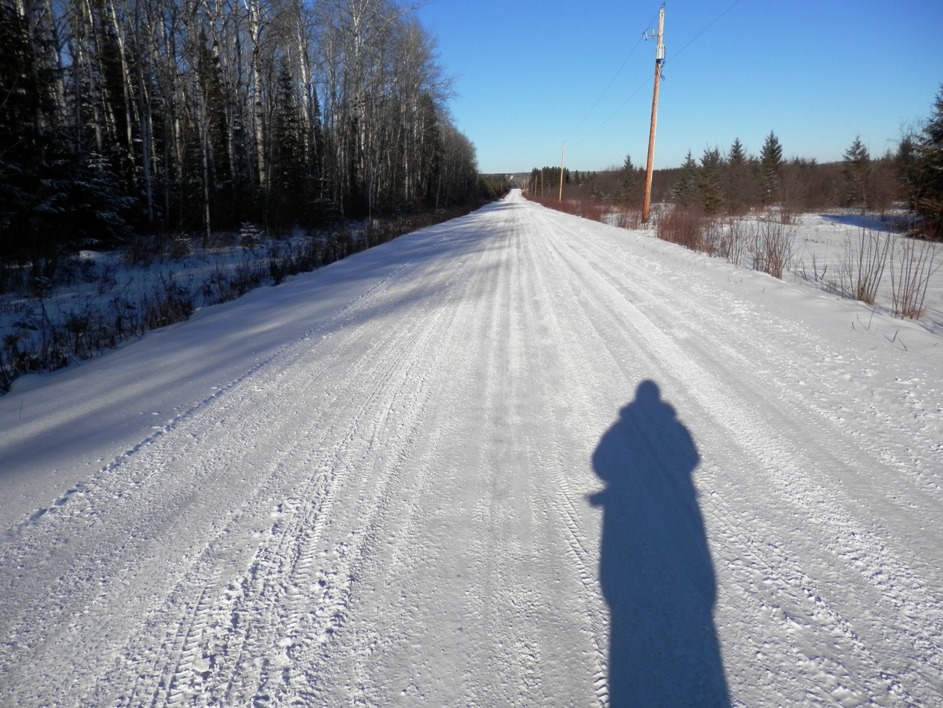
Longest shadow of the year was cast today
Which way am I headed and what time is it?
I took this photo today, Dec. 21, the winter solstice, on my daily walk on the road.
Which direction am I walking and what time was it when I took this photo? You should be able to figure it out.
This is the shortest day of the year. Every day from now on brings more sunlight.
Click to go back to our website
Click to see the latest on the blog

Don't you hate it when this happens?

Surprise! Young buck trips a branch-load of snow
You are taking a walk out in the woods right after a snowfall. It's like walking into a Thomas Kinkaid painting, everything still and white and beautiful and then -- whump! -- a load of snow goes down your neck.
"JEEZ but that's cold!'
The same thing happened to this young whitetail buck in front of my trail camera here in Nolalu.
We have enough snow to make it a white Christmas but that's about all. So far it has been a very mild winter, only -10 C tonight. It's been a little colder in Red Lake, probably -20 C or about 0 F there.
Today is the shortest day of the year. We need to turn the headlights on in the car at 3 p.m. if it is cloudy which it usually is this time of year.
We have put solar Christmas lights on a couple of trees out in the field the last few years but they don't turn on until January. There just isn't enough light in December to charge them.

Click to go back to our website
Click to see the latest on the blog

Thursday, December 20, 2012

Drift sock slows down your troll too

Cabela's drift sock
How many times would you like to have slowed down when you were trolling for walleye?

This is the reason some anglers use electric trolling motors but these are a hassle because they are in the way and carting around the heavy battery is no fun at all.
We have one group who simply uses drift socks like the one in the photo. They use it tied to the bow when backtrolling and tied amidships when drifting. The drift sock sinks just beneath the water surface and acts as a drag that significantly slows down the boat. This is especially useful on windy days.
I like the drift sock because it is simple and effective, requires no fuel, packs flat in your trunk and stows out of the way in the bow of your boat.
It's a great thing when you can work with Nature instead of fighting it.

Click to go back to our website
Click to see the latest on the blog

Wednesday, December 19, 2012

Guess who is coming to dinner!

I left the top off our compost bin and this gorgeous red fox took that as an invitation to help himself.
He had no problem leaping four feet over the edge of the plywood box and even perching on a support in the corner.
There aren't many things as beautiful in the wild as a red fox, in my opinion, especially in the winter.
There are two of these delicate canines hanging around our house in Nolalu. This is the larger of the two.
They respect our chocolate lab, Sam, enough to run when he barks at them but they never go far. Sam is starting to develop a symbiotic relationship with the foxes. He can't leap over the walls of the box and the foxes often leave a lot of tidbits behind. So Sam only half-heartedly chases them away. The way to a lab's heart is definitely through his stomach.
Click to go back to our website
 Click to see the latest on the blog

NOTO members are leaders in the outdoors

Bow Narrows Camp is a long-standing member of Nature and Outdoor Tourism Ontario (NOTO) and I would strongly recommend that every fishing and hunting, hiking and canoeing, river rafting and adventure-tourism business in Ontario join this tremendous group.
Here is why: NOTO is Ontario's preeminent tourism organization. NOTO camps must follow a code of ethics that ensure guests, wildlife and the environment are treated with the highest respect. NOTO members are not fly-by-night operators; they are skilled professionals who make their livelihood in Ontario's great outdoors.
NOTO membership is the gold standard when it comes to outdoor tourism. When camp owners join NOTO it shows they are serious about their business, that they want to excel in their field.
NOTO provides many levels of support to its members, from information about laws and regulations to lower credit card fees to professional development seminars at its annual convention.
Every fishing and hunting camp, canoe outfitter and all other outdoor-related businesses in Ontario have benefited from NOTO's advocacy with provincial and federal governments. Now is the time to support the very organization that has been tirelessly fighting on your behalf.
Be a leader in your field. Keep on top of the latest developments and products. Show your customers that you are striving to make your business the very best for them. Do all this by joining NOTO.
Click on the NOTO website and learn more about being part of Ontario's greatest tourism organization.

Tuesday, December 18, 2012

Buy yourself this gift for Christmas


I've always considered myself to be in "pretty good" shape. It is really impossible to run a wilderness fishing camp and not be. Each day at camp is filled with lots of walking, climbing, and most of all, carrying. I probably lift, on average,  a ton of things every day: groceries, lumber, gas and diesel barrels, boat gas tanks and of course, lots and lots of luggage. I don't do as much lifting at home in the winter but then I do a lot more aerobic exercise: walking, hiking, skiing, snowshoeing. I also do body core strengthening, mostly because I have a bad back. When spring comes around I also frequently go jogging each day, preparation for the daily workout of camp life. So, I'm usually in "pretty good shape," at least for a guy who just turned 60.
So, I've been alarmed that I have been gaining a spare tire around my middle the last few years. I've tried dieting -- always with just temporary benefits -- exercising even more and still, to my chagrin, I can only lose a few pounds at best and feel terribly hungry and tired in the process.
I've also been studying, book after book. And, I've been observing the general population. EVERYBODY is getting fat. What the heck is going on?
The generally-held belief that people are just sitting on their butts all day, watching TV or the computer and not exercising is shattered when you look at today's marathon runners, at least the amateur ones. Many, many of these people who run dozens of miles each day and over 26 miles on occasion, are absolutely chubby! It used to be you could easily identify long-distance runners because they were as thin as beef jerky. What the heck is going on?
A lot of recent dieting books have seen the connection between the obesity epidemic and advice from health agencies about 30 years ago to switch to a low-fat, high-carbohydrate diet. The graphs for the population gaining weight, developing diabetes and lots of other diseases and medical conditions (i.e. hip and knee replacements) are identical over that period.
Enter Wheat Belly, a book by cardiologist William Davis, MD.
Back in the 1970s, he explains, wheat underwent a transformation, part of the Green Revolution to increase production of food to feed the exploding population of the world. The result is the wheat we are consuming today in bread, pastas, desserts, etc., has nothing in common with the wheat our parents and grandparents ate. It is chemically different, genetically different, and among a litany of bad things it does to our bodies and joints, it also penetrates the blood-brain barrier, creating narcotic-like receptors in our brains. It makes us get hungry every two hours. It makes us tired. And, more than ANY other food, it makes us get fat.
A slice of whole wheat bread makes us fatter than does a tablespoon of white sugar!
You really need to read the book to understand the mechanism of how it does this.
His advice: learn to lead a life without wheat. You don't need to be gluten-intolerant. Everybody should do it. No wheat at all. Forget the "healthy whole grains." There's no such thing.
So, I started a wheat-free regimen a month ago. I actually began on the week that Brenda and I took a Caribbean cruise, probably not the best atmosphere to lose weight. I ate all I wanted but did so with vegetables, meats, cheese and some fruit. I had a great time and really enjoyed the food. By the end of the week I had lost six pounds. More importantly, I lost an inch on my waist.
Nearly a month later now, I have lost another inch. And I've made no attempt to reduce my caloric intake. I always eat until I'm full. I just do it with foods other than those made of wheat.
Best of fall, I'm not tired any more. I don't need to take a nap in the middle of the day. And my back has felt wonderful.
A blog about wilderness life might seem a strange place to recommend a diet book and I do so only because our guests are also our friends. I would be a poor friend if I didn't let you know about this book.
Again, it is Wheat Belly, by William Davis, MD.

Click to go back to our website
 Click to see the latest on the blog

Saturday, December 15, 2012

Spider, snow fleas out already in December

Spider on snow
Snow fleas, Nolalu, Ontario, Dec. 15, 2012
I once wrote that snow fleas are the first sign of spring . If that is true then we really had a short winter this year as I took this photo of snow fleas today, Dec. 15. There was also a spider out on the snow surface.
The temperature here in Nolalu, ON, has crept up to the melting point, 0 C or 32 F. Apparently that's all it takes to bring out the snow bugs. Nolalu is 50 kilometres or 30 miles southwest of Thunder Bay at the top of Lake Superior.
Snow fleas aren't really fleas, just flea-like creatures called springtails. They look like pepper on the snow surface.
The spider, however, is really a spider. I've noticed that many of the spiders you see in the winter are missing a leg or two. That might be one of the perils of winter insect life, sort of like losing a toe to frostbite for humans.
Click to go back to our website
 Click to see the latest on the blog
Wednesday, December 12, 2012

View of the heavens from Cabin 1

You didn't need a nightlight when this photo was taken in Cabin 1. The moon shining through the gable window would have done the trick.
Click to go back to our website
 Click to see the latest on the blog

Tuesday, December 11, 2012

Giant fish and giant conservation ethic

Somewhere under the giant pike is the measuring trough
Brett Styve with replica of his trophy fish
Bow Narrows angler Brett Styve and a giant northern pike in Red Lake know each other well.
Brett knows this spectacular 45-inch pike can put on a rod-warping, drag-screaming fight, and the pike knows that Brett is no novice with a rod and reel.
They might meet again next summer because Brett is coming fishing with his dad, Paul, once again and the enormous pike is still out there. Only now it is probably even larger.
The saga did not end when Brett and Paul finally boated the leviathan in August of 2012. Instead, after grabbing a quick  photo of the fish in the measuring trough -- as you can see the fish wouldn't even fit in it -- the magnificent creature was released back into the waters of Red Lake.
And a replica of the pike, not the skin of the real fish, now graces the walls of the Styve household in Iowa.
The Styves are perfect examples of today's enlightened angler. They keep only the fish that can be harvested sustainably -- the ones beneath the slot size -- and release the big spawners with the genes for large size and fast growth.
By following these practices anglers can not only enjoy the thrilling fishing of Red Lake today but forever. They simply are harvesting that part of Nature's bounty which is available annually and not destroying the foundation of the entire system.
Almost all Bow Narrows anglers are like these two -- intelligent, mindful conservationists. It is wonderful to see.
Click to go back to our website
 Click to see the latest on the blog

Saturday, December 8, 2012

When e-mail isn't so instantaneous

Have you ever sent an e-mail to someone and they don't answer back?
I am learning that e-mail may not be the fastest way of communicating.
We have a friend and customer, let's call him Ken since that's his real name, who asked me up at camp last summer if we were having problems with the Internet. I told him no. Then why aren't you answering my e-mails, he asked. That would be because we never got any from him!
My first thought was that our computer's spam filter was erroneously labeling his e-mails as spam. Not so. None of his e-mails were in the spam folder.
Then it occurred to me that our Internet Service Provider's spam filter was doing it. Nope.
Ken's e-mails just never got here and now he thinks we are shunning him. We're not Ken, really.
I don't know what is going on for sure but here is something we've seen happen to ourselves.
You know how your computer is given a unique IP address when you sign on to the Internet? It's unique alright, unique to you and about 50 other people at the same time. If any of them have been blacklisted by a spam filter, none of you can send e-mails. And there is no message that comes to you warning that this is happening.
If you have sent us an e-mail and we haven't answered, I can guarantee you that it was because it never got here. Pick up the phone and call us! You know for sure then that you are really communicating.
Our winter phone number is: 807-475-7246
We are here most of the time and if not, leave a message on our answering machine. We absolutely will get back to you.

Click to go back to our website 
Click to see the latest on the blog

Thursday, December 6, 2012

Keeping cool in the eyes of the Dragonhunter

The largest of the dragonflies takes a breather from hunting
Our grandson, Raven, stares down one of Nature's most fearsome predators, the Dragonhunter!
The sight of this largest of the dragonflies would send ice through your veins if you happened to be a flying insect. It's harmless to humans, of course, and was just catching a ride on Raven's life vest while he was out fishing at camp last summer.
At about 3.5 inches in length, this sole member of the genus Hagenius can kill and eat wasps and hornets, creatures as large as Monarch butterflies, other species of dragonflies  and even other Dragonhunters.
There are probably a hundred species of dragonflies in the Northern U.S. and Northwestern Ontario. Each has its specific habitat, time of emergence and prey preferences.
Some hunt from perches, darting out to catch a bug and then flying back. Others, like the Dragonhunter, fly a zig-zag pattern throughout their territory, ready to zoom-in on any other flying object.
All dragonflies spend most of their lives underwater as larva where they prey on other aquatic insects but also on minnows!
Depending on the species, dragonflies may spend years underwater as nymphs and only days or weeks as flying adults.
Dragonflies are really mankind's best friends as each of these beautiful winged marvels can consume hundreds of mosquitoes and gnats in a single day.
If you are interested in knowing more about the dragonflies of the North, including Michigan, Wisconsin, Minnesota and Northwestern Ontario, grab a copy of this book:
Dragonflies of the North Woods by Kurt Mead. It is published by Kollath-Stensaas Publishing of Duluth, MN. The ISBN is 0-9673793-6-9.
This book is part of the North Woods Naturalist Series and is a gem.
Click to go back to our website
 Click to see the latest on the blog

Tuesday, December 4, 2012

Pick your arrival and departure times now!

Our annual letters to customers with reservations will be arriving in your mail any day now.
These letters note your vacation dates, the number of people in your group, the type of plan you wanted (American Plan or Housekeeping) and also your preference for boat times both for arriving in Red Lake and departing from camp.
Incidentally, our package rates will be unchanged for 2013!
Our policy is to let you choose your boat times at the time you make your deposit.
In other words, the first people with deposits get the first choice on arrival and departure boats.
You can beat the mail by calling us at our winter phone number: 807-475-7246 and use a credit card to make your deposit which is $100 per person.
Some of you have already sent your deposits or did so when you were at camp last summer. Thank you! Unless you told us differently, we will have slotted you into the same arrival and departure times as last year. It doesn't hurt to call us and check anyway.
Our transportation boat, the Lickety Split, picks up guests in Red Lake on Saturdays and Sundays at 9 a.m., 10:30 a.m. and 2 p.m.
At the end of the week it departs camp for Red Lake, both Friday and Saturday, at 6:30 a.m. and 8 a.m.
So to repeat, as an incentive for people to get their deposits in right away, they get to choose their arrival and departure times when they make their deposit.
It's the old 'early bird gets the worm ' story except you are the bird and the boat is the worm!
We would prefer you call us rather than e-mail this information as we believe it a more secure way of transmitting your credit card number. But it's up to you.
What happens if the boat you wanted is already full? The Lickety Split carries nine people and their luggage, usually, depending on the size of the people and the amount of gear they bring. If the boat is already booked, then we'll move you to next available time. It's not a long wait. The round trip takes just 90 minutes.


Saturday, December 1, 2012

Red Lake's walleye population absolutely enormous

Expect lots of walleyes next summer like this one caught by my brother, Bill, in 2012
I don't believe there have ever been as many walleye in Red Lake as there are today. At least that goes for the 52 years my family has owned and operated Bow Narrows Camp.
During the last couple of years it has been possible to literally catch hundreds of these golden-hued fish in a single day. There even may be too many of them! How can that be possible? How can you have too many of a fish?
Let's start by examining some of the factors that may be contributing to the burgeoning walleye population.
1. Earlier, warmer springs
Climate change has meant ever-earlier ice-outs. The latest record was just this year, 2012, when the ice broke up on April 13, beating the previous record by more than a week. The historical ice-out average used to be May 8 with some ice-outs as late as May 20.
Walleye spawn in the spring, just as the ice is disappearing. The earlier they can get at it and the warmer the weather the faster their eggs and fry develop. In other words, warm springs mean better survival of the young.
2. Smelt
These tiny fish somehow got into Red Lake in the late '70s or early '80s along with just about every other road-accessible lake in Ontario. The exact way this happened is unknown but obviously, since a road is always in the picture, humans are responsible.
Smelt are a high-calorie food source for walleye and makes them gain weight rapidly, but smelt are also a double-edged sword. On the downside smelt are themselves a predator that eat native minnows and the larval-stages of fish, especially deeper water species such as lake trout, whitefish, tulibee (a kind of herring) and ling (aka burbot, eelpout). Smelt are likely at least partly responsible for the decline in lake trout (See Many lake trout spawned; new direction starts). Humans are also responsible.
Although smelt may have been feeding on larval lake trout, the smelt population crashed a few years back -- something that always happens when they get into a lake. The native minnows have come back and even though there are still smelt in the lake, they should never again reach the numbers they once held. That's great news, especially for deeper-water fish like lake trout.
Lake trout are voracious predators. When they disappeared from deep areas on the eastern end of the lake, they left a void. Nature abhors a vacuum; so, walleye moved to take their place. Now there are walleye in some of the deepest water as well as their former shallow territory.
At the western end of the lake, where Bow Narrows Camp is located, lake trout never totally disappeared and are making a comeback. Still, it's an uphill battle because even here there are walleye in many of the deep spots and walleye prey on tiny lake trout. When the lake trout grow larger than the walleye the tables will be turned. And when the lake trout population gets back to a certain level, then no walleye will dare go to deep water again.
3. Fewer lake trout mean fewer predators
With fewer lake trout to diminish walleye numbers, the only big predators left are northern pike which, it must be noted, are doing their best. Just witness all the huge pike our fishermen have been catching. These are well-fed fish! I think we caught more really-big pike in 2012 than in any recent year.
How could there be too many walleye?
So, back to that question posed in the first paragraph.
Walleye populations need big predators that thin them out in order for the remaining walleye to grow exceptionally large in size. Red Lake has always been known for its really, really big walleye. We don't want to lose that reputation.
Northern pike and lake trout have always done a nice job at making it a survival-of-the-fittest for walleyes in Red Lake.
Then the lake trout population took a hit and walleyes got the upper hand, at least temporarily.
The Ministry of Natural Resources has been stocking lake trout fingerlings from Pipestone Bay, just north of camp, in the rest of the lake for about 10 years now and the lakers have been slowly growing in numbers. Last fall, the MNR started a new tactic in which it will produce even more fingerlings each season with the intention of saturating some of the deepwater bays with lake trout to basically outnumber the walleye predators. 
In the meantime fishermen can continue enjoying the walleye bonanza and can do their part by keeping small fish to eat and letting the big ones go. It always makes much better conservation sense to eat several smaller fish than it does to kill one large one. You want to remove the excess in the population, not kill the reproducers that have made it to the top. (See the Stunning Reality of Keeping Big Fish).
If we all had done that years ago, lake trout would never have declined.
So what can fishermen expect of walleye fishing in 2013?
 It is going to continue to be spectacular with a horde of  fish in the 17-20 inch size range and most of the bigger ones in the 25-28 inch group and fewer in the 30+ inches. There probably will also be really small fish showing up, ones that were too small to bite last season. That's just a guess but looking back at the warm springs, it seems highly likely there are lots and lots of walleyes entering the fishing pool.
So walleye fishermen, sharpen your hooks. You are going to have sore arms from reeling in fish for many years.

Click to go back to our website
 Click to see the latest on the blog

Thursday, November 29, 2012

Another creature feature, something foxy


Sam and I are sure encountering the wildlife!
Yesterday we saw nine deer and a fox and today I was talking with my friend, Don Melnyk, out on the road when he spotted another fox and called it right to the truck by making squeaking noises on his hand.
Click to go back to our website
Click to see the latest on the blog

Tuesday, November 27, 2012

Sam and I met a creature on our walk today

Sam and I went for a hike behind our house today and met this handsome marten, called a pine marten in the U.S.
This medium-sized member of the weasel family was likely out hunting red-backed voles, red squirrels, snowshoe hares and ruffed grouse.
I caught a glimpse of him sailing over the snow and rushed toward him so that he would seek safety in a tree until I could take out my camera and get a photo.
Click to go back to our website
 Click to see the latest on the blog

Thursday, November 22, 2012

My top secret lure for summer walleye

Shh!

Don't tell!
I'm not going to mention my top secret lure for catching walleye in the summer. If I did, some professional tournament search engine robot would put two and two together and the first thing you know, everybody would be fishing with them. But you might be able to get a hint if you check out what's hanging from the mouths of the walleyes in these photos.
I like the 1/4-ounce version of this phenomenal lure. I plunk it right along the weedline and reel it slowly back toward the boat so that the lure is down near the bottom, at least most of the way. It is pretty good at shucking most of the weeds.
It works just as well in open territory -- on rocks and sandy bottoms.
And, it catches northern pike like crazy. That's why I always use an ultrathin wire leader, say six-pound or 12-pound test. The new Knot2Kinky wire works great for this. I make the leaders about four-inches long. That prevents almost all of the northern pike from cutting me off but it's not so long that walleyes pay any attention to it.
I put no live bait on the rig whatsoever. I use it just like it comes in the package. And boy, are these lures expensive. (Not!)  I think they each retail for an outlandish $2.

Click to go back to our website
 Click to see the latest on the blog

Tuesday, November 20, 2012

'I wonder if this is a good spot for moose?'

Dan and Sam
Calf and cow moose
Sam and I checked out a trail near camp for moose sign last fall and decided to set out our trail camera.
Look what came by a day later.
Click to go back to our website
 Click to see the latest on the blog

A real Beaver heads to the air base

Chimo Airways base in Red Lake
Red Lake is a busy floatplane base and a common aircraft here is the de Havilland Beaver. Chimo Air, however, which is located right beside our dock at Red Lake Marine, uses de Havilland Otters, like the turbine-engine model on the left, and Noorduyn Norseman planes like the one on the right as well as smaller Cessna aircraft. It doesn't have any Beavers, that is, until this actual animal swam right up to its dock last summer with a tree in its mouth.
You know you are "Up North" when critters are right in the town. Other wildlife commonly seen in Red Lake are black bears, coyotes, foxes, moose, deer, bald eagles and even, on the outskirts, timber wolves.
Click to go back to our website
Click to see the latest on the blog

Monday, November 19, 2012

Wally is looking after camp this winter

'Wally' the long-tailed weasel is on the job
Brenda, Sam and I have returned to our home in Nolalu for the winter but there is still someone looking after camp -- Wally.
Wally is a long-tailed weasel who first showed up in late August. He made it his mission to clear-out all the mice from the yard starting around the fish house and lodge. When we last saw him in late-October he was ranging around the entire clearing, all the way down to Cabin 10.
He would dash into every pile of brush we made and then reappear a minute later with a mouse in his mouth.
Wally felt completely at ease around us and even Sam, our chocolate Lab. Despite being nearly under our feet he proved a difficult model to photograph. He just wouldn't hesitate long enough to focus on. When I took this photo he had just begun to change into his winter white. He was nearly all white by the time we left. The only thing that won't camouflage with the snow will be the black tip of his tail.
Click to go back to our website
 Click to see the latest on the blog

Wednesday, November 7, 2012

TechLite Lumen Master 200 a great flashlight


If you have been looking for a small, powerful flashlight, check out the TechLite Lumen Master High Intensity flashlight. This little light fits in the palm of your hand yet reaches out hundreds of yards with its 200-lumen CREE LED beam.
I've had one of these for a year now and frankly, it's the only flashlight I want to use.
The light is well-made out of machined aluminum and has rubber o-rings that make it waterproof.
Amazingly, you can stand on our main dock at camp and illuminate the far shoreline across the narrows.
A three-pack of these flashlights sells for about $28, I understand, at Costco.
We don't have Costco stores either in Red Lake or Thunder Bay near where we live in the winter. I actually got my first flashlight at Northwest TimberMart, a building supply store in Red Lake. After trying one I went back and bought all they had and gave one to every member of my family who were at camp moose hunting at the time. TimberMart has not stocked any more, to my knowledge.
However, one of my family discovered the lights are sold at Cosco and brought me a three-pack this fall.
The TechLite runs on three AAA batteries. As you can imagine, such a powerful beam takes a fair amount of power. There are three settings of light intensity, low, medium and strobe. You get about four hours on the low setting which, incidentally, is still brighter than most D-cell flashlights. The high setting will eat a set of batteries in just one hour but it's search-light-like beam is incredibly bright.
Frankly, I don't understand why every LED flashlight has a strobe setting.but there's one on this light if you can think of a use for it.
I must say the TechLite flashlight is better than any other light, is brighter, and costs a fraction of many of the high-end lights sold by sporting goods stores.
It would make a great Christmas gift!