Thursday, February 3, 2011

Ruffed grouse burrow beneath the snow at night

grouse in winter
grouse burrow

I just snapped these pix on a snowshoe walk with Brenda. We saw this ruffed grouse or partridge at a distance. They are really spooky here on our property in Nolalu. At camp you can nearly pick them up. Local people refer to them as "chickens."


That's not the case in Nolalu. They usually flush 20 yards ahead of you.


The second photo shows a grouse "burrow." This is where a grouse spent the night -- burrowed beneath the snow. They actually fly right into the snow, then wiggle through it a bit. The next day they wiggle upwards and take off, as seen where the wings struck the snow in the photo. There are never any telltale tracks leading into or away from the burrow.


Every grouse will do this burrowing if the snow is deep enough. It is much warmer under the snow than above.


They're pretty good at hearing you come near and will explode out of the snow while your heart goes into cardiac arrest. I think they get a big kick out of it!


Unfortunately, red fox don't make as much sound and sometimes nab the grouse right in their sleeping chamber.


Click to go back to our website:


Click to see the latest on the blog:


Tuesday, February 1, 2011

A perfect September grouse hunting day

Sam with grouse
Once in awhile the stars just seem to align perfectly.

This was one of those days.

It was last September and Sam and I skipped out of camp one morning to see if we could find a ruffed grouse.

We drove our boat to a peninsula covered with golden-hued birches and dark jackpine. Sam leaped ashore before I could even tie up and started zigzagging through the ground cover of wild roses and tall grass. His nose worked overtime as he eagerly searched for our prey.

But it was also very windy and therefore difficult to pinpoint the odor that must have been everywhere. A few seconds later I climbed over the bow of the boat and tied up to a tree. As soon as my feet touched the ground a pair of grouse that had been sitting at the base of the birch exploded skyward and disappeared into the dark stand of pines.

Although they had been within mere feet of Sam when he jumped out of the boat I realized they had also been downwind, their scent carrying out over the lake. No matter, they were still on the peninsula somewhere.

I loaded up my Ithaca Model 100 12-gauge side-by-side with #8s and headed down the centre of the spit of land. Sam immediately moved ahead of me and went into search mode. We got to the base of the point of land without kicking up anything although we never could have heard them had they flown; the wind whistling through the pines drowned out all other sounds.

We started back toward the tip, this time sticking near the lake. Sam had moved about 20 yards ahead when I saw a grouse launch off the ground in front of him and come rocketing my way. The lightweight double barrel barked as the bird came straight at me and it dropped like a stone. Sam had it in his mouth in seconds and brought it proudly back to me.

I praised him for finding and then retrieving the bird and started forward again. Sam again took the lead and after a few more minutes flushed the second bird out of the alders that grow all around the water's edge. It flew nearly straight up, climbing skyward to perhaps not only get above the alder but the larger trees as well. At the peak of its climb I fired the second barrel and the bird tumbled right to Sam's feet.

He and I couldn't have been happier. We took our pair of grouse and headed back to camp.


Click to go back to our website:
Click to see the latest on the blog:

Monday, January 31, 2011

They really should call this Sunrise Country

Sunrise at Red Lake, Ontario
Jerry Purcell of Cedar Falls, Iowa, took this fabulous shot of a sunrise last summer right in the narrows where camp is located. What a stunner!

Jerry is a friend of Bob and Rosalie Moninger who have the cabin just upstream of camp.

The photo was even used on their local television station KWWL-TV.

Northwestern Ontario, from about Ignace to the Manitoba border, is in the Sunset Country travel region. Photos like this make us wonder if it should really be called Sunrise Country.

The old adage "the early bird gets the worm" comes to mind when I see photos like this.

Most people were still snug in their beds when Jerry recorded this image.

Sunrise is a great time to get out on the lake, and not just for the scenery. This is the best time of day to see moose and bear and other wild creatures. Walleye fishing is pretty darn good at this hour too. Northern pike is usually always better as the sun gets higher.

Click to go back to our website:


Click to see the latest on the blog:


Sunday, January 30, 2011

Lynx tracks one of Ontario's rarest sights

lynx track
close-up of lynx track

There was a rare sight in our front yard yesterday morning.
As I was snowblowing the driveway I discovered the tracks of a lynx.
This cat is one of the rarest animals in Ontario.
Although not endangered, lynxes are just naturally scarce.
Each animal takes a gigantic territory. If I remember my biology lessons from university, in good habitat, each lynx requires 25 square miles. In poorer conditions it might take four times that amount.
Nolalu certainly is good habitat, at least at the moment. Lynxes eat almost nothing but snowshoe hares and this "rabbit" population is currently at the peak of its 11-year cycle. You cannot walk anywhere without seeing the giant footprints of this creature which is also known as the varying hare. However, you could easily go all winter and never see a single bunny. The reason is the snowshoe hare turns white in the winter and this camouflage is just about perfect.
Although lynxes do not turn white (they are sort of a spotted gray), these cats and snowshoe hares have an identical adaptation that makes them perfectly suited for winter.
They both have large fluffy feet that keep them from sinking deeply into the snow.
In the photos this lynx sunk about six inches into a fresh powder of nearly 12 inches. In a week or so the snow will have settled and hardened and the lynx will be able to pad along silently right across the top.
I saw a lynx, probably this very one, a month or so ago when it crossed a road. At first I thought I might finally get to see the "cougar" that so many people here have seen. The animal was certainly the right color and just like everyone else, the first thing I noticed was that it didn't move like a canine or a deer. And then I thought I saw the most distinctive characteristic of a cougar -- a three-foot-long tail -- as the animal slipped into the ditch. When I drove alongside the spot where it had disappeared I was pleasantly surprised to see the animal sitting in the ditch. It was a large lynx, a cat with just a bobtail. I realized that what I had mistaken for a long tail from a distance was actually its long leg stretched behind it. I wonder now how many other "cougar" observers have made this same mistake.
I would dearly love to capture this lynx on my trail camera but that would take almost a miracle. Lynxes don't follow trails and the chances of one just walking through the bush to standing in front of my single camera are about the same as winning a lottery.
Incidentally, lynxes are not dangerous to people. Unfortunately, their cat curiousity sometimes leads to their being shot when they "walk right up" to hunters.
I had a lynx follow me for quite a distance one time at camp. I had walked to another lake where I had lifted a minnow trap and was on the way back to the boat when I saw the lynx sitting on the trail about 30 feet away. It then followed me all the way to my boat and was sitting on the shoreline watching me as I drove away.

Click to go back to our website:
http://www.bownarrows.com/
Click to see the latest on the blog:
http://www.bownarrows.blogspot.com/

Friday, January 28, 2011

This angler has a keen eye for wildlife


Bow Narrows angler Doug Billings found a lot of photography subjects during his trip to camp in 2010. These are just a few of the stunning images he captured.

Our guests always amaze us with their great photographs.

Some of it is being in the right place at the right time. But it also takes knowledge of what makes a spectacular shot and usually, a lot of time getting into the right position. Finally, it means having the foresight to always carry a camera, just for times like these.

We would like thank Doug and everyone else who has emailed us their photos so that we can share them with the rest of our Bow Narrows friends and all other nature lovers and outdoorspeople.

Click to go back to our website:


Click to see the latest on the blog:


Thursday, January 27, 2011

Caribou tufting one of our cabin's wall hangings


There are some interesting things hanging on the walls of the cabins at Bow Narrows Camp.

Several cabins have antlers or animal rugs on the walls. Others have paintings (some of them originals) but others are prints.

Cabin #1 has this interesting depiction of a barren land caribou.

I wonder if many people know that the image itself is made of caribou?

This art form is called "tufting," and it is practised by First Nations people in Canada, especially those in the Far North.

The animal shape is created with actual caribou hair which is intricately sewn to the canvas on the rear side.
Click here for a great website from Nunavut, the large territory in Canada's eastern Arctic, that explains the art of tufting.

Click to go back to our website:


Click to see the latest on the blog:


Monday, January 24, 2011

One of the jobs to put camp away in the fall


When we close camp in the fall there are a lot of things to do. Some are pretty obvious such as pulling out the boats and winterizing the water system.

Here's one you probably wouldn't think about.

Brenda takes apart the kitchen range, kitchen griddle and range hood and cleans everything until it is spotless.

It takes a big tub for this job. We had to special order this stock watering tub from our hardware store. Brenda says it works perfectly!

Click to go back to our website:


Click to see the latest on the blog:


Wednesday, January 19, 2011

Casting strategies for catching northern pike

Hunter Baughman
Kleve Granger

Kleve Granger


Casting for northern pike is, in my opinion, the most productive method of catching these tremendous gamefish. It sounds simple -- cast an appropriate lure around the shoreline and weedbeds -- and I've written about it before (See Casting Techniques for Pike). Still, within this broad method of fishing there are "tricks" and tips that are worth passing on.


One of the first things to do is to dispel the notion that where you catch tiny northern pike, you won't catch anything larger.


The middle and bottom photos of Bow Narrows angler Kleve Granger should dispel that myth.


Kleve and his fishing buddy, my great-nephew Hunter Baughman in the top photo, have learned to keep fishing any place you catch a northern pike, of any size. One reason is that tiny pike are food for larger pike.


So the notion that there is a "hammer-handle-only bay" isn't accurate. What is sometimes true is that the shallowest end of a bay is where the tiny pike are hanging out but in slightly deeper water are bigger fish looking for little guys that stray too far from the shelter of the shallows.


A lot of times the little pike and the big bruisers are in the very same water. The little ones protect themselves by hiding in cover like weed patches and shoot out only to grab an opportune snack, like your Mepps spinner for instance.


It's a thrill when you start pulling in the small fry through the open water only to have it inhaled by a "monster pike."


As in all fishing, it pays to stay alert to how and where you are getting action. For instance, you might find that virtually all the pike are as close to the shoreline as they possibly can get. This can be inside the weedline that develops around some shores from mid-summer and later. Conversely, other times the fish might be smack dab in the center of weed patches. If they are, then casting around the edges of the weeds isn't good enough. You've got to get right in the weeds. They can also be laying in deeper water outside the weeds.


Other times the fish seem to be on rock piles or around fallen logs. Frequently the feed beds (piles of sticks) in front of beaver houses are hotspots.


If you pay attention to where you are getting the most action, then you can concentrate your time on these locations and thus catch more fish than if you were just plugging the entire shoreline. Or at least, if you are plugging a shoreline and come across the favorite habitat, you'll know to work it thoroughly before moving on.


Lure color and size can make a tremendous difference. I've seen times where a Mepps #4 or Blue Fox #4 would catch twice as many fish as a #5 and vice-versa. See Lighten Up for Northern Pike. Mostly, follow this rule: the clearer and more calm the water, the smaller and more subtle should be your lure. So, on a bright day with absolutely no wind, you might want to use a Mepps or Blue Fox #3 in black. But on a cloudy, windy day you might better use a #5 in bright orange. Of course the same holds for other lures: spoons, plugs, etc.


Speaking of the wind, it is usually the largest factor when it comes to fishing. If you can, fish where there is a chop (medium size waves). This always stirs up the fish. However, don't fish where the waves have been so strong that the water is muddied. The edge of muddy water is OK and muddy water itself is great for walleye fishing but usually is not good for pike.


I think the reason for that is because walleye can hunt with their lateral line sense while pike hunt strictly with their eyes. If the water is so murky that they can't see, then they move to someplace where they can.


Time of day is always a factor. Northern pike do not bite at night (they can't see). They usually like sunshine to the point that on a day with broken cloud cover, you'll catch pike every time the sun pokes through. Those are favorite pike days, sunshine that peaks out from between clouds and a good chop to the waves.


Finally, one other tip. As we've written in some of the above-mentioned blogs how much better pike can hit smaller lures, it cannot be emphasized enough that to use these smaller lures you will need lighter weight steel leaders. You need to watch every time you go in tackle stores for these because most stores just stock the heavyweight 30-pound variety. If you can find leaders around 18-pound with a snap big enough to connect to a pike spoon, grab them.


I often use a South Bend or RedWolf 12-pound leader for using small lures when pike fishing. These have tiny snaps that aren't the best for catching lots of pike but the light gauge wire certainly lets the lure perform flawlessly. As soon as I notice the little snap getting bent out of shape or the wire getting kinked I tie on a new leader.


Click to go back to our website:


Click to see the latest on the blog:


Sunday, January 16, 2011

Kicksled my favorite way to go ice fishing

Josh Baughman on kicksled, Whitefish Lake, Ontario
Our son, Josh, skis on a kicksled across Whitefish Lake, Ontario, on his way to an ice fishing spot.

For nearly 10 years now I have used this Nordic-invention to carry my ice fishing gear and to speed travel across the ice.

With about the same effort as walking you can propel yourself about 50% faster on the sled, say six mph. With slightly more effort you can double your speed to about eight mph. Give it everything you've got and you can reach 12-15 mph.

What you do is stand on one runner and push off with the other foot. As soon as your sled starts to slow down, you push again. When one leg gets tired, you stand on the other runner and push with the other leg.

The whole contraption is very light, something like eight pounds. The sled has a seat that can be used for carrying a kid or gear like an ice-fishing pail. I lay my auger --I have a new six-inch Nils hand auger -- from the handlebars down to the front of the sled and keep it in place with a bungee cord.

Kicksleds have metal runners, something like ice skates, that are about seven feet long. These work incredibly well on bare ice. But if there is snow, which is the usual case, you must fasten plastic skis under the runners. These are made for this purpose and just snap in place. I put my skis on 10 years ago and have never taken them off.

Kicksleds on skis do, however, require a packed surface to slide easily. Early in the winter the wind usually clears most of the snow from the ice but later on there is always eight inches or more. In these conditions I just follow a snowmobile track.

Other than whoever is accompanying me on my spare kicksled, I've never seen anyone else use a kicksled for ice fishing. That's a pity because it's a great way to travel and good exercise too.


Click to go back to our website:
Click to see the latest on the blog:

Wednesday, January 12, 2011

Timber wolves begin whitetail deer hunt

timber wolf, Nolalu, Ont., 2011
whitetail deer, Nolalu, 2011

No sooner do I speculate that it's time for timber wolves to appear on the scene to go after the whitetail deer behind our house than my trail camera catches that very scenario.


These photos were taken one day apart.


The wolf is just a medium-size one. Since it carries its tail down we can figure it is not the alpha male or female in the pack.


There are five deer in the other photo. Part of one deer can be seen over the back of the one in the foreground.


These deer were not coming into a feeding station or anything like that. They were just traveling in a group along one of our snowshoe trails.


The photos were taken about 100 yards from our house. So far no wolves have come into the clearing by the house. I hope it stays that way.


Click to go back to our website:


Click to see the latest on the blog:


It's time for all registered guests to send deposits

Everyone who has made reservations and not yet secured them with a deposit should have now received a letter from me.
If you have not gotten your letter, you should call or e-mail because something is wrong.
We ask you to send in your $100 per person deposit as soon as possible.
You can do this by sending us a personal check covering everyone in the group or checks from each person in the group. Make the checks payable to Bow Narrows Camp and mail them to our winter address:
Bow Narrows Camp
RR 1 Old Mill Rd.
Nolalu, ON P0T 2K0
Canada
You can also call us at our winter phone number and make your deposit with a credit card.
Our winter phone number is 807-475-7246.
Deposits ensure that the people who say they are coming fishing next summer are serious about it. We advise group organizers to always get a deposit from each individual in the group rather than paying for everyone's deposit himself. In this way he knows he can count on them coming. A lot of people will say they would like to go fishing in Canada but until they ante up the $100 deposit are really just thinking wishfully.
When they don't show next summer it embarrasses the group organizer and hurts our business since we had reserved a larger-than-necessary cabin for the group and consequently lost income.
So, the lesson is, get the $100 from each person.
We would like to receive everyone's deposit before the end of January.
All deposits are fully refundable upon 60 days notice of cancellation.
Click to go back to our website:
www.bownarrows.com
Click to see the latest on the blog:
www.bownarrows.blogspot.com

Tuesday, January 11, 2011

Deer "treats" just out of reach of this buck


My trail cam captured this buck in Nolalu.


The deer have eaten virtually everything palatable to them within reach including the leaves of white cedar and Old Man's Beard lichen seen framing Sam in just about the same spot as the buck was photographed.


The snow here is about 18 inches and the deer have stopped moving in the open, preferring to stay under the conifers where the snow isn't as deep.


Any day now timber wolves will appear on the scene and will start their annual hunt.


These big canines are always a worry for us since each winter they kill dogs in the area.


Sam is excellent at staying right by the house but last year there were wolf tracks there too.


If they repeat that behavior this winter I will get a wolf licence and we'll have a few more rugs to put up in the cabins at camp.


Click to go back to our website:


Click to see the latest on the blog:


Saturday, January 8, 2011

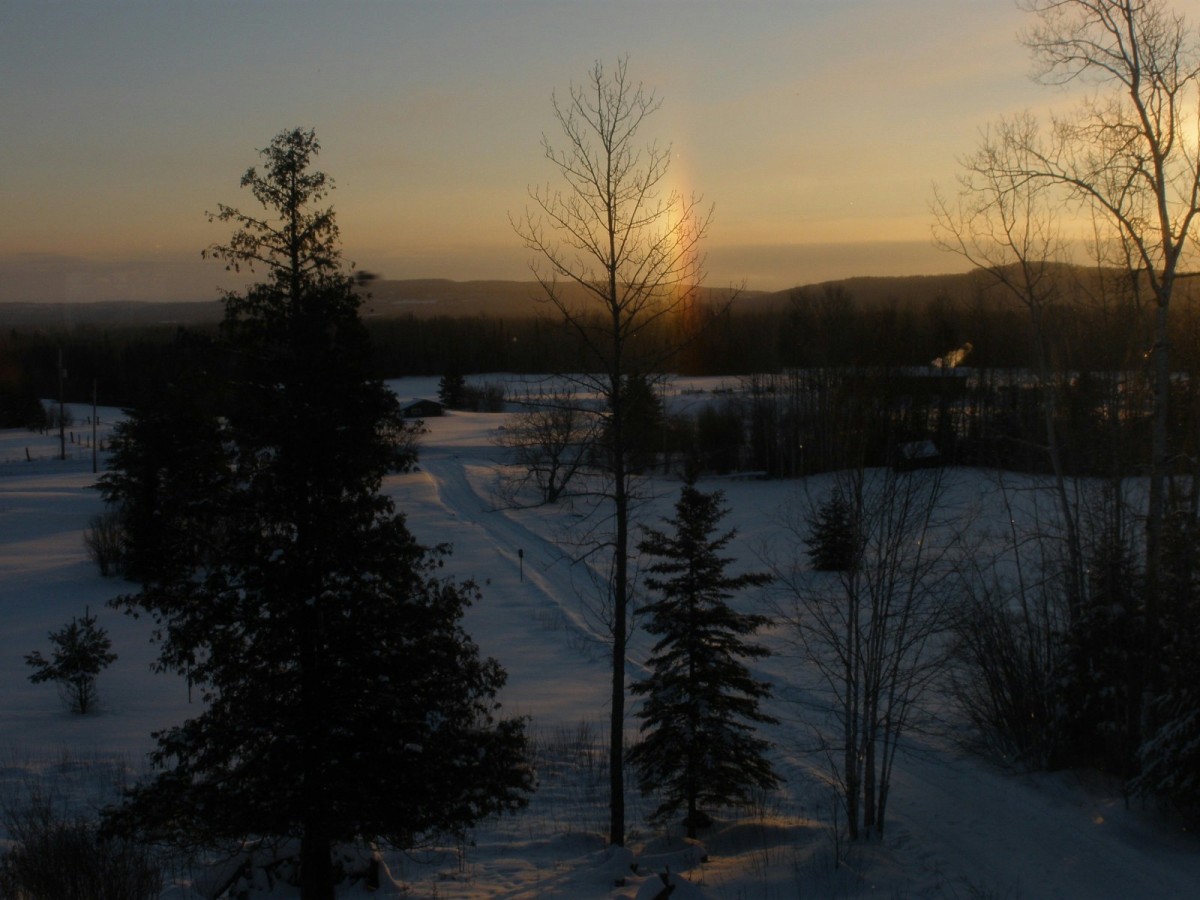
Beautiful sun dog in field this crisp morning

Sun Dog, Nolalu, Ont., 2011
This was the scene in front of our home in Nolalu, ON just after sunrise this morning.

The "sun dog" appeared to be right in our neighbor's field.

Sun dogs are created from light that is refracted by ice crystals in the air. You usually see them on either side of the sun when it is high in the sky. I've never seen one that appeared to be nearly on the ground before.

It was quite snappy here this morning, -20 C or -5 F.
Northwestern Ontario is experiencing what most of us would call normal winter weather this year. In Nolalu we have about 18 inches of snow on the ground. Nightime temperatures have been around -20 C and daytime -10 C or so.
Most people here enjoy such winter weather. We like to cross-country ski, snowshoe, snowmobile, down-hill ski and go ice fishing.
You just need to dress for the season. People who do find the winter an exhilarating time of the year. People who don't scurry in their tight jeans and leather jackets from the house to the car and back and thumb through catalogs for Caribbean cruises!

Click to go back to our website:


Click to see the latest on the blog:


Thursday, January 6, 2011

Top-down method of lighting a wood fire


Here's a great way to light a fire in a wood stove that works every time yet boggles the mind. It's called the top-down method.

Start with a few medium sizes of dry, split firewood. On top of that place 12-20 finely split pieces of kindling. You can criss-cross these into a few levels.

Next roll, cornerwise, 6-9 sheets of newspaper into tubes and tie overhand knot in each tube. Place these on top of the kindling.

Light the paper knots, close the door to the stove and completely open the draft control.
Leave the draft open while the kindling flares away and only close it to half way once the kindling has begun to turn to glowing embers and the main wood has begun to burn. Leave it that way until the stove is producing sufficient heat, then close the draft to 1/4 of its opening. That's where the stove will burn most efficiently, producing the most heat value from the wood.

This system seems upside-down compared to the traditional fire-starting method which is to put crumpled paper on the bottom, kindling above that and bigger pieces of wood on the very top.

The thought was that the fire from the paper burns upward and its flames ignite the kindling whose flames go upward and light the firewood.

The problem is that once the fire is lit, frequently the weight of the firewood will compress the whole works and snuff out the flames. Or, as the kindling burns down, the firewood shifts or rolls out of the burning pile and consequently the fire goes out. This never happens with the top-down method. Also with the traditional method many people leave the stove door open a crack so the "wind" of the air coming in carries the flames from the bottom to the top. This is highly dangerous -- sparks can jump out of the stove onto the floor of the cabin, and also if the stove is left unattended it can burn extremely hot.

So the top-down method is far safer and more successful to boot.

But how can it work at all? After all, the flames of each level of components don't even touch the next level.

The reason is wood just needs to reach a certain temperature to ignite. It doesn't need to "touch" the flames. The heat of the burning newspaper, reflected against the baffle plate in the top of the stove, radiates its heat to the kindling below which ignites and burns even hotter and then does the same thing to the firewood on the bottom.

Rolling the newspaper into tubes makes the paper burn longer and tying it into knots keeps it from falling off the top of the pile.

Here's a couple other wood stove tips.

Never add wood to a stove until it has burned down to coals. Then put in several pieces of wood of varying sizes rather than all one-size. The irregular shape of the woodpile in the stove makes it burn better.

Round, unsplit wood, burns slower and longer. It makes the best wood for keeping a fire overnight.

Incidentally, when burning wood in a stove, you must let the stove "cycle" through the burning process to properly consume the wood, heat the cabin, and make the stove operate efficiently.

This means letting the fire burn down to coals each time before adding more wood.

If you keep feeding in wood every time there's an opening in the stove, the stove never gets a chance to consume the creosote produced by the inefficient first-burning of the firewood. The glass door will become blackened with such creosote. That's a clue that you aren't doing things right. When you let the stove "cycle" the glass will stay clear.

At night, put in several pieces of wood, round ones if they're available, otherwise just larger pieces and close the draft entirely, and go to bed. The temperature in the cabin will fall. That's what is supposed to happen. It should be cooler at night. You should still be warm under your blankets and the cooler cabin air is great for sleeping.

When you heat with a woodstove the temperature continually rises and falls. It isn't like you were heating with a natural gas furnace that runs on a thermostat.

Even when the draft is closed at night there is a small opening that lets the fire burn slowly. This is the only time you should allow the fire to burn so slowly and inefficiently. In the morning, there should be some glowing coals left. Rake these into a pile and put 12-20 pieces of finely split, dry kindling on the top. Open the draft and soon the kindling will be blazing. When it has mostly burned down, put larger pieces of wood on top, close the draft to half-way and the cycle starts again.

Click to go back to our website:

Click to see the latest on the blog:

Sunday, January 2, 2011

Red Lake's walleye population is sky-high

Dan Baughman, 2010

Walleye were so numerous and aggressive on Red Lake, Ontario last summer, and for that matter, for the last several summers, that many times you could catch them virtually anywhere using any technique of fishing.


I caught and released this beautiful, chunky walleye last July while casting for northern pike in the middle of the day. It was one of several that I caught that afternoon, along with about a dozen pike.


I was using a 1/4-oz jig with a 3.5-inch salt-impregnated twister tail. I was also using a clip-on spinner on the jig turning it into a somewhat larger version of a Beetle Spin.


To catch walleye I would cast it parallel to the shore and let it sink to the bottom before retrieving it. For pike I cast it right to the shore or around weed patches. I was also using a six-inch black steel leader, something that would normally scare off walleyes.


Many members of my family caught walleye also while pike fishing that week. Most of them were using spoons like Little Cleos and spinners like Mepps and Blue Fox. No one was using bait.


While we were catching walleyes fairly handily with pike lures in shallow water in protected bays, other anglers were nailing them out in 16 feet on the edges of the deep bays.


The point is the walleye were just everywhere, at all depths, and biting virtually anything. (Of course the real walleye fishermen, using live bait like leeches and worms did far better than us pike fishermen and it is always advisable to use bait if you are targeting walleye.)


Although we normally catch almost nothing but big walleye at our western end of Red Lake, now we catch lots of small ones as well. It would seem there is a walleye population explosion.


You can easily just keep the perfect 14-16-inchers for eating now. In the past you felt guilty about bringing in a 22-incher for lunch but that was the smallest one you had caught all day.


There's still lots of 22-26 inchers out there and even some 28-30 inchers, but in addition now, there are schools of 9-18 inchers as well. In other words, there are more walleye than we have ever seen.


The reason for this bonanza isn't totally known but we have had a number of warm springs and early ice-outs in the last decade and this is known to make for spectacular walleye spawning.


Climate change here has meant ever-earlier ice-outs and perhaps, warmer water temperatures in our lake that has a great variety of water depths including some very deep, cold bays that didn't used to be so good for walleye.


At the same time the lake trout population has drastically declined. We know that is being caused by poor reproductive success and that too could be a result of climate change.


The trout seem to be coming back, however. as we are starting to catch small lakers again. (All trout must be released in Red Lake.)


However, they may have a hard time getting a foothold because, unbelievably, even their deep locations are now populated by walleye! Ministry of Natural Resources biology personnel, searching for little lake trout, have simultaneously found walleye inhabiting depths of water from 60 feet to the surface. They are just everywhere!


And the great variety in sizes means Red Lake is going to have incredible walleye fishing for many years to come!

Click to go back to our website:
Click to see the latest on the blog:

Friday, December 31, 2010

Stromatolites another reason Red Lake is special

stromatolite on Red Lake, Ontario
As I understand it, the earth was created about 4.6 billion years ago.


Then, about a billion years later, the first cyanobacteria (also called blue-green algae) appeared. They were single-cell organisms and the very first lifeform that could photosynthesize, that is, they could use the sun's energy to create carbon-based sugar and in the process produce oxygen. That oxygen was released to the amosphere which up to that point was mostly carbon dioxide and other gases.


The cyanobacteria became incredibly abundant, virtually covering the Earth, and over another billion years ended up creating the very atmosphere we breathe today.


They were so numerous when they existed that they created thick stringy mats that became fossils. Those fossils are called stromatolites.


There are three places in Canada where stromatolites are found. One is on Red Lake, in fact, right on the shoreline in front of Bow Narrows Camp and also other locations nearby.

The other two are Steep Rock Lake in Atikokan, Ontario, and near Yellowknife, Northwest Territories.


They are also found in Australia.


This photo, which was taken just down the shore from Bow Narrows Camp, shows the stringers of fossilized algal mats.
For more on stromatolites visit this website at Queen's University in Toronto.

Click to go back to our website:


Click to see the latest on the blog:


Wednesday, December 29, 2010

Check out West Red Lake Mining Museum

West Red Lake Mining Museum
map on museum sign

glacial erratic


Brian Kreviazuk
Make sure you check out the West Red Lake Mining Museum this summer.
This self-guided museum is largely finished after being under construction for several years.

It is located near the western entrance to West Narrows, only about half a mile from Bow Narrows Camp.

The log building is actually an original cabin from the 1926 Gold Rush to Red Lake which was the third-largest in the world. The cabin was formerly located at Bow Narrows Camp (our old Cabin 10) and was moved to the current site when the concept of the museum was first broached about seven years ago. Only one story of the original two-story structure was re-erected at the museum site.

The entire project was done by volunteers under the guidance of Brian Kreviazuk seen here repairing the museum's dock last fall.

The museum location was originally the home site of Bill Brown, Red Lake's first postmaster. He is buried on an island in front of the museum. If you look carefully you can see his headstone from your boat.

Back in the 1920s and '30s the west end of Red Lake was a hive of activity with many small gold mines in the area. Eventually everyone moved to the east end of the lake where the town of Red Lake is now situated. Almost none of the mines at the west end produced any gold while the ones at the east end were winners. Today the town of Red Lake boasts the world's richest gold mine, owned by GoldCorp, and there are new mines under construction.

It seems incredulous that the wilderness at the west end where Bow Narrows Camp is located was once inhabited by hundreds of gold rush pioneers. It is nothing but trees and bays and islands today. About all that remains are the rock piles from the mines and a few corners of the old log cabins.

There is also a large glacial erratic or boulder behind the museum that is a real stunner. The size of a house, it is one of the largest boulders ever discovered from the glaciers that covered this area 10,000 years ago.

As of last fall the museum contained old photographs of life in the area back in the gold rush. Photos are changed from time to time and other exhibits are planned next year as well.

There is no charge to visit the museum.

Although there is a large museum about the history of Red Lake in town, it largely ignores the mining history at the west end of the lake. The West Red Lake Mining Museum attempts to correct that oversight.

Click to go back to our website:


Click to see the latest on the blog:


Monday, December 27, 2010

How to prevent Gulp Alive jars from leaking

Gulp Alive lid
A lot of people have found Gulp Alive baits to work nearly as well as live bait; some say it's even better.

But everyone hates the smelly, sticky liquid that always leaks from Gulp Alive jars once they are opened.

The solution is not to take off the cardboard cover on the rim. In large baits such as Gulp leeches and Gulp worms, just make a double cross-slit across the surface of the cardboard, leaving the entire cardboard piece in place. You can just push your fingers through the cross-slits and get the bait.

In smaller baits such as these Gulp Alive waxworms which I like to use for perch ice fishing, you can cut out the inside of the cardboard leaving the cardboard over the rim. This leaves room for your fingers in the small jars to pick up the bait.

The cardboard acts as a gasket on this popular artificial bait's jars. If you take away the cardboard, the jars will leak.

Do Gulp Alive waxworms work for perch? Well, I've got to go clean a mess of perch right now and oh yes, a nice northern pike as well.
Click to go back to our website:


Click to see the latest on the blog:


Friday, December 24, 2010

Merry Christmas from us at Bow Narrows Camp

Brenda and Dan Baughman and Sammy dog
Brenda and I and our dog, Sam, wish everyone a Merry Christmas and Happy New Year.

Our wish is that you will all have a joyous and peaceful holiday.

Click to go back to our website:


Click to see the latest on the blog:


Tuesday, December 21, 2010

The balsam fir -- call it the first aid tree

balsam fir trunk
balsam fir blisters

Growing just about everywhere in the Boreal Forest are balsam fir trees.
Visitors to Bow Narrows Camp might know these from their massive number of branches, often covered in grey arboreal lichens known collectively as Old Man's Beard. The trees also have very pointed tops.

Balsams are also a favorite Christmas Tree and are sold for this purpose everywhere.

They have a wonderful fragrance and soft, flat needles.

Something that isn't as well known is that they also provide a great wilderness first aid salve for cuts.

The trunk of the balsam, especially older trees, is covered with bumps or blisters, and in each of these blisters is a clear sap. That sap makes a first-class antiseptic salve.

Take a knife blade or even just a sharp twig and puncture the blister. You'll end up with a drop of the sticky sap clinging to your blade or twig. Spread this on a bandage and place over the wound.

I've done this countless times and, in my experience, it works wonderfully. The wound heals quickly and never even becomes sore.

I first learned of this from old Bill Stupack, the prospector-trapper who first built Bow Narrows Camp. Bill spent most of his life living alone in the bush and swore there was nothing better for treating wounds.

One bitterly cold winter he was on his trapline at Prairie Lake, about 20 miles west of Red Lake, and accidentally cut himself badly on the head with an axe. He had been swinging the axe when it struck a branch and came down right on the top of his head, creating a large gash.

It was a 40-mile snowshoe to medical help (this was before snowmobiles) so that was pretty much out of the question. So Bill ended up stitching up the cut on his own with needle and thread. Then he found a balsam and cut a slab of bark to bring back in his little log cabin. He needed to thaw out the sap before it could be used. After plastering the sewn-up gash with balsam he bandaged it and made his plans to head to town. But then the weather took a turn for the worse and he ended up staying put for a week.

When the storm finally cleared Bill decided the cut was healing up just fine and took out his stitches and stayed another couple of months trapping.

They made them tough in those days.

Click to go back to our website:

Click to see the latest on the blog: