Thursday, December 16, 2010

Never use treble hooks for bait fishing

treble hook in stomach
Ontario Fishing Network

If there is one fishing regulation I would change it would be this: I would make it illegal to use treble hooks for fishing with live or dead bait. The reason is it kills so many fish.

We still have fishermen who use treble hooks when dead bait fishing for northern pike, especially in the spring.

Most of them say they know exactly when to set the hook so that the fish doesn't swallow it and end up dead.

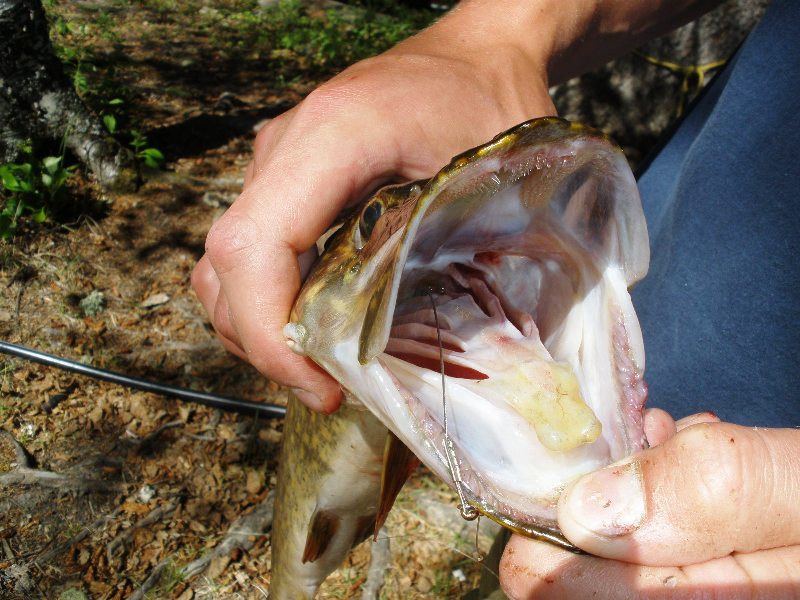
The photo above tells a different story. It is a pike taken on an artificial on the second day of the season and already someone had caught and lost it leaving a treble hook in its stomach and leader hanging out its mouth. This fish was doomed anyway if this angler hadn't kept it. Fortunately, it was of legal size.

How many fish are hooked in the stomach and released because they are in the slot size?

We catch quite a few pike each summer with treble hooks protruding through the walls of their stomachs. Fish with single hooks inside them are usually fine. The single hook doesn't poke a hole through the stomach lining. But with a treble two or all three of the hooks will work their way right through, eventually killing the fish.

It's all so needless. With a quick strike rig the hook can be set the instant the fish takes the bait. There is no reason to let the fish "take it" before setting the hook. That's because there are two hooks on the rig, a single hook in the front of the bait and a treble hook in the center. If the bobber goes down there is a hook in the fish's mouth-- set the hook immediately -- before the bait is swallowed.

With a circle hook you can let the fish swallow the bait a little, then slowly pick up tension on the line by reeling and as the circle hook comes sliding out of the fish's mouth, it catches it right in the very corner.

Both methods allow you to safely and humanely release the fish.


Click to go back to our website:


Click to see the latest on the blog:


Sunday, December 12, 2010

Burlap bag simply the best for keeping fish

burlap bag or keep sack
Angler Steve Wilhelm brings some fish in a burlap bag to the fish house at camp last summer.

We have used burlap bags for keeping fish for 50 years now at Bow Narrows Camp and my great-uncle Bill Baughman used them at his camp, Rainbow Lodge on Pickerel River, Ontario, for nearly as long before us. So collectively we have been using the bag system for keeping fish for nearly 100 years. And we've never seen anything that worked better -- not stringers, not mesh baskets and not livewells.

Did you ever notice how it's the simple things that work best? Well, there's nothing simpler than this.

Here's how the system works. Dip the bag (also known as a keep sack) in the lake to get it wet. Put the fish in the bag and lay it on the bottom of the boat. The evaporation of the water from the bag produces a cooling of the fish. It's the same principle of the old cowboys' blanket canteens.

You can keep fish in excellent shape this way all day. Just dip the bag back in the lake if it dries out.

Although it seems counter-intuitive, it's actually a bad idea to keep fish alive once you've decided to keep them. For one thing, keeping fish on stringers or in livewells will make them excessively slimy. This is because the mucus on their skin needs to be continually washed away by the fish's swimming forward.

A lot of the stereotypes people use about northern pike comes from the fact they kept their fish on stringers. I've seen pike kept overnight on a stringer that seemed to be encased in a mucus-gelatin. They had to be blasted with a hose and let dry in the sun for several hours before they could be cleaned.

Fish in the bag never get this way. They are clean and cold and not slimy.

Fish kept on stringers and in livewells also get water-logged. Their stomachs are full of water when we clean them and their flesh is soft. Again fish in burlap bags are not like this. Their flesh is as firm as if it had been kept on ice.

When you keep fish on a stringer you also stand a good chance of losing them. I wish I had $10 for every time someone using a stringer lost the entire stringer overboard or forgot to bring it in the boat and the propeller chopped up the fish or another fish "ate" the fish on the stringer. It's just not a good idea.

We've tried other types of bags and have found that only the burlap "potato sacks" work. Burlap is organic and is absorbent and this has something to do with it. On the downside, burlap decays quite rapidly so we must get new bags about three times a summer.

If you are new to camp, there is a supply of bags on the drying line beside the fish house. When you bring your fish to the fish house for cleaning, you can leave your bag in the cleaning bins with your cabin number and grab another bag to take back to your boat.

Click to go back to our website:


Click to see the latest on the blog:


Thursday, December 9, 2010

Studies find walk in the woods really is good for us


I really like walking in the woods, and so does Sam, our dog, and I can vouch that that there is something therapeutic about the experience.


Now medical research has proven the connection. Walking in the woods is more beneficial to our minds and bodies than just walking along the road or street or in a gym.


John Swartzenberg, MD, chair of the editorial board of the University of California, Berkeley Wellness Letter, reports in the December issue that "green exercise" pays big dividends.


Tests have shown people have better memory and attention when hiking in the woods compared to indoors. Hiking lowers stress, blood pressure and heart rate and improves immune functions better than does exercising at a gym.


Researchers also found a "third-day effect" where after a few days of hiking people attain a special stage of relaxation and mindfulness.


We've seen something similar with our guests at Bow Narrows Camp. It was my father, Don, who noticed that people who come fishing for just three days, rather than a week, never have a very good time. He was right. As proof of this, three-dayers almost never return to camp whereas the vast majority of week-trippers do. Once we realized what was going on we started not taking the three-day guests. After all, we want people to enjoy themselves.


Although the medical studies didn't analyze fishing trips for their benefits, I think the situation is the same. When we're off in the woods on a fishing trip we reach a state of deep relaxation. No doubt some of this is because we're out of range of cell phones and e-mails. But there's more to it than that. It really does seem to come from the fact we are physically outdoors.


After a day or two of of not hearing street noise, we become absorbed in the natural sights and sounds around us. The calls of birds and the whistling of the wind through the pines occupies our attention and our thoughts turn to what a great world this still is.


Click to go back to our website:
Click to see the latest on the blog:

Wednesday, December 8, 2010

Northern pike are feasting on crayfish

O. virilis crayfish in Red Lake
Creme Lure tube

Creme lure tube


Creme lure tube


It might surprise you to know that a big part of the diet of northern pike in Red Lake is crayfish!

We find crayfish in the stomachs of a great many pike that we clean for our guests. Of course, crayfish don't digest as easily as minnows and other softer prey so they linger longer but still, there's no doubt that pike do eat this crustacean.

A careful examination of these crayfish last summer indicated they are all the native species of crayfish which is Orconectes virilis and not the invasive species O. rusticus or rusty crayfish that have gotten into a great many lakes in Wisconsin and Minnesota and other places.

It is not a good idea to use live crayfish for bait for fear of transferring invading species to new lakes. However, there is an artificial bait favored by bass fishermen that is known to imitate crayfish and that is the tube jig.

If you want to try something new next summer, bring some tube jigs in 4-5-inch size in various colors and work these around rocky shoals, points and entrances to narrows.

If you are unfamiliar with tube jigs they look like a regular jig but have a bullet-shaped head that allows a hollow plastic tube to fit over the top.

Pike are well-known to hit regular round jigs, either bucktail or with plastic twister tails.

The tube jig differs in that it is entirely covered by the tube. It's a bit slower to fall through the water and often spirals which could imitate a dying fish or swimming crayfish.

To fish a tube jig for pike, cast it out and let it sink to the bottom. Give the rod a slow jerk and let the jig fall back to the bottom while you reel in your slack line. Repeat the process until your lure is all the way back to the boat. You can also just reel the jig right in but with the occasional pause or twitch of the rod.

Crayfish like to hide in crevices of rocks and in boulder piles so those locations would be good places to try the tube jig.

Weight of the jig head makes a big difference on the jig action. Light jigs fall more slowly and so must be given more time between jigs. Try 1/8, 1/4 and 3/8-ounce sizes.

Click to go back to our website:


Click to see the latest on the blog:

Tuesday, December 7, 2010

Put your Canadian tax rebate toward your deposit

If your bank refuses to cash your Canadian tax rebate check from your trip to camp last summer or is going to levy some outrageous service charge for cashing it, then just send it to us as part of your deposit for next summer's trip.

Depending on when you came to camp last year that rebate check could be as much as $55.90 if you came on the American Plan and $42.25 on the Housekeeping Plan.

The rebate was larger after July 1 last summer. It amounted to 6.5% of the cost of your trip.

The rebate was only offered to non-Canadian visitors.

We require a deposit of $100 per person to hold your reservation. If you want to include your rebate check in your deposit then just send us a personal check for the remainder of the $100.

Finally, make sure you sign the back of your rebate check. We are not able to deposit it without your signature.

You can also send us your normal $100 deposit plus your rebate check and we will put the entire total towards your trip.

As always, your deposit is fully refundable upon 60 days notice of cancellation.

We also have guests who prefer to pay for their entire trip in advance. If they need to later cancel then we refund the entire amount if they give us 60 days notice and refund all but the $100 if less than 60 days.

Click to go back to our website:
www.bownarrows.com
Click to see the latest on the blog:
www.bownarrows.blogspot.com

Wednesday, December 1, 2010

Do northern pike suspend? Yes, sort of.

Red Lake northern pike
I'm sure Bow Narrows angler Carl Cieplik didn't catch this beautiful northern pike by trolling over deep water. He almost certainly was casting along the shoreline and weedbeds.

But I have known of other anglers who "accidentally" caught pike, including some whoppers, by doing that very thing -- trolling lures that run just below the surface in waters that were 20-100 feet deep.

Usually these fishermen never expected to catch anything in these conditions; they were just moving from one island to another and didn't want to reel in all their line.

I don't know of anyone who caught many pike at one time doing this. Usually it's just the one.

So while its not a recommended way of fishing for pike -- just about all of them are along the shorelines or at least are on the bottom in deeper water -- it is possible.

In a way, I don't think these fish are suspended. Rather, they are cruising just below the surface.

Many times on dead calm days I've seen schools of fish, some of them pike but mostly lake trout, whitefish and tulibees, that have "pinned" a cloud of baitfish against the surface.

This phenomenon is called a "bait ball" by ocean fishermen.

There are also usually sea gulls, terns and loons taking part in the action. In fact, that is what you'll notice, all the bird activity out in the middle of the lake. They will spook when you are about a hundred yards away but you can then cut your motor and idle or paddle up to the bait ball. Usually you can catch three or four fish before either you scare everything away or you lose the location in the featureless center of the lake.

If you want to try something new when fishing at camp next summer, try trolling out in the big water on a day when the lake surface is like a mirror. Let out a lot of line, 100 feet or more, and use a shallow running stick bait such as Rapala. Try something that will stay within 12 feet of the surface.

You might just find a school of fish or big loners that are looking for bait fish that show up easily from below against the mirror surface.

Click to go back to our website:


Click to see the latest on the blog:


Monday, November 29, 2010

Scene helps deal with loss of our friend


We just learned we lost a good friend over Thanksgiving.

We're getting to an age now where we've lost quite a few friends as well as all of our elders.

That doesn't make it any easier.

I find some solace in this photo of a stump behind our home.

Where once a mighty tree had stood, now a young sapling grows. Life didn't end here.

Click to go back to our website:


Click to see the latest on the blog:


Saturday, November 27, 2010

New Invisaswivel might be useful for walleye

Invisaswivel
A new, fluorocarbon swivel could be handy when walleye fishing this summer.

Called the Invisaswivel, it is said to be clear and strong.

Walleye are spooked by just about anything metal so I'm thinking this product could be just the ticket whenever you need to use a swivel such as when trolling walleye spinners.

You can also eliminate line twist when jigging for walleye by putting a swivel a couple of feet ahead of your jig.

Check out the Invisaswivel yourself.

The website is: http://www.aquateko.com/

Click to go back to our website:


Click to see the latest on the blog:


Friday, November 26, 2010

Village Corner in Vermilion Bay is no more

Village Corner, Vermilion Bay
If you're like me you always made a stop at the Village Corner in Vermilion Bay on the way up to Red Lake. It was on the corner of Hwy. 17 and Hwy. 105 (the Red Lake road).

Well, the Village Corner caught fire and burned down last fall. I haven't heard if it will be rebuilt but I imagine it will, probably not before next spring, however.

The Village Corner was a busy place. It had a gas bar, terrific tackle shop, restaurant and some other shops. It was also the bus stop and a favorite truck stop.

If you need to get gas in Vermilion Bay now, you need to go farther west on Hwy. 17. Famous Bobby's sells gas and is also a great tackle and bait shop.

Click to go back to our website:


Click to see the latest on the blog:


Tuesday, November 23, 2010

Our 2011 fishing package rates same as last year

View from the lodge
Here's some good news!

Our fishing packages in 2011 will cost the same as they did in 2010. In fact, they haven't changed for the past three years.

Our goal is to always offer a premium-quality vacation at the most affordable price while still making continuous upgrades and improvements to camp and our equipment.

In 2011 we will have all electric-start Honda outboards and a couple of new Lund boats.

Last season we installed a massive state-of-the-art septic system for the entire camp that uses peat moss as a biofilter. We also rebuilt all of our crib docks.

The year before that we put in a large water filtration plant that provides delicious safe drinking water to every tap in camp. We also rebuilt our boathouse.

We've got some cabin remodeling in mind for this coming season.


Click to go back to our website:


Click to see the latest on the blog:


Friday, November 19, 2010

How big a tree will a beaver cut down?


Our grandsons Quillan and Raven marvel at the work of North America's largest rodent near camp this fall.


The beaver that had been working on this quaking aspen was going to need more than one night to do the job.


These animals only eat the bark from the trees and prefer the new growth on the limbs rather than the tough bark on the trunk. This tree just had a few branches, probably 60-70 feet off the ground.


I knew a wildlife researcher who was able to show that beaver are able to calculate the work that must go into cutting down a tree compared to the nutrition they will gain from it. When beaver first move into an area they cut down small to medium-sized trees, bypassing big old trees like the one in this picture. Eventually, when there is almost nothing left, they take the time to gnaw down the big projects.


They will go about 100 feet away from the water to get trees. In this photo all the smaller trees in the background are white birch. These aren't favored by beaver as long as there are aspen, alders and willows to eat. But when it takes too much work to get their favorite food, they'll turn on the birch too.


Beavers are as common around camp as are robins in other parts of the world. We see them every evening swimming around the docks.


Although beaver run afoul of humans because of their tree cutting, many other creatures appreciate the beaver's hard work.


They create clearings in the forest where new growth will sprout and provide food for herbivores like moose and deer. Ruffed grouse like to eat rosehips that grow on wild rose bushes in these spots. In winter, snowshoe hares nibble on the stems of the young aspen that will spring up from the roots of the old tree.


Click to go back to our website:
Click to see the latest on the blog:

Wednesday, November 17, 2010

A great day to take a ride aboard the Lickety Split

One mile to Middle Narrows
Looking back at Wolf Narrows

These were the views out the bow and stern of our camp trip boat, the Lickety Split, during a calm day on Red Lake, Ontario, last summer.


Such mirror-like water is a pleasure to make the 20-mile journey in although it's not a favorite with our fishermen. They prefer a little "walleye chop."


The Lickety Split can make the voyage in nearly all weather. One type of weather system we do avoid is the thunderstorm. If we encounter one during the trip we simply go to the safety of the shoreline and wait until it passes. But normally we can time our departure at the dock to avoid thunderstorms altogether.


"A sudden storm is soon over," is the old adage and a good one. Waiting-out a thunderstorm normally means just a 15-to-30-minute delay.


In most conditions the Lickety Split can take nine people and their gear to camp or back to town in just 35 minutes. In rough water, however, the trip can take twice that long as it is necessary to slow down and sometimes to follow alternate routes.


We always see loons and eagles during the voyage and sometimes are lucky enough to spot swimming moose, deer and black bear as well.

Click to go back to our website:


Click to see the latest on the blog:


Tuesday, November 16, 2010

I've got to get one of these 'diesel deer forwarders'


Our son Matthew uses his diesel Kubota tractor to take out a nice buck from the woods.

My brother-in-law Ron got this 10-pointer.

I've been concentrating on deer hunting since we got home from camp and have seen a bunch but I'm waiting for "Mr. Big."

Click to go back to our website:


Click to see the latest on the blog:


Monday, November 15, 2010

The beauty in small things

fritillary butterfly at Red Lake, Ontario
This fritillary butterfly resting on the weathered wooden step of one of the buildings at camp caught my eye this fall.

It's amazing the detail delivered by the macro mode of small pocket cameras. I used an Olympus FE 340 which is about the size of a deck of cards.

Click to go back to our website:


Click to see the latest on the blog:


Thursday, November 11, 2010

How to temporarily paralyze a walleye

paralyzed walleye
Gently push forward the walleye's pectoral fins (they're the ones on the side near the head) and a walleye absolutely cannot move. It's as if the fish was paralyzed. It will sit motionless on your hand until you allow the fins to flip backwards again.

You can use this little trick to amaze your friends next summer.

First say that you are going to put the fish into a deep trance.

Look deeply into the fish's eyes, all the while saying the magic words, "balloon ball, balloon ball."

Then stretch the fish out on on your palm (with the fins pushed forward).

Incredibly it will lie motionless.

Then, with the other magic word (and a slight shifting of your hand away from the fins), "Shazaam," and the fish comes back to life and jumps into the water.


Click to go back to our website:


Click to see the latest on the blog:


Tuesday, November 9, 2010

Walleyes brilliantly colored in 2010

golden walleye
Not only were walleyes especially plentiful in 2010, they also seemed exceptionally beautiful.

Check out this beauty held by Bow Narrows angler Jason Pons.

Was it just me or were the walleyes actually a deeper hue of gold last summer?

Comments anyone?

Click to go back to our website:


Click to see the latest on the blog:


Sunday, November 7, 2010

Great feeling to have next summer's wood ready


Our son Josh was at camp for a couple of weeks this fall and he managed to split, stack and cover what should be next year's supply of firewood.

Here he stands amid some of the 10 cords of aspen firewood.

The trees were felled by the crew that installed our new septic system last spring. September was the first occasion we had to buck-up the trees into stove lengths.

In the Boreal Forest we don't have the great firewood species of trees that most of our guests from the States enjoy. We simply burn whatever is available. For years following a spruce budworm infestation, we burned balsam fir because there were dead, dry balsam all around the camp. It has about the lowest heat value but the standing trees are an extreme fire hazard so we had to get rid of them.

When we go looking for firewood by boat we usually get dead standing jackpine or white spruce.

Quaking aspen such as the huge pile split up by Josh burns about as well as pine or spruce. But it always must be cut green and then split and dried. You never find a dry aspen on the stump. Dead trees are always punky.

White birch is our species with the most heat value but it also must be cut and dried for at least six months before using. The birch bark is very resistant to rot and is also waterproof (that's why it was used by the native people for canoes.) You can find hollow lengths of birchbark in the forest where the tree has fallen down, it's inside rotted away and nothing is left but the bark.

Click to go back to our website:


Click to see the latest on the blog:


Thursday, November 4, 2010

Thanks to our great staff of 2010!


The Year of 2010 was one the busiest seasons we have ever had; yet, it went off like clockwork thanks to our talented and hardworking staff.

This photo was taken as the three staffers left in late August. I was unable to upload it to the blog at the time due to our Internet connection problems.

The three staffers in the Lickety Split with Brenda and I are Landon Broennle, Kristina Belanger (next to Brenda) and Emilie Godin.

The trio were on their way to catch a Bearskin Airways plane for Thunder Bay.

You can't quite see it in the photo but Kristina and Emilie were wearing black rubber boots. That was because they had reached the airline's baggage weight (and space) limit and they still hadn't packed their trusty boots. So they simply wore them home, even though it was a pleasant day!

That kind of aplomb was typical for these three. Nothing got them down or frustrated them.


Click to go back to our website:


Click to see the latest on the blog:


Tuesday, November 2, 2010

The season is over and we're home

Late October sunrise Bow Narrows Camp on Red Lake, Ontario
Brenda, Sam and I are back home again.

We pulled out of camp a week ago and spent most of last week in Dryden where we attended the annual conference of Nature and Outdoor Tourism Ontario (NOTO).

We also had to make two trips to our home in Nolalu and one extra trip back to Red Lake to ferry all of our belongings including a bull moose and a wood chipper.

Now that I'm back in the world of high-speed internet I find I can upload photos to the blog again. It would seem our clunky telephone connection at camp was finally just too slow to communicate anything other than text. This may mean we will need to install a satellite system next season.

Anyway, we're home now and I can update the blog regularly again.

The photo above was taken the morning we left camp. I think sunrises are even more beautiful than sunsets. Their color changes by the second.

It was good we left camp when we did because the next day saw something resembling a hurricane strike the entire region. There were winds of 80 kmh (50 mph) and rain that came down in sheets for the entire day. We could barely stay on the road as we drove the moose meat down to Nolalu.

Click to go back to our website:


Click to see the latest on the blog


Friday, October 1, 2010

Lake trout spawning project a success

Ontario Ministry of Natural Resources crews left here yesterday after gathering 100,000 or so lake trout eggs. The eggs will be raised in the OMNR fish hatchery in Dorion, near Thunder Bay, and the fingerlings released back to Red Lake in 18 months time.
I believe this is the eighth year of this project which is intended to ensure Red Lake continues to have a viable lake trout population while researchers determine why the fish cannot successfully regenerate in Pipestone Bay.
It still isn't clear why they cannot reproduce there. So far we've learned that the fish are healthy, the water is pristine but there seems something about the sediment that kills the trout eggs. It was thought that manganese, a naturally occuring metal that is present in the very rocks where they spawn, might be the culprit but that is now not so certain.
Even if it was the problem the scientists are stumped why it didn't affect the trout eggs in the past. There is also some evidence that the problem might be slowly going away. Many of the fish being caught for the spawning project are relatively young, perhaps 8-12 years old. The poor spawning record of the trout seems to have begun in the 1980s. The presence of the young fish means trout are successfully spawning somewhere. But the lake trout population continues to be just a fraction of what it was 20 years ago.
Fishing regulations require all anglers to immediately release lake trout on Red Lake. They must also use lures with single, barbless hooks when targetting trout. Barbed and treble hooks are OK when fishing for other species.
Although the bulk of the OMNR spawning crew left camp on Thursday a small group stayed behind to catch more trout whose eggs will be reared in incubation boxes that are placed in various locations around Red Lake. The eggs inside the boxes will hatch this winter and the hatchlings can swim free out into the lake. It is hoped they will imprint on the shoals where the boxes were placed and come back there to spawn when they become mature. In this way the trout could be encouraged to spawn somewhere other than Pipestone Bay which is the only location they are unsuccessful.

Click to go back to our website:
http://www.bownarrows.com/
Click to see the latest on the blog:
http://www.bownarrows.blogspot.com/