We've just received great news!
The Foreign Convention and Tour Incentive Program, known simply as the federal tax rebate to our guests, will apply to one-half of the new Harmonized Sales Tax (HST).
This is an increase of 38% and means our fishing packages, after the rebate, will cost even less than last year!
Here's how it adds up (all figures are Canadian funds. The cost in U.S. depends on the exchange rate but will probably be slightly less):
Our American Plan package costs $860, the same as last year. With the new 13% HST the total is $971.80. The rebate recoups half of the HST; so, the rebate will be $63.17. The net cost of the package then is $908.63.
Last year the package was also $860 but with the combined provincial and federal taxes came to $957.61; however, the tax rebate only amounted to 2.5% for a total of $22.71. The net cost then, for last year, was $934.90.
So our American Plan customers this year will end up paying $26.27 less than they did last season once they receive their tax rebate.
Likewise guests coming on the Housekeeping Plan will pay $18.93 less after receiving their new rebate of $47.74.
The new HST begins July 1, 2010. Guests coming to camp before this date fall under the old system and will pay the old taxes. The previous taxes amounted to two per cent less on our packages but then the tax rebate was also less. So guests coming before July 1 pay exactly what they did last season.
Bow Narrows Camp fishing packages meet the criteria for the tax rebate and our business has been pre-approved by the tax authorities for our guests receiving the rebate.
With rebates of $63.17 for American Plan and $47.74 for Housekeeping Plan, you can't afford to forget to apply.
We will give you the form for the mail-in rebate when you pay for your fishing package at camp. You must fill it out and mail it along with your original invoice once you get home.
Click for previous HST blog information.
Click to go back to our website:
http://www.bownarrows.com/
Click to see the latest on the blog:
http://www.bownarrows.blogspot.com/
Monday, December 14, 2009


Saturday, December 12, 2009
Johnson Silver Minnow -- ultimate weedless spoon

When it comes to pulling a spoon through weedbeds for northern pike, nothing beats a Johnson Silver Minnow.
This old-time favorite will come not only through the weeds but also through trees, rocks and just about everything else.
The key is to keep that adjustable weedguard turned up so it is just above the single hook. This deflects the weeds but bends down when smacked by a pike.
I like the red-and-white, silver and gold colors best but it's worth getting this spoon in many colors.
You can make this lure about a hundred times more effective by adding a trailer to the single hook. As the photo shows here, my favorite trailer is a plastic curly or twister tail.
This is hooked through the side of the plastic worm, not skewered on like you would with a jig.
The tail needs to be positioned so it is exactly in the sternmost curve of the hook to give the lure its fantastic wiggle that pike find irresistible.
This lure should really come with its own hook sharpener because if you don't keep the hook needle sharp you will miss most hook-ups when a fish strikes. In fact, if you are getting strikes and not hooking fish you always need to sharpen your hooks with any lure.
Retrieve this lure so it develops its maximum wiggle -- too fast and it just spins, too slow and it comes in like a little underwater boat.
Always keep your rod tip low on the retrieve. This makes the lure run deeper.
You also need to really set the hook when it is struck by a fish since you must sink that single hook into flesh.
But that single hook is also a great advantage of using this lure. You can quickly remove it from the fish's mouth and get back to casting for more.
Click to go back to our website:
Click to see the latest on the blog:
Tuesday, December 8, 2009
What is the best size of walleye to eat?

A conservation concept that has really taken hold is the knowledge that there are certain sizes of fish that should be kept and others that should be released.
Bow Narrows angler Paul Stowick holds up a great eating-size walleye in the photo above. It's not too big but has plenty of meat.
In short, big fish should always be released. They are the top breeders and carry the genes for fast growth and large size that we all want to see passed on to other generations of fish. Every time you release a big fish you are helping build a healthy fish population.
In walleyes, it's best to release all fish over 18 inches even though Ontario fishing regulations allow you to keep one that big or larger. I think the intention of the regulations was to allow an angler to keep a trophy for mounting purposes.
However, the truth is the fish replicas that all taxidermists now produce are far superior to a real-skin mount. They look better and they last forever, unlike a natural skin mount.
All the angler needs to do is measure the length and the girth and take a photo. The big fish can then be released.
Still, no one would begrudge an angler for wanting a memento of a once-in-a-lifetime fish and the thrilling fight it put up.
The problem comes from some fishermen who use the one-over 18-inch rule to just keep the heaviest fish possible for eating. This harkens back to the day when anglers proved their prowess with great stringers and coolers full of fish. That day passed away about 20 years ago but a few people haven't heard about it. Today's anglers want great fishing, not the slaughter of as many fish as possible.
Besides it being unhealthy to fish populations to keep big fish, it's also unhealthy to the angler.
Fish bio-accumulate natural and man-made toxins from the environment. The bigger the fish and the longer it has lived, the greater the level of these toxins. This is true for every water body on Earth, from ponds to oceans.
So getting back to walleye, what is the best size to eat?
I would say 14-18 inch walleyes are about ideal. One fish of this size will easily feed one person.
Walleyes smaller than 14 inches just don't have much flesh on them but from a conservation standpoint it would be better to eat two small walleyes than one over 18 inches.
Walleyes reach sexual maturity at 18 inches. So keeping one 18 inches or larger removes one from the breeding population. Keeping smaller fish isn't as detrimental because many of them wouldn't make it to sexual maturity anyway. In Red Lake a lot of them end up as food for giant northern pike and even lake trout.
Walleyes under 18 inches also cook better than large ones; their fillets are thin enough to cook evenly whereas on big fish you need to over-cook the thin portions of a fillet in order to cook the thickest section.
Man, I can almost smell those fillets cooking right now!
Click to go back to our website:
Click to see the latest on the blog:
Wednesday, November 25, 2009
Do we become slaves to our technology?

Most people would call this a depthfinder and they're common sights at Bow Narrows Camp. In fact I would say the majority of our guests bring them.
But to some people, it's a fishfinder and that's what they try to do with it, find fish.
The difference is that the first group goes fishing and uses the depthfinder to fish at a particular depth. The second group goes driving around looking at the fishfinder to tell them where to fish.
There's not much difference between the two when the fish -- read this, walleyes -- are at 16 feet or deeper because then they show up on the depthfinder/fishfinder.
The problem arises when the fish are shallower than that which they usually are on Red Lake for the first couple of months. The guys with the fishfinders can't find anything until they get over deep water, then they can see fish. There they are, schools of fish suspended half way to the bottom in 50-100 feet of water. They then try everything in the tacklebox but with no success. That's because those lovely marks on their screens are tulibees, not walleyes. Tulibees are lake herring and can be difficult to hook.
The walleyes are back in the shallow bays on the windy shores in probably 8-12 feet of water. Anglers who went trolling at this depth, perhaps using their depthfinders as a guide, did well. The guys with the fishfinders didn't even try there because they "didn't mark anything."
The fish were there; they just didn't show up on the fishfinder either because the transducer "cone angle" was too narrow in the shallow water or because the fish moved away from the boat momentarily as it passed overhead.
For people who are "hooked" on using a fishfinder, I suggest they come from mid-July to the end of the season because they will be able to "see" walleyes on their fishfinders. There will be some in the shallows that they can't see, especially from mid-July to mid-August, but there will be some in the deeper places too.
If you don't think there are people addicted to using fishfinders, consider the following.
We once had a guest who was a lake trout specialist and who returned home to the Midwest without even attempting to fish at camp when he discovered that one of his four on-board fishfinders wasn't working. True story.
Click to go back to our website:
Click to see the latest on the blog:
Monday, November 23, 2009
Many reasons to give thanks for 2009

Since it is almost Thanksgiving Day in the U.S. (in Canada we celebrate Thanksgiving in October) I thought I would recall a couple of our major blessings at camp for 2009.
The first is our guests.
You know, on our website there is a page called Who We Are and it only talks about Brenda and me and my father, Don. But it should really talk about our guests as well.
Many of these people have been coming to Bow Narrows Camp for nearly as long as us. They have seen hot summers and cold ones, wet seasons and dry, spectacular fishing and tough fishing, forest fires, northern lights and meteor showers and everything else that comes from taking an outdoors vacation in the North. We look forward to seeing them and enjoy their company as much as we do our own families.
Sadly a couple of these friends passed away this year. We will miss them terribly. All we can do is to be thankful for the time we did spend together.
Our other major blessing in 2009 was our wonderful staff.
Nothing makes me as optimistic about the future of the world as knowing there are young people such as these coming up in it.
They had a work ethic that nearly wore me out, were quick learners and resourceful. They were cheerful in the wettest weather we have ever seen and they were just lots of fun.
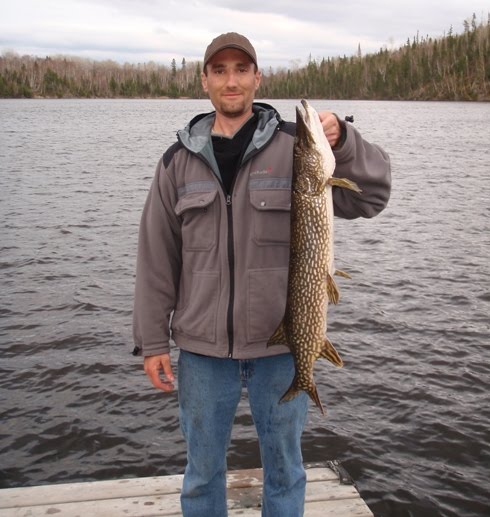
In the top photo are, from left, Emilie Godin, Ben Godin and Jenn Bucci. In the bottom photo is Joe Cox.
It isn't necessary to be a good fisherman to work at camp but as these photos show these staffers knew how to use a rod and reel.
Those four were our main staffers but others who worked at camp for shorter periods in 2009 were our son Josh Baughman (he rebuilt the boathouse in June) and Jeremy Baldwin and Rosalie Tilley who worked at camp in September. They were all excellent, hard workers and we thank them all.
We also thank our brother-in-law Ron Wink for taking a week in June to help us wire our new water treatment plant and Brenda's brother Gordon Cooper for helping us with some surveying tasks.
We are also fortunate to have so many wonderful merchant and service providers in Red Lake such as the folks at Red Lake Marine, Sobeys Supermarket, Scotia Bank, Green Airways, Viking Outposts, Mike Litwin's PetroCanada, Home Hardware and Northwest TimberMart, to name a few.
Finally, we are grateful for our good friends at the Ministry of Natural Resources whose jobs are to protect the very resources that we count on for a living.
All of these people and many more really deserve to be on the Who We Are page.
Click to go back to our website:
Click to see the latest on the blog:
Thursday, November 19, 2009
It looks like an El Nino winter ahead

Virtually all of Canada including Northwestern Ontario is experiencing record high temperatures this November, apparently the result of El Nino, the cyclical warming of the Pacific Ocean west of South America.
This typically happens every 4-6 years but this time around it seems more pronounced than normal.
Daytime temperatures in Northwestern Ontario should be around the freezing mark but instead are 6-10 C (40-50 F).
The weather during a normal El Nino winter in Northwestern Ontario is warmer and often snowier than other years. So far this winter it is much warmer but quite dry. This is particularly welcome after our wet summer last year.
It should be a boost to fish populations as it will mean at least one extra ice-free month. El Nino is also kind to animals since they don't need to expend as much energy keeping warm.
I've got my fingers crossed that it will also lead to an early ice-out next spring. Once in awhile the ice goes out in Red Lake in late April instead of early to mid-May. This is a god-send to us at camp as it lets us get to work mending docks and doing other maintenance before the fishermen arrive. It also almost always leads to spectacular walleye and northern pike spawns.
Click to go back to our website:
Click to see the latest on the blog:
Tuesday, November 17, 2009
Consider Lake Superior route to or from camp


If you've never travelled the highway around Lake Superior you might consider adding it to your itinerary when coming or going from camp this summer.
In most cases it will add at least a few hours to your trip but it's one of the most scenic routes in the world and it's a shame if you've never seen it.
Just about all of our American guests cross the border at International Falls/Fort Frances and then proceed to Red Lake on either Hwy 71 going west and then north to Hwy. 17, or they go east and north on Hwy 502 to Hwy 17. They then go to Vermilion Bay where they turn on to Hwy 105 which ends at Red Lake.
Let's be clear, these are the fastest ways to get to Red Lake. And of these two, the Hwy 502 route is perhaps 30 minutes quicker than going via Hwy 71.
These routes also have beautiful scenery in the form of woods and lakes. But you don't see vistas that go on for dozens of miles like you do if you drive around the shore of Lake Superior.
On the west side of Lake Superior you would take Hwy 61 from Duluth to Thunder Bay, then Hwy 11-17 to Vermilion Bay (Hwy 11 splits off towards Atikokan on the way).
Here you drive right next to Lake Superior as well as along cliffs and through tunnels. There are a bunch of quaint little towns on the way including Grand Portage Lodge and Casino and Grand Marais, Minnesota.
You then cross the border at Pigeon River. It's a much smaller border crossing than is the one at International Falls/Fort Frances and during peak travel times should be a lot quicker to get through.
However, if the border crossing times were identical then this route would add about three hours to your trip as compared to going through Int'l Falls.
If you've got some extra time, check out Old Fort William in Thunder Bay. This is an authentic reconstruction of the old fur trading post that used to exist here. Everybody is dressed in period costume and are busy doing the very things the fur traders and courier du bois would have done in the 1800s. There are dramas and events every day.
It's a big place and you can easily spend most of a day at it.
For a longer but even more spectacular ride, take Hwy. 11-17 east of Thunder Bay to Sault Ste. Marie (again, Hwy 11 splits off along the way).
Here you travel almost entirely on the cliffs and hills of eastern Lake Superior where you can see for dozens of miles across the world's largest lake.
We took the photos above on this route this November as we drove to our annual convention of Nature and Outdoor Tourism Ontario.
Again, there are many neat little towns along the way such as Nipigon, Schreiber, Wawa and White River. Anyone who has taken this route would agree it is one of the most awesome drives in the world.
However it is certainly farther if you are driving from the U.S. Midwest. I would allow an extra day to take this route. You would then cross the border at Sault Ste. Marie in upper peninsula Michigan.
Click to go back to our website: http://www.bownarrows.com/
Click to see the latest on the blog: http://www.bownarrows.blogspot.com/
Click to see the latest on the blog: http://www.bownarrows.blogspot.com/
Sunday, November 15, 2009
We clean all your fish for you

One of the services we offer at Bow Narrows Camp is cleaning all your fish.
You just bring your fish to the fish house, put your cabin number on a plastic tub and put your fish in the tub. We do the rest.
Your fish will either be packaged in shrink wrap on a styrofoam plate to take home with you or will be brought to your cabin or the lodge for you to eat at camp, depending on your instructions.
We remove ALL the bones from fish fillets, including the infamous Y-bones from northern pike.
You get two boneless, delicious fillets from each fish.
We pack the fish that you are taking home on the styrofoam plates so that the fillets can be measured by conservation officers should you be stopped in a roadside check. The COs can tell at a glance that your fish are of legal size. We also leave a small piece of skin attached to the fillets to identify the species.
Conservation officers from Red Lake to the U.S. border now recognize our packaging and have given our customers countless compliments on transporting their fish in such a clear, identifiable manner.
In the photo above former long-timer staffer Janet Schonewille works at the fish cleaning table.
All of our fish cleaners become experts but Janet was one of the best and has been the only girl to do the task.
Click to go back to our website: www.bownarrows.com
Click to see the latest on the blog: www.bownarrows.blogspot.com
Click to see the latest on the blog: www.bownarrows.blogspot.com
Wednesday, November 11, 2009
2010 reservation availability up, new HST ahead
The 2010 reservation availability is now posted. Just click on it under Favorite Blog Entries to the right.
You can also access Reservation Availability from our main website.
Next I'll update our Rates page on the website. There's not much to change. The rates for 2010 will be the same as for 2009.
The only difference will be in the sales taxes. The Ontario Government is ending its provincial sales tax (PST) in 2010 and is instead combining its tax with the federal government's goods and services tax (GST). The new tax is called the harmonized sales tax (HST).
It goes into effect July 1, 2010. You will only pay the HST from that point.
It will be 13 per cent and will apply to everything.
The former PST and GST also totalled 13 per cent on most things but in the past the accommodation portion of your trip was taxed at a lower rate with the result that the two taxes totalled about 11 per cent on our fishing packages. So the new tax means you will be charged two per cent more in taxes than in the past.
However, it is expected that the federal government will still make available a tax rebate to visitors such as Bow Narrows Camp customers just as before. This was for half of the old GST.
We are still waiting for a ruling on what this will mean under the new HST. If it would again be for half than it would mean that everyone would get a larger rebate.
Click to go back to our website:
www.bownarrows.com
Click to see the latest on the blog:
www.bownarrows.blogspot.com
You can also access Reservation Availability from our main website.
Next I'll update our Rates page on the website. There's not much to change. The rates for 2010 will be the same as for 2009.
The only difference will be in the sales taxes. The Ontario Government is ending its provincial sales tax (PST) in 2010 and is instead combining its tax with the federal government's goods and services tax (GST). The new tax is called the harmonized sales tax (HST).
It goes into effect July 1, 2010. You will only pay the HST from that point.
It will be 13 per cent and will apply to everything.
The former PST and GST also totalled 13 per cent on most things but in the past the accommodation portion of your trip was taxed at a lower rate with the result that the two taxes totalled about 11 per cent on our fishing packages. So the new tax means you will be charged two per cent more in taxes than in the past.
However, it is expected that the federal government will still make available a tax rebate to visitors such as Bow Narrows Camp customers just as before. This was for half of the old GST.
We are still waiting for a ruling on what this will mean under the new HST. If it would again be for half than it would mean that everyone would get a larger rebate.
Click to go back to our website:
www.bownarrows.com
Click to see the latest on the blog:
www.bownarrows.blogspot.com
Monday, November 9, 2009
The things you discover while hunting

I enjoy discovering things in the fall while I'm grouse or moose hunting almost as much as the hunting itself.
Take this long-forgotten jug that I stumbled on this October.
Was it once filled with moonshine back in the 1926 Red Lake Gold Rush? And how did it end up way back in the bush?
It looks like someone set it down on a stump which has since decayed into just a mound of moss.
Take this long-forgotten jug that I stumbled on this October.
Was it once filled with moonshine back in the 1926 Red Lake Gold Rush? And how did it end up way back in the bush?
It looks like someone set it down on a stump which has since decayed into just a mound of moss.
Click to go back to our website: http://www.bownarrows.com/
Click to see the latest on the blog: http://www.bownarrows.blogspot.com/
Friday, November 6, 2009
Last summer's flood likely a boost for fish

When you live and breathe fishing the way we do here at Bow Narrows Camp the conversation always turns to how whatever weather condition we are experiencing will affect fish populations.
Last summer saw the highest water levels on record for mid-July to mid-September; so what will that do for fishing next year?
It actually should be wonderful. Fish and virtually all other aquatic organisms ultimately benefit from fluctuating water levels provided their annual spawning activities aren't disturbed.
Last year's flood came mid-summer well after northern pike and walleye had spawned in May and was gone by late-September before the lake trout spawned in October.
The benefit comes from the influx of nutrients during the high water and then the aeration and scouring of the bottom by waves in low water. This increases the productivity of this zone of the lake for such things as aquatic vegetation. Water weeds love this fluctuation in water levels. The worst thing for a lake is for the level to remain static as this leads to a decline in weed growth. At least that is the case for relatively cold water lakes such as Red Lake and most other lakes in the Boreal Forest. It might be a different story in the South where too much weed growth can become a problem.
Up here weeds are highly desired as they provide cover for a host of aquatic creatures, from tiny invertebrates to larger things like dragonfly nymphs and of course, minnows and young game fish.
We should see increased weed growth next summer around the edges of the deep bays like Pipestone and the Potato Island basin. It might even be similar to the years soon after a forest fire burned off the north shore of Pipestone Bay in 1986. As any angler knows northern pike fishing blossomed in that region of the lake for years afterwards as deep weedbeds appeared off the sandy shores of this bay.
Shallow bays, or course, continued to produce good weed growth, depending on water temperatures -- more weeds in warm summers and fewer in cold periods.
Another benefit from all the rain last summer is that it provided tons of food for fish in the way of insects and worms.
Fish surveys by the Ministry of Natural Resources last fall showed there is a very large population of young walleye in the lake and this age group in particular should have received a tremendous boost by the extra food sources.
Our expectation is to have a bumper population of eating-sized walleyes next summer in addition to our usual group of lunkers that always provide thrills.
Click to go back to our website: www.bownarrows.com
Click to see the latest on the blog: www.bownarrows.blogspot.com
Click to see the latest on the blog: www.bownarrows.blogspot.com
Saturday, October 31, 2009
Thoroughness my favorite northern pike technique


My favorite system is to cast the shoreline while being alert for any fish activity. I always position the boat so that the wind will drift me through the area I want to cast. If it's not too windy I shut off the outboard and let the wind do its thing. If it's very windy I might leave the engine turned on but in neutral, ready to reposition the boat should I drift out of position quickly.
The thing that I do that could be different from other anglers is that I continue to work an area for as long as I get any action whatsoever. For instance on my first drift through a spot I might only get a small pike or even just a strike. That's great, I figure, because it shows fish are here. So I head back upwind and drift through again, this time fishing either a little closer or a little farther out from shore or maybe trying a different lure.
I like to have two radically different lures on hand, usually a small Mepps or Blue Fox spinner in No. 3-5 and a medium-sized spoon.
In the photo above I caught a small hammer-handle pike the first time I went though this little cove on a No. 4 Mepps Black Fury spinner and had one other strike.
The next time I passed through I had another strike but no hook-up. Hmm, I thought, there are fish here but there's something not quite right with what I'm doing. It was evening and the light was starting to fade so I put on a Len Thompson No. 00 spoon, white with a fluorescent orange stripe. They should be able to see this, I thought.
I then caught six more pike in about 10 minutes, including two nice dinner fish about 25 inches long.
On another outing I kept drifting back through the same little spot for about an hour even though I was only catching miniature pike and even a perch. Although the fish were small it was pretty fast action. Finally I drifted through farther away from the shoreline and landed a nice 35-inch pike, the kind most people would like to catch.
I just find that by working an area thoroughly I develop a feel for the place. Sometimes I discover that all the fish are around a certain clump of weeds or some other structure. There may be lots of other weeds and structures around but on this day, every fish is clustered in this one little spot. And if there are little fish there are also likely to be big fish around.
If you don't keep going back to the area where you had fish action you might only get a single fish from this hot spot.
Click to go back to our website: www.bownarrows.com
Click to see the latest on the blog: www.bownarrows.blogspot.com
Sunday, October 25, 2009
Who's watching camp over the winter?

Here's a quiz for you. What creature does the most damage to the buildings at camp after we close for the winter?
Bears?
Wolves?
Wolverines?
Beavers?
Porcupines?
I suspect most people would pick bears as the culprits. They are certainly big and destructive. However, bears are either fast asleep by the time we leave camp in late October or are sitting beside their dens waiting for the first snow before snuggling inside. Nope, bears have actually never damaged anything at camp over the winter.
Timber wolves are right in the yard when we are away. We can tell they were here when we come in the spring by the scat they leave behind. We also find moose marbles (droppings) all over the place and that's what the wolves are looking for: moose. They couldn't care less about the buildings.
There are wolverines in the area. One was known to have ripped apart a beaver house not far from camp a few years ago and eaten all the beavers inside. But unless you had a building full of meat which we don't of course, they too aren't interested in camp.
Beavers are a good guess. They could potentially cut down trees and damage buildings and in fact have done so in the summer. But once the ice covers the lake they are restricted to their houses and forays under the ice.
Porcupines are few and far between here. Apparently they were plentiful back in the gold rush days of the 1920s but I've only ever seen one animal.
Believe it or not, the creature that does the most damage to our buildings are ruffed grouse!
That's right, the chicken-sized upland birds that are favorites with fall hunters.
They fly right through the screens on our screened porches ruining the entire panel of expensive mesh.
Sometimes almost every cabin has been hit by these feathered rockets.
Grouse are not the most agile of fliers. They take off the ground with a thunderous explosion of wings and then glide under the branches of trees to a landing on the ground. Apparently they view the porch roofs as tree branches and look right through the screen.
You would think hitting aluminum screen going 40 mph would be devastating to a 1-2-pound bird. After all the impact leaves a two-foot gash in the screen. But no, the birds almost always survive. For this reason we always leave the porch doors propped open so they can find their way back outside.
This year we are trying to reduce grouse-porch collisions by painting silhouettes of great horned owls on the screens. Staffer-artist Rosalie Tilley made the stencil and did the painting.
Amazingly you cannot see the owl image from the inside, so it doesn't obstruct your view.
Hope it works.
Click to go back to our website: www.bownarrows.com
Click to see the latest on the blog: www.bownarrows.blogspot.com
Click to see the latest on the blog: www.bownarrows.blogspot.com
Thursday, October 22, 2009
There was a surprise in the sky tonight


Some old friends came by to visit tonight -- the aurora borealis or northern lights.
I had just gone outside for an armload of firewood to stave off the frost when I glanced up and saw them. They have been absent from the skies for nearly two years, apparently the result of unusually calm solar activity. Solar radiation that erupts from sunspots speeds its way to Earth and lights up the gases in the outer atmosphere. Astronomers reported this spring that the Sun had not begun its usual 11-year cycle of intense solar storms. I didn't need to hear that as I already knew we were missing our usual nighttime show.
And now it's back!
As soon as I saw the lights I reached for my pocket digital camera and took some shots.
After a little experimenting I discovered the setting for candlelight produced the best results.
I know northern lights are ephemeral at the best of times: here one minute and gone the next so I clicked away as fast as I could.
There are few indicators to predict what the lights will do but one that I've noticed is that when the lights spread all over the sky, not just in the north, it's going to be a good show.
So I ran inside, donned my floater coat, got in a boat and went across the narrows for what should be the best seat. And the lights disappeared!
Oh well. It was fun while it lasted.
Click to go back to our website: www.bownarrows.com
Click to see the latest on the blog: www.bownarrows.blogspot.com
Click to see the latest on the blog: www.bownarrows.blogspot.com
Wednesday, October 21, 2009
Season nearly over for Brenda, Sam and me


The autumn leaves are finally falling and it won't be long before Brenda, Sam and I head home for the winter.
The water systems are almost completely drained, including that of our new water filtration plant and all that remains is to finish construction on the boathouse and put away equipment in their various sheds.
The only other people we've seen on the lake the last few days were Ernie and Mary Leischeid who were setting beaver traps at houses around camp yesterday. They found three houses within 400 yards of camp. We wish them success as it has seemed the aspen trees in our yard have been under attack from all sides by North America's largest rodent. We've lost many this summer even though we have placed metal fencing around the bases of these trees.
Sam and I took a quick boat ride the other day and saw this beautiful tamarack tree on a small island right around the corner from camp. Tamaracks are deciduous conifers. Their needles turn yellow and then fall off in the fall. In the summer they blend right in with the other conifers but really stand out in the fall.
Click to go back to our website: www.bownarrows.com
Click to see the latest on the blog: www.bownarrows.blogspot.com
Click to see the latest on the blog: www.bownarrows.blogspot.com
Sunday, October 18, 2009
Tiny grouse indicative of wet summer

This little ruffed grouse that Sam and I got hunting the other day could be the result of all the wet weather we had last summer. It's about half the size that a young-of-the-year grouse should be at this point.
No doubt this grouse came from a hen that re-nested after its first or even second nest of eggs was destroyed by something, either a predator such as a fox or skunk or just by the weather. Grouse hens are able to incubate their clutch of 8-10 eggs in virtually any temperature, even below freezing, but there's nothing they can do if the nest is flooded which was certainly a possibility this summer.
Sam and I have taken four grouse this fall and this was the only young one. The rest were more than a year old. The ratio should be the other way around: lots of young birds and few old ones.
Incidentally, predators that destroy nests and cause some birds to re-nest actually help the population in the long. The reason is that almost all the birds will usually have their clutches of eggs hatch at the same time and consequently all their young will be exposed to whatever the weather happens to be at that time.
Ruffed grouse and most other upland birds will die if the weather happens to be cold and wet when they first emerge from the egg. So birds that are forced to re-nest after their eggs are destroyed by predators end up with their chicks emerging at a different time.
On the downside these birds are younger and smaller by the time winter sets in and have less chance of survival but sometimes, and perhaps this might be one of those years, they are the only new members of the population to have made it through the summer.
Click to go back to our website: www.bownarrows.com
Click to see the latest on the blog: www.bownarrows.blogspot.com
Click to see the latest on the blog: www.bownarrows.blogspot.com
Thursday, October 15, 2009
Beauty around every bend

Below-freezing temperatures, heavy frost and snow flurries have created beautiful scenes everywhere here.
This is what greeted us at the end of Trout Bay where Douglas Creek flows into Red Lake.
In the roller coaster weather that we have experienced this year, October is shaping up to be colder than normal with daytime highs just a few degrees above freezing and nighttime temps well below the freezing mark.
A couple of mornings ago we saw lake trout swirling on the surface in front of the lodge as they made their way back to feeding areas after spawning in Pipestone Bay.
Ministry of Natural Resources crews have told us the water temperature is just now cooling off to the preferred 10-11 C for spawning. That's about two weeks later than normal, no doubt due to the record-warm September we experienced.
Click to go back to our website: www.bownarrows.com
Click to see the latest on the blog: www.bownarrows.blogspot.com
Click to see the latest on the blog: www.bownarrows.blogspot.com
Monday, October 12, 2009
Snow is on and somebody is home

My two brothers-in-law and I are hunting moose this week and we're seeing a great many impressive beaver houses around the lake.
This one is about six feet tall and has a large feedbed in front. The feedbed is composed of aspen, willow and birch and will serve as food all winter for the beavers inside. They swim through underwater tunnels from the house out to the feedbed, grab a stick and haul it back inside to eat. All of this will be under the ice of course. Incidentally, this activity of beavers moving to and fro prevents the ice from freezing deeply in the area between house and feedbed. Never walk on the ice right up to a beaver house as you are in danger of falling through, even when the ice is three feet thick on the rest of the lake.
Besides the large size and feedbed of this house, you can also tell there are many beaver inside by the melted spot on the top. This is known as the "chimney" and is caused by the body heat of the beavers inside escaping out the top of the house. The bigger the chimney the more beaver are inside. There are a bunch in this place.
Some of these houses may hold a dozen beaver and several dozen muskrats. The 'rats are believed to like the houses because they offer protection from otters (beavers would kill any otter than made the mistake of coming into the house) and the beavers seem to tolerate their smaller rodent cousins perhaps because their body heat is welcome and they don't compete for food. Muskrats eat roots of aquatic plants which they must find under the ice.
Muskrats, beavers and otters have a way of breathing under the ice that extends their distance from open holes and houses. They place their nostrils against the bottom of the ice when they exhale and their exhaled breath forms a bubble which they can then rebreath. (We only consume a portion of the oxygen in each breath. It's the same for all creatures.) They create these "filling stations" of oxygen to create under-ice travel corridors.
Click to go back to our website: www.bownarrows.com
Click to see the latest on the blog: www.bownarrows.blogspot.com
Click to see the latest on the blog: www.bownarrows.blogspot.com
Thursday, October 8, 2009
Trout spawning project yields fewer eggs

Despite a herculean effort by Ontario Ministry of Natural Resources staff they weren't able to gather as many lake trout eggs this fall as normal.
The water temperature never did get cold enough to bring large quantities of trout into the spawning shoals during the week-long project which ended Wednesday.
So they are sending about half of the normal amount of fertilized eggs to the Dorion fish hatchery near Thunder Bay where they will be raised to fingerling size and released back to Red Lake in a year and a half.
In this photo MNR staffer Christine Apostolov strips a female trout of eggs into a bowl held by Red Lake High School student Nicky while biologist Leslie Barnes looks on.
At the end of the day Jason, the man in the background, still had to make the 6-hour drive with the eggs to the hatchery.
The lake trout stocking project involves many MNR personnel including senior managers in addition to dedicated fish and wildlife personnel.
They pulled out all the stops this year trying to gather enough trout for the project but female trout were hard to find. They are always the last to come to the shoals in Pipestone Bay and the netters could only find one or two at a time whereas there were plenty of male trout.
This brings to a close a season that can only be called bizarre due to the weather.
The temperatures now appear to be headed to normal for this time of year. Snow is expected most of this week with lows below freezing.
The lake level is finally back to near normal high-water levels.
It won't be long before Brenda and Sam and I close camp and head home for the winter.
Click to go back to our website: www.bownarrows.com
Click to see the latest on the blog: www.bownarrows.blogspot.com
Click to see the latest on the blog: www.bownarrows.blogspot.com
Monday, October 5, 2009
Lake trout spawning project is underway

Ontario Ministry of Natural Resources personnel are here at camp to collect lake trout eggs to be raised in the Dorion fish hatchery and later released back to the lake.
This year the fishers are having a difficult time catching enough trout for the project due to the exceptionally warm water temperature. Trout don't come to their spawning shoals until the temperature is 10-11 C. At the start of the project a few days ago the temperature was 15 C.
It's now down to about 12 and some trout have been collected.
They are kept in underwater pens until enough of them are gathered. Then their eggs and milt will be stripped from them and the fish released back to the lake.
Here project manager Myles Perchuk brings a female lake trout to the pen.
The MNR hopes to collect about 120,000 eggs. Most of those will be raised to fingerlings in the hatchery and then brought back in a year and a half but some will also be placed in underwater incubator boxes to hatch naturally at various places around Red Lake.
For more on the lake trout project, look back through previous blog entries.
Click to go back to our website: www.bownarrows.com
Click to see the latest on the blog: www.bownarrows.blogspot.com
Click to see the latest on the blog: www.bownarrows.blogspot.com
Subscribe to:
Comments (Atom)