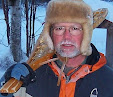
Brenda says I'm driving her crazy with my analyzing the spring weather, trying to get a bead on ice-out time. When the ice goes out, she says, it's out. Until then the lake is frozen.
Hah! If only it was that simple!
OK, it may be that simple but what fun is that? Besides, I'm itching to get into camp, get things ready, get firewood cut, docks fixed, etc. before the first fishermen arrive.
So my ears perk up every time I hear or read any weather news.
Weather expert and climatologist Graham Saunders who writes a weekly weather column in the Thunder Bay newspaper, the Chronicle Journal, thinks the lake ice will go off earlier than normal this year! His reasoning is the snow has mostly melted and last week was a great one for melting with temperatures in the teens.
----------HERE'S A BREAKING REPORT!
After first making this post an old friend, JP Fraser, e-mailed me to say a flock of white pelicans was seen at Amethyst Harbor on Thunder Bay of Lake Superior today. That's great news because white pelicans need open water to feed so there must be an ice-free patch somewhere.
----------
Another bit of heartening news comes from Environment Canada's three-month long range forecast. It predicts above-normal temperatures for the period April-May-June.
So why am I not cheered by this?
Because I'm looking out the window at snow falling. The temperature is a hair above freezing and we're supposed to have below-normal temperatures the rest of the week.
My best guess for ice-out on Red Lake is still May 16 which is opening week for most camps. The average ice-out for Red Lake is May 8 so, I'm guessing it will be a week later than average.
We are actually opening one week later, May 23, just to be safe.
If those above-normal temperatures are coming they better do it soon.
Click to go back to our website
Click to see the latest on the blog
Sunday, April 19, 2009


Is climate change harming loon populations?


Red Lake must have one of the most abundant loon populations in the world but I'm afraid an effect of climate change could be harming them.
These beautiful and inspiring birds can be found nesting literally at every turn in the lake. Nesting loons are highly territorial and will claim all the water in sight as their own. So as soon as you go around the corner (and out of sight of one pair) there is another pair doing the same thing.
Loons are probably the oldest species of birds in the world. Fossils have proven there were loons on earth during the Cretaceous Period, the age of the dinosaurs.
Unlike most other birds, loons have solid bones. This could be a result of their being on the first step of the bird evolutionary ladder. It also lets them sink better than other birds and to dive deeper.
Loon also have the least amount of wing area for their body length. They fly at speeds of up to 90 mph and take off and land exactly as an airplane does -- into the wind.
They truly are a wonder and their incredible calls, from tremulos to wolf-like howls, are the real call of the wild. In fact, the word loon is Norwegian meaning "wild, sad cry."
It would be heartbreaking to see them decline so I hope I'm being a pessimist when I say I see something happening with the weather that is detrimental to loons.
For about the past five years now we've been getting all of our rain in incredible downpours rather than longer rain periods that might last several days as in the past. This is especially true in June, when the loons are nesting.
The result of getting 2-4 inches of rain in a single night instead of over a period of a week is that most of it runs off into the lake before it can be absorbed by the ground. This makes the lake level rise and rise rapidly.
Loons cannot walk on land. Their feet are placed too far back on their bodies. Their feet are almost on either side of their tails. It's one of the reasons they are such great swimmers. It's as if their feet were propellars.
To build a nest a loon stacks water weeds in a pile in shallow water until it is about a foot higher than water level. The loon can push its way on its belly up to the nest which is never more than one loon's-body-length away from the water.
They build their nests in May and traditionally this is the high water period of the year. After all the snow has just melted and drained into the lake. From that point on the water level should continually go down and should be at its lowest just before freeze-up.
The loon usually lays one to three eggs and the pair, which mate for life, takes turns sitting on the nest for about a month before the eggs hatch.
It is during this one-month incubation period that things have been going wrong the last five years or so.
The problem is the heavy spring storms raise the water level and flood their nests. I don't believe one per cent of Red Lake's loons have successfully fledged in five years.
Although most bird species will re-nest if their first nest is destroyed, my observation is that most loons do not re-nest and of the few that do most do not successfully raise young.
So what does this have to do with climate change?
The predictions (and I would have to say "observations" these days) of climatologists is that global warming causes ever-more drastic weather events -- in this case, cloudburst rain storms.
Incidentally, if you don't believe in climate change and don't see it occurring right now it's probably because you don't live in Canada. The effects of climate change are more pronounced the farther north you go. For instance, there's hardly a thing happening in the southern U.S. while the Arctic sea ice and glaciers are disappearing rapidly.
Five years of big storms, of course, are only evidence of weather, not climate. Climate is measured over many decades. So hopefully things will improve in the coming years for the loons.
Fortunately there are still plenty of them on Red Lake. They are a long-lived bird, both individually and obviously, as a species. I just wish they would get a break from the weather and successfully fledge a new crop.
Friday, April 17, 2009
How to help make the boat trip out to camp

In a little more than a month from now we will make our first trip of the season with guests to Bow Narrows Camp, 20 miles by water from the town of Red Lake.
Our cabin cruiser, the Lickety Split, can make this journey with 9 passengers in as little as 35 minutes in favorable weather.
It's a beautiful journey, past islands, through narrows, and alongside of ducks and loons. We sometimes encounter moose, deer and black bear swimming from island to island.
There are several things you can do to help make this trip from the parking lot in Red Lake to your cabin at camp go as smooth as possible.
You will already have been given a pickup time to meet the Lickety Split in Red Lake. If everything is working according to plan, and the wind and waves allow us to travel at normal cruising speed, each round-trip takes 90 minutes, including loading-unloading.
When you reach the parking lot, back your vehicle up to the dock and unload onto the large wagon waiting there. Take the wagon to the end of the dock and off-load your luggage and fishing gear, leaving the wagon -- and a travel lane on the dock -- clear for guests leaving camp. This will let us quickly unload the boat and take on your gear.
Dan will show you a designated parking spot.
After a quick goodbye to the departing guests, we will be on our way to camp.
Unless your group is exactly eight or nine people, there will likely be more than your party aboard the boat. All the luggage is going to be placed in the same place in the boat; so, make sure you can easily identify yours when we get to camp. (Some duct tape and a marker are great for this.) This is especially true for cases of refreshments.
We will form a human-chain to relay the luggage into the hold of the boat.
Once at camp, a couple of our staff usually form the chain inside the boat while the guests make up the chain on the dock. This lets them sort the luggage as it comes off the boat.
Then the next group's luggage is put on the boat for the outgoing trip and we're off again.
It's a real help to all of us if none of the luggage items weighs more than 40-50 pounds. This includes coolers.
Another helpful tip is not to have lots of loose items like shoes and flashlights. Stick them all in a duffel bag or packsack brought just for this purpose.
We don't place a weight limit on you like the fly-in camps do but obviously, weight is a consideration. The boat can only carry so much of it. We just ask you to use your head. Don't bring heavy items if you can avoid it.
A good rule of thumb is if each person has one duffel bag or suitcase, one tackle box, a couple of cases of refreshments and a rod case.
Speaking of refreshments, please bring beer and soft drinks in cans, not bottles, as they are much lighter. Liquor and wine, of course, usually only come in bottles so there's no other way of bringing those.
If coming on the Housekeeping Plan, you can avoid the necessity of back-breaking coolers by buying your groceries in Red Lake instead of hauling them all the way from home. Believe it or not Red Lake has a modern supermarket with virtually the same items you have available in your stores, including fresh produce, probably from the same sources as in your home town.
The prices at Sobeys Supermarket in Red Lake are comparable to at home, especially when converted to American dollars. You may also be able to bring a smaller vehicle or fewer vehicles on the trip if you don't need space for grocery coolers. You can either buy your groceries just before catching the boat to camp or if staying the night in Red Lake, buy them the previous night and have them stored at the store.
If you do buy food at Sobeys in Red Lake, ask to have it packed in cardboard boxes. This is done all the time at the store and it allows us to pack your food into the boat without anything becoming damaged.
Wednesday, April 15, 2009
How to convert Celsius to Fahrenheit; don't
Since we're on a weather bent, I thought I would pass on this gem of weather-related trivia.
In Canada, we measure temperatures in Celsius, much to the confusion of our American friends and guests.
We often hear them at camp trying to remember the formula on how to make the conversion to Fahrenheit as they look at the day's weather forecast.
(To convert Celsius to Fahrenheit, you multiply the temperature in Celsius by 9/5 and add 32.)
Who are you, Einstein?
Can you multiply a number by 9/5 in your head?
If you can then why are you wasting your time thinking about the weather? You should be a mathematician or a statistician or even a bookie.
I overheard one of our guests point out one time that it's meaningless to go through complex calculations just to precisely estimate the temperature.
This little poem tells you all you need to know about Celsius, he said.
Zero's freezing.
Ten is not.
20's warm.
30's hot.
Click to go back to our website
Click to see the latest on the blog
In Canada, we measure temperatures in Celsius, much to the confusion of our American friends and guests.
We often hear them at camp trying to remember the formula on how to make the conversion to Fahrenheit as they look at the day's weather forecast.
(To convert Celsius to Fahrenheit, you multiply the temperature in Celsius by 9/5 and add 32.)
Who are you, Einstein?
Can you multiply a number by 9/5 in your head?
If you can then why are you wasting your time thinking about the weather? You should be a mathematician or a statistician or even a bookie.
I overheard one of our guests point out one time that it's meaningless to go through complex calculations just to precisely estimate the temperature.
This little poem tells you all you need to know about Celsius, he said.
Zero's freezing.
Ten is not.
20's warm.
30's hot.
Click to go back to our website
Click to see the latest on the blog
Tuesday, April 14, 2009
Beautiful spring weather across Northwest Ontario


All regions of Northwestern Ontario are getting beautiful spring weather now.
Daytime temperatures are as high as the low teens Celsius (50s F) and in Red Lake, at least, there are supposed to be some nights ahead where it doesn't go below freezing.
This is great news for the spring thaw but alas, there is a long way to go.
Hugh Carlson of Viking Island Lodge and Outposts said on the radio today that there is at least 32 inches of ice on the lakes.
So when will spring breakup occur?
No one can tell yet but since it is now April 14 and there is 32 inches of ice out there it's guaranteed not to be an early-record which, for Red Lake was April 22.
Hugh was optimistic that it would be gone by the start of walleye season, May 16.
All that matters is the weather from now until then.
Meanwhile, as you can see in the photos, some people (like Brenda) are catching some rays by breaking out the lawn chairs and putting their feet up on snowdrifts.
Click to go back to our website
Click to see the latest on the blog
Monday, April 13, 2009
Fly fishing for northern pike is a blast

You don't hear or read about it very often but northern pike can be caught readily on a fly rod.
In this photo Dave Heneise uses his fly rod while Paul Heneise fishes with spinning tackle.
We've had many fishermen bring their fly rods and the ones who stuck with it for awhile discovered pike are a great fish to catch on these limber sticks.
In fact, we once had a father and son who refused to fish in any other manner.
The key is to use streamer flies on a short wire leader.
Flies 3-4 inches in length seem to work well and ones with lead eyes that make them sink a little more rapidly seem to work even better.
We've also seen people use similar-size plastic squids with good success.
One problem with fly fishing for pike is that it takes a while to work each retrieve, so you often want to have a good idea you are into a mess of pike before cracking out the fly rod.
A lot of guys use their spinning rod until they catch a couple of fish in an area, then switch to the fly rod.
You can also just figure that some places are always going to have a concentration of fish: beaver houses, coves, rock piles, sandbars, weedbeds.
We had one fly fisher who nailed a big pike, I forget the exact size but it was in the mid to high 30+inches, on his fly rod right across the narrows from camp and we all got to witness the thrilling fight it put up before it was released.
Sunday, April 12, 2009
Cavity dwellers thank Pileated Woodpecker

John Muir, America's most famous naturalist, made what I believe to be the most far-reaching
observation of all time when he said: "Whenever you tug on a single thing in Nature, you find it attached to the entire universe."
I think of that line every time I hear someone rant about how "progress" is being unnecessarily halted because of environmental regulations that protect the spotted owl, or some obscure minnow or frog or even woodland caribou -- creatures that are not seen as having any importance compared to parking lots or roads or pulp that can make toilet paper.
So what's that got to do with the pileated woodpecker in the photo above?
The pileated, North America's largest woodpecker, is solely responsible for providing the homes to all kinds of creatures.
Each year this bird which was the model for Woody the Woodpecker cartoons, whacks out a new hole in a sound, living tree to use as a nest. Those holes continue to exist for dozens of years afterwards.
They subsequently become the nesting site for a bunch of cavity nesters including all species of merganser ducks and goldeneye ducks which you can observe whizzing through the trees at camp as they come and go from their nest holes in large quaking aspens. Ducks, you see, can't make their own hole, their beaks and heads aren't made for the job.
The same thing goes for kestrels and merlins (small hawks), flying squirrels, red squirrels, pine martens and many other mammals.
When you tug on the string connected to the pileated woodpecker, a whole lot of creatures are attached to it.
The same can be said of everything else.
Click to go back to our website
Click to see the latest on the blog
Saturday, April 11, 2009
Clue discovered in lake trout mystery


Nadine Thebeau, the area biologist for Red Lake, says the Ministry of Natural Resources has discovered a potential reason why lake trout are not reproducing in Pipestone Bay.
Sediment samples taken from spawning areas of the lake trout show levels of manganese high enough to be lethal to lake trout eggs.
Thebeau and her band of MNR researchers have known for quite some time that trout eggs were not surviving in most areas of Pipestone Bay but that the eggs would survive if taken to virtually anywhere else in the lake.
Manganese, she points out, is naturally occurring in the rock of Pipestone Bay. It remains to be seen why manganese is causing a problem now when, presumably, it wasn't a problem in the past.
Nadine's research also has shown that Pipestone is by far the favored spawning place for lake trout.
The MNR discovered in a study in 2001 that there were no lake trout in the lake that had been born since 1989. The MNR subsequently changed fishing regulations for Red Lake's lake trout to catch and release only and began netting spawning lake trout in the fall, stripping them of eggs and milt and raising the fingerlings in a hatchery. About 100,000 fingerlings have been released back to the lake each year since.
Nadine didn't speculate on what caused the manganese problem but a likely culprit was the forest fire that burned off the north shore of Pipestone Bay in 1986. We may never know how that increased manganese levels in the bay sediment but it occurs to me that perhaps the manganese from the soil around the rock had been taken up by the trees, as are other elements. The fire turned the trees to ash and the ash would have eventually made its way into the bay.
If that's what happened then the problem should diminish over time as there is now a dense covering of new trees growing in the old burn site. That would stop further manganese from leaching and eventually the manganese that's in the bay will be covered by normal sediments.
And there's evidence that the trout situation might indeed have started to turned around.
We are finally seeing young trout again. Our anglers caught and released many lake trout in the 22-26 inch range the last couple of years. These fish were likely less than 10 years old.
None of these were the nursery-raised fish. They can be recognized because they have one of their fins clipped, a different fin for each year. So the trout are successfully spawning again, at least a little, on their own.
The MNR team, however, did catch one of the hatchery fish as part of their spawning project last fall.
The hatchery-raised fish have been released at the eastern end of the lake in an attempt to get them to spawn somewhere other than Pipestone Bay. It may be working since only one was caught trying to spawn in Pipestone.
It should be noted that no one has said the elevated levels of manganese in Pipestone's sediments pose a health hazard to humans. It also doesn't seem to have any effect on other species of fish. Northern pike and walleye populations are very healthy.
Lake trout eggs are about the most sensitive organisms known in nature. Anything out of the ordinary can disrupt their development.
Forest fires, of course, are natural phenomena in the Boreal Forest. In fact, virtually every inch of the Boreal Forest burns every 80-120 years.
Red Lake's lake trout must have lived through hundreds of forest fires over the 10,000 years since the last ice age.
They are a long-lived fish and perhaps were just able to outlive the effects of the forest fires on Pipestone.
While we wait for the lakers to once again become a self-sustaining population, there are a number of things anglers can do.
1. Record the numbers of tagged fish and also note their length and where they were caught.
2. Check any lake trout you catch for a clipped fin before releasing it.
3. Record lengths of all your trout. Don't weigh these fish as the weighing process can harm them. Always quickly return the fish to the water. If possible, don't even bring them aboard the boat, just measure them in the water and turn them loose.
4. Follow fishing regulations that require you to use lures with single, barbless hooks when fishing specifically for lake trout. (You can use any type of lure for other species.)
Regulations also stipulate that you cannot use live or dead bait when lake trout fishing.
5. And finally, of course, follow regulations that require you to immediately release any lake trout you catch.
Click to go back to our website
Click to see the latest on the blog
Friday, April 10, 2009
Timber wolves kill whitetail deer

My dog, Sam, and I recently found where timber wolves killed two more whitetail deer behind our house. This brings to three the number of deer killed by wolves that we've found on our property in Nolalu.
It sounds like a lot but it's probably no more than normal. The deer come to our property as the winter progresses each year. We have a lot of mature conifer trees that prevent much of the snow from reaching the ground. The deer come to the area to get out of the deep snow and also to eat tree lichens such as several species known collectively as Old Man's Beard.
Wolves show up each year in February and March and start picking off the deer.
Wolves have been known to kill dogs here and for that reason I always keep a watchful eye on Sam once I know the wolves are around.
I've learned, however, that most wolves don't go after dogs. About once every 10 years, it seems to me, there will be a pair of wolves -- a male and a female -- that go on a dog-killing spree. Eventually they get shot and then there's no more problem with wolves killing dogs for a long time even though there are always a lot of wolves in the area.
About 20 years ago our neighbor's dog was killed by wolves and the Thomsons warned me that our dog, Lady, might be next. The very next night I was wakened by Lady barking outside from her house. In about 10 minutes a large wolf came out of the bush and headed right for her where she was tied on a line. When it was about 20 feet from her I stepped outside and the wolf took off. I let a load of buckshot fly in its direction. Never hit the wolf but I got my point across that this wasn't a good place for a wolf to get another dog. The instant after I shot a second wolf howled from the bush.
They never came back to our house but the dog-killing in the village continued for a couple of weeks until finally someone shot both wolves as they came up to a deck to get a small dog tied there, right in the middle of the day.
I heard from trappers in the area this year that most of the wolves this winter are suffering from mange. In the past they have been known to get inside barns at night to keep warm when they had the mange and lost their fur. I knew of one case where the horses caught mange from the wolves.
Even though wolves are a potential threat to Sam, I try not to tar them with the same brush as the dog-killers. Sam has grown up with wolves all around him and he's good at staying close to the house when they are around.
The wolves just go about their business of thinning down the deer herd and so my policy is to let them do their thing.
Click to go back to our website
Click to see the latest on the blog
Wednesday, April 8, 2009
Late snow will delay Red Lake, Ontario ice-out
Heavy snowfalls that fell on Northwestern Ontario last week will certainly delay spring ice out on Red Lake, Ontario this year, as well as most lakes in Northern Ontario.
Red Lake got about 10 inches of snow while farther to the south some areas such as our winter home in Nolalu got 20 inches.
Until that snowfall most exposed areas, such as lakes, were nearly barren of snow, setting the stage for the spring thaw.
Now the meager warm temperatures, barely above freezing to this point in the day and far below freezing at night, will take a week or more in the case of Red Lake and probably several weeks in the Thunder Bay area to melt away the new snowfall. Until then virtually no melting of lake ice will begin.
There is currently three feet of ice on Red Lake and approximately that much snow in the bush although there is likely only about a foot on top of the lake ice.
The new snow reflects sunlight and discourages the lake ice from thawing, even when the temperature is above freezing.
The weather forecast, at least, is encouraging. Temperatures in the high single digits (Celsius) and even low double digits are in the offing. If driven into the snow by strong winds these temperatures will start to eat the snow away. Once it's gone we could be looking at up to a month before the 36 inches of lake ice melts.
You can check out the forecast yourself by clicking on it on our website's weather page.
Speaking of ice, the U.S. Coast Guard reported there was three feet of ice on about two-thirds of Lake Superior this spring. The big lake only freezes completely across about once every 40 years. It nearly did it this year.
It's been a long, cold winter up here. January and February saw just about every night go down to -30 C. We're used to it being cold but that's a long stretch for such bitter temperatures, even for us.
Click to go back to our website
Click to see the latest on the blog
Red Lake got about 10 inches of snow while farther to the south some areas such as our winter home in Nolalu got 20 inches.
Until that snowfall most exposed areas, such as lakes, were nearly barren of snow, setting the stage for the spring thaw.
Now the meager warm temperatures, barely above freezing to this point in the day and far below freezing at night, will take a week or more in the case of Red Lake and probably several weeks in the Thunder Bay area to melt away the new snowfall. Until then virtually no melting of lake ice will begin.
There is currently three feet of ice on Red Lake and approximately that much snow in the bush although there is likely only about a foot on top of the lake ice.
The new snow reflects sunlight and discourages the lake ice from thawing, even when the temperature is above freezing.
The weather forecast, at least, is encouraging. Temperatures in the high single digits (Celsius) and even low double digits are in the offing. If driven into the snow by strong winds these temperatures will start to eat the snow away. Once it's gone we could be looking at up to a month before the 36 inches of lake ice melts.
You can check out the forecast yourself by clicking on it on our website's weather page.
Speaking of ice, the U.S. Coast Guard reported there was three feet of ice on about two-thirds of Lake Superior this spring. The big lake only freezes completely across about once every 40 years. It nearly did it this year.
It's been a long, cold winter up here. January and February saw just about every night go down to -30 C. We're used to it being cold but that's a long stretch for such bitter temperatures, even for us.
Click to go back to our website
Click to see the latest on the blog
Friday, March 27, 2009
A couple of handy fishing gadgets

Ron Nelson, a long-time angler at Bow Narrows Camp, shows a couple of handy fishing gadgets in this photo.
One is a set of nail clippers and the other is an eye-buster tool.
Nail clippers are the best thing for cutting fishing line -- way better than a knife.
The eye buster is a little metal tool that breaks out the paint from the eyes of jigs. If you don't have this tool you can also use a large hook to ream out the eyes but then that hook gets dulled.
Ron has both tools on a lanyard hung around his neck. You can also get clip-on tether cords that clip to your life jacket or shirt.
It's far handier to have these often-used tools around your neck or tethered to your vest than have to search for them in the tackle box or pick them off the bottom of the boat everytime you want them.
Monday, March 23, 2009
Our 20 hp Honda four-stroke outboards

All of our fishing boats are powered by 20 hp Honda four-stroke outboards and virtually everyone agrees these are perfect fishing motors.
They are so quiet you can barely tell they are running at idle.
They do not produce any smoke.
They troll very slowly yet zip our 16-foot Lund boats around at over 20 mph with two anglers and all their gear in the boat.
And they start very easily although there is a definite procedure to learn to start the recoil-start models.
The first thing to know is that you do not need to advance the throttle to start these engines. You always start them at the lowest setting on the throttle.
1. Make sure the engine gear shift is in neutral. (You cannot pull the starting rope if it is in forward or reverse.)
2. When the engine is cold rotate the throttle handle four times to prime the carburetor. These engines have an accelerator pump on their carburetors, just like cars used to have. Instead of pumping the gas pedal, here you rotate the throttle handle.
3. Pull out the choke and with the throttle handle on the lowest setting, pull the cord.
The engine will always start on a single pull.
4. Leave the choke out until the engine has totally warmed up. This will take up to five minutes in cold weather, a couple of minutes in summer. The engine will not die with the choke pulled out.
5. Once the engine is warmed up, push in the choke and the engine will automatically slow down its idle. You are now ready to leave the dock.
You probably will never need to choke the engine again for the rest of the day.
If it doesn't ever start on one pull, rotate the throttle handle a couple of times to prime the carb, leave the throttle at its lowest setting and pull the starting cord.
We also have some electric start models which we usually reserve first for people with bad backs or who otherwise might have difficulty pulling a starting cord.
With these all you do is make sure the engine is in neutral, turn the throttle to the lowest setting and push the start button on the tiller handle. The engine automatically chokes itself, turns up the idle speed until warm and then drops the idle speed.
Just wait for the engine idle speed to slow down before leaving the dock as this is the signal the engine is warmed up.
The recoil-start models all have built-in alternators that will charge any type of 12-volt battery.
Many of our fishermen use this feature to charge gel-cell batteries that power their fish finders.
Ask us for the wiring harness if you would like to use the motor to charge your battery.
The alternator will also charge an electric trolling motor battery.
We have a couple of electric trolling motors for rent for $50 per week. If you would like to reserve one during your stay, drop us an e-mail at fish@bownarrows.com
An indicator on the trolling motor's handle tells you the charging state of the motor's battery. You must always recharge your battery with the 20 hp Honda, so keep an eye on the battery condition and refrain from using the trolling motor until there is a good charge in the battery.
The Honda will recharge the battery in just a couple of hours under normal fishing conditions.
By using this system you never need an external charger yet the trolling motor is available almost all the time.
Saturday, March 21, 2009
What if I accidentally kill a pike in the slot size?
What should a person do if he or she accidentally kills a northern pike that is in the slot size?
Ontario fishing regulations specify a no-keep slot size of 27.5 inches to 35.4 inches for northern pike.
You are not permitted to keep any fish this size and may keep only one larger (we strongly suggest you do not keep any larger fish unless you want to mount them. See Conservation).
We provide measuring tapes in our fishing boats for you to measure the length of your fish.
It's a wise idea to stay an inch away from the slot size, just for safety's sake. In other words, make the largest pike you keep 26.5 inches not 27.5 inches. A fish will "grow" in length after it dies and its muscles relax.
There are a lot of things you can do to prevent accidentally killing pike such as using the proper Fish Unhooking Tools or pinching down barbs on multi-hook lures but occasionally, despite your best intentions, a fish rips a gill out and dies.
No one likes to see a fish wasted and there is an inclination to bring the fish back to camp, even if it is in the slot size.
Please don't do this!
You must throw the fish back into the water where you caught it!
It is an offence to have a fish in the slot size in your possession.
As part of our regular service at Bow Narrows Camp we clean all your fish for you.
We will not put a knife to a fish in the slot size.
By bringing it back you are jeopardizing our camp's reputation and our livelihood.
Why can't a person keep such a fish if it was killed accidentally?
Ministry of Natural Resources conservation officers point out that if they were to allow such fish to be kept there are some people who would routinely "accidentally" kill fish. It's a sad commentary on the human race but it's true.
Just throw them back and examine if there is anything different you can do about your fishing technique to prevent it happening again. Sometimes there is nothing you could have done.
There are a lot of tips here on the blog that might help.
Just type in Conservation in the search window at the top of the blog.
Click to go back to our website
Click to see the latest on the blog
Ontario fishing regulations specify a no-keep slot size of 27.5 inches to 35.4 inches for northern pike.
You are not permitted to keep any fish this size and may keep only one larger (we strongly suggest you do not keep any larger fish unless you want to mount them. See Conservation).
We provide measuring tapes in our fishing boats for you to measure the length of your fish.
It's a wise idea to stay an inch away from the slot size, just for safety's sake. In other words, make the largest pike you keep 26.5 inches not 27.5 inches. A fish will "grow" in length after it dies and its muscles relax.
There are a lot of things you can do to prevent accidentally killing pike such as using the proper Fish Unhooking Tools or pinching down barbs on multi-hook lures but occasionally, despite your best intentions, a fish rips a gill out and dies.
No one likes to see a fish wasted and there is an inclination to bring the fish back to camp, even if it is in the slot size.
Please don't do this!
You must throw the fish back into the water where you caught it!
It is an offence to have a fish in the slot size in your possession.
As part of our regular service at Bow Narrows Camp we clean all your fish for you.
We will not put a knife to a fish in the slot size.
By bringing it back you are jeopardizing our camp's reputation and our livelihood.
Why can't a person keep such a fish if it was killed accidentally?
Ministry of Natural Resources conservation officers point out that if they were to allow such fish to be kept there are some people who would routinely "accidentally" kill fish. It's a sad commentary on the human race but it's true.
Just throw them back and examine if there is anything different you can do about your fishing technique to prevent it happening again. Sometimes there is nothing you could have done.
There are a lot of tips here on the blog that might help.
Just type in Conservation in the search window at the top of the blog.
Click to go back to our website
Click to see the latest on the blog
Wednesday, March 18, 2009
Difference between daily and possession limits
Ontario fishing regulations specify the daily limit for northern pike is four for a regular limit licence and two for a conservation licence.
Of these none can be in the slot size of 27.5 to 35.4 inches in length and only one can be larger than 35.4 inches.
For walleyes, the daily limit is also four for a regular licence and two for a conservation licence.
Of these only one can be larger than 18 inches. There is no slot size.
Regulations also state you can not have more than one day's limit in your possession.
This means you can never have more than the above-mentioned limits for each species anywhere in your possession. This includes your boat, cooler, the camp freezer, your refrigerator or anywhere else.
While the numbers are the same for daily and possession these two terms have different meanings.
Daily limit means the number of fish you can keep in one day. Possession limit means the number of fish you have accumulated over a period of time.
The difference is best illustrated by taking the example of an angler who let's say is fishing with a conservation licence. He keeps two walleyes for lunch. After eating them they are no longer in his possession. So can he then catch two more in the afternoon and maybe this time put them in the freezer to take home?
The answer is no. By keeping two fish for lunch he caught his daily limit and cannot keep any more until the next day.
Now let's say he puts one fish in the freezer to take home. How many can he keep on the following days to eat for lunch. The answer, if he is fishing with a conservation licence, is one. That's because he can only have two fish in his possession.
However, after eating his walleye for lunch he can later keep one more that day to fill out his daily limit of two and without exceeding his possession limit of two.
The smart thing to do when you come to Bow Narrows Camp is to eat fish at camp the first 3-4 days you are at camp and save fish to take home the last day or two.
It's also good to realize how few fish it takes to make a meal. One walleye under 18 inches will feed one person. A northern pike 22-26 inches will feed two or three people.
These are the proper sizes of these species to keep. It's poor conservation practise to keep big fish as these are the ones that replenish the population.
Click to go back to our website
Click to see the latest on the blog
Of these none can be in the slot size of 27.5 to 35.4 inches in length and only one can be larger than 35.4 inches.
For walleyes, the daily limit is also four for a regular licence and two for a conservation licence.
Of these only one can be larger than 18 inches. There is no slot size.
Regulations also state you can not have more than one day's limit in your possession.
This means you can never have more than the above-mentioned limits for each species anywhere in your possession. This includes your boat, cooler, the camp freezer, your refrigerator or anywhere else.
While the numbers are the same for daily and possession these two terms have different meanings.
Daily limit means the number of fish you can keep in one day. Possession limit means the number of fish you have accumulated over a period of time.
The difference is best illustrated by taking the example of an angler who let's say is fishing with a conservation licence. He keeps two walleyes for lunch. After eating them they are no longer in his possession. So can he then catch two more in the afternoon and maybe this time put them in the freezer to take home?
The answer is no. By keeping two fish for lunch he caught his daily limit and cannot keep any more until the next day.
Now let's say he puts one fish in the freezer to take home. How many can he keep on the following days to eat for lunch. The answer, if he is fishing with a conservation licence, is one. That's because he can only have two fish in his possession.
However, after eating his walleye for lunch he can later keep one more that day to fill out his daily limit of two and without exceeding his possession limit of two.
The smart thing to do when you come to Bow Narrows Camp is to eat fish at camp the first 3-4 days you are at camp and save fish to take home the last day or two.
It's also good to realize how few fish it takes to make a meal. One walleye under 18 inches will feed one person. A northern pike 22-26 inches will feed two or three people.
These are the proper sizes of these species to keep. It's poor conservation practise to keep big fish as these are the ones that replenish the population.
Click to go back to our website
Click to see the latest on the blog
Monday, March 16, 2009
Can I take a floatplane sightseeing trip?

We sometimes have guests who would like to take a floatplane sightseeing trip while they are staying at Bow Narrows Camp.
There are charter floatplane services in Red Lake who will land at camp, take you for a 20-minute ride around the west end of Red Lake and return.
It can be a fun sidelight to your trip at camp and if you haven't seen Northwestern Ontario from the air you are in for a treat.
You will be blown away by the numbers of lakes. There seems to be more water than land as far as the eye can see.
The cost for this varies depending on the number of people taking the trip and current fuel prices. Usually the airlines wants a minimum of 6 people before booking the trip.
My guess at the cost for the trip this summer will be $100 to $150 per person.
The plane in the photo above is the historic Norseman. This fabric-covered plane has been the workhorse of the bush since the 1940s. There are more Norseman aircraft in Red Lake than anywhere else in the world.
Red Lake holds a festival each July in honor of the Norseman. Called the Norseman Festival it attacts aviation enthusiasts from all over North America.
Click to go back to our website
Click to see the latest on the blog
Thursday, March 12, 2009
Great deals available on airline fares to Canada
If you haven't checked airline fares for awhile you are in for a pleasant surprise!
Airline fares throughout North America are the lowest they've been in 6-8 years.
In some cases you can fly for about half of what it cost last year.
Remember, when coming to Red Lake you have a couple of choices when it comes to flying.
You can either fly right into Red Lake or fly to Winnipeg, rent a car and drive to Red Lake.
Find out more about flying up here by clicking on How to Fly to Red Lake, Ontario.
Click to go back to our website
Click to see the latest on the blog
Airline fares throughout North America are the lowest they've been in 6-8 years.
In some cases you can fly for about half of what it cost last year.
Remember, when coming to Red Lake you have a couple of choices when it comes to flying.
You can either fly right into Red Lake or fly to Winnipeg, rent a car and drive to Red Lake.
Find out more about flying up here by clicking on How to Fly to Red Lake, Ontario.
Click to go back to our website
Click to see the latest on the blog
Wednesday, March 11, 2009
Old Miles Mine makes a good hike


When you're at Bow Narrows Camp this summer you might consider taking a hike up to the Miles Mine, one of the abandoned gold mines at the west end of Red Lake.
It's a little more than a half-mile to the mine from the end of Trout Bay and the trail is usually in pretty good shape.
Like several of the other gold mines at the west end, this one was started in the '30s and didn't re-open after a devastating forest fire a half dozen years later.
All these gold mines were vertical shafts, nor horizontal into a mountain like you see in the cowboy movies. All that can be seen of the mine itself is a hole in the ground which is full of water. Don't get near the shaft as it is possible that the rubble around it can collapse into the hole.
Also, stay away from the old headframe. If it hasn't fallen down since I took these photos it could any day.
The Miles Mine also has a few remnants of buildings including a shack about two-thirds of the way up the trail to the mine that a very large bear left his mark on.
Bears like to scratch trees to mark their territory, but this one left his claw print on the tarpaper above the door to the shack. I don't know if it impressed other bears but I find it awesome. To give you some perspective on how high this is, my brother-in-law Gord Cooper in the photo is 6 feet, 3 inches tall and he can't stretch to where the bear reached.
You can search through the tailing pile from the mine to see if you can find any gold. All of these mines found some, just not enough to make a go of it. There's also some rusty old equipment laying around, some of it old steam-engines that provided the power in those days.
Mostly the trip to the mine is just an interesting walk. The trail cuts through a mixed forest of quaking aspen and white spruce.
The Trout Bay end of the trail usually shows a lot of beaver activity with felled trees and peeled limbs lying around.
There are frequently moose, timber wolf and bear tracks and scat on the trail. You'll probably see a few ruffed grouse or even spruce grouse on this walk.
There are newer trails made up by the mine but I would advise not taking any of these. They were made by prospectors and mine exploration outfits and don't really lead anywhere. They can also be confusing. You don't want to get lost. It's best just to go straight to the mine and then straight back to your boat.
Sunday, March 8, 2009
Snow fleas are the first signs of spring

With each passing day the sun gets higher in the sky and the temperature gets warmer.
One of the very first signs of spring are the appearance of snow fleas, tiny insect-like creatures called springtails, a type of hexapod, that are best seen in footprints in the snow on a sunny day when the temperature is near to melting.
The snow has melted a couple of inches now but there is still a thick blanket on the ground.
Sam and I went for a snowshoe hike today and discovered where timber wolves killed a deer about 100 yards from our house.
The only thing left of the deer were small bits of hide and hair. Even the bones had been eaten.
Click to go back to our website
Click to see the latest on the blog
Saturday, March 7, 2009
How many walleyes does the average angler catch?

This is a question that I get quite frequently.
I understand that people are just trying to get a read on the quality of fishing here but it still makes no sense.
It's silly because the answer, if I would give one, still tells you nothing.
An example, one boat goes fishing and catches 100 walleyes in a day. Another boat catches zero. Is the answer then that the "average angler" gets 50?
An answer also doesn't tell you anything about the size and therefore the quality of the fish.
Brenda and I once caught 100 walleyes in a single hour. We were using jigs with barbless hooks and plastic twister tails -- no bait. You could not get this outfit to the bottom without catching a walleye. This was the fastest walleye action I have ever seen including in the old days fishing on remote "unfished" portage lakes. However every one of the hundred fish we caught and released that August afternoon was only 12 inches long! They were tiny. But it sounds impressive -- 100 walleyes in an hour!
OK, that was an exception, so what does the "average" guy catch?
It depends, do you mean the "average" fisherman who has been coming to Bow Narrows Camp for 10 years or the "average" fisherman who has been fishing for 10 years on other lakes but is new to Red Lake or the "average" fisherman who has never fished for walleyes before or the "average" fisherman who insists on using techniques that worked on another lake in another province and won't adapt to our lake? Maybe you mean the "average" guy who fishes for pike 95 per cent of the time or conversely the "average" person who fishes for nothing but walleyes from daylight to dark. What about the guys who are fishing with little kids or the ones who won't fish in the rain or the ones who will fish no matter what the wind and weather?
The very question of "how many" indicates that the person is really concerned about numbers, not quality. So would he be happy catching hundreds of 12-inch walleyes? Or would he prefer to catch fewer but bigger fish? That is virtually always the choice. You cannot catch 100 eight-to-12 pound walleyes in an hour, if for no other reason that it takes about five minutes to land each of them.
Red Lake's claim to fame is its large numbers of big walleyes. Where on a small lake you might only catch one 25-inch walleye in a week on Red Lake you might catch two dozen that big or bigger in a single day. We routinely catch walleyes 28 inches (eight pounds) and it would seem most walleyes end their growing at 32 inches (12 pounds). However every so often someone catches a 34-incher (14 pounds).
We frequently hear seasoned anglers that are new to our camp remark, "I've never seen so many big fish!" How many did they catch? I don't know, frankly, but I know they were impressed with the fishing.
Instead of telling people how many walleyes they can catch in one day, I usually refer them to our camp's setting as shown on Google Maps. Switch the map to satellite mode, click off the box showing the camp's info and zoom down. Look at all the bays and islands and narrows that are nearby the camp. This irregular shoreline is prime fish habitat! It also shows how the camp is protected from the wind, no matter what the direction.
The satellite photo doesn't show the lake depths but the large bodies of water all have places where it is over 100 feet deep. The smaller bays and narrows are usually 30 feet deep or less.
This is important because there is a wide variety of depths and temperatures available to the fish. That's why we can catch them throughout the season -- we just move to where they are feeding.
The map also doesn't show you what the bottom of the lake is made of. In most places at the west end of Red Lake where Bow Narrows Camp is located the bottom is clay -- the most productive material. A fishery is just like a farm, it starts with good soil. Clay produces more plankton and tiny invertebrates that form the start of the food chain than does sand or rock.
These are the factors that make Red Lake such a tremendous fishery and it's our extreme good fortune that Bow Narrows Camp is located right in the middle of the best place to fish on the entire 30-mile-long lake.
Click to go back to our website
Click to see the latest on the blog
I understand that people are just trying to get a read on the quality of fishing here but it still makes no sense.
It's silly because the answer, if I would give one, still tells you nothing.
An example, one boat goes fishing and catches 100 walleyes in a day. Another boat catches zero. Is the answer then that the "average angler" gets 50?
An answer also doesn't tell you anything about the size and therefore the quality of the fish.
Brenda and I once caught 100 walleyes in a single hour. We were using jigs with barbless hooks and plastic twister tails -- no bait. You could not get this outfit to the bottom without catching a walleye. This was the fastest walleye action I have ever seen including in the old days fishing on remote "unfished" portage lakes. However every one of the hundred fish we caught and released that August afternoon was only 12 inches long! They were tiny. But it sounds impressive -- 100 walleyes in an hour!
OK, that was an exception, so what does the "average" guy catch?
It depends, do you mean the "average" fisherman who has been coming to Bow Narrows Camp for 10 years or the "average" fisherman who has been fishing for 10 years on other lakes but is new to Red Lake or the "average" fisherman who has never fished for walleyes before or the "average" fisherman who insists on using techniques that worked on another lake in another province and won't adapt to our lake? Maybe you mean the "average" guy who fishes for pike 95 per cent of the time or conversely the "average" person who fishes for nothing but walleyes from daylight to dark. What about the guys who are fishing with little kids or the ones who won't fish in the rain or the ones who will fish no matter what the wind and weather?
The very question of "how many" indicates that the person is really concerned about numbers, not quality. So would he be happy catching hundreds of 12-inch walleyes? Or would he prefer to catch fewer but bigger fish? That is virtually always the choice. You cannot catch 100 eight-to-12 pound walleyes in an hour, if for no other reason that it takes about five minutes to land each of them.
Red Lake's claim to fame is its large numbers of big walleyes. Where on a small lake you might only catch one 25-inch walleye in a week on Red Lake you might catch two dozen that big or bigger in a single day. We routinely catch walleyes 28 inches (eight pounds) and it would seem most walleyes end their growing at 32 inches (12 pounds). However every so often someone catches a 34-incher (14 pounds).
We frequently hear seasoned anglers that are new to our camp remark, "I've never seen so many big fish!" How many did they catch? I don't know, frankly, but I know they were impressed with the fishing.
Instead of telling people how many walleyes they can catch in one day, I usually refer them to our camp's setting as shown on Google Maps. Switch the map to satellite mode, click off the box showing the camp's info and zoom down. Look at all the bays and islands and narrows that are nearby the camp. This irregular shoreline is prime fish habitat! It also shows how the camp is protected from the wind, no matter what the direction.
The satellite photo doesn't show the lake depths but the large bodies of water all have places where it is over 100 feet deep. The smaller bays and narrows are usually 30 feet deep or less.
This is important because there is a wide variety of depths and temperatures available to the fish. That's why we can catch them throughout the season -- we just move to where they are feeding.
The map also doesn't show you what the bottom of the lake is made of. In most places at the west end of Red Lake where Bow Narrows Camp is located the bottom is clay -- the most productive material. A fishery is just like a farm, it starts with good soil. Clay produces more plankton and tiny invertebrates that form the start of the food chain than does sand or rock.
These are the factors that make Red Lake such a tremendous fishery and it's our extreme good fortune that Bow Narrows Camp is located right in the middle of the best place to fish on the entire 30-mile-long lake.
Click to go back to our website
Click to see the latest on the blog
Tuesday, March 3, 2009
New landing net made for conservation fishing

Frabill has just announced a new type of landing net which they call their Conservation Series.
The new nets have no knots which can abrade a fish's body causing injury.
They have a very small mesh size that prevents fish from getting their snouts and fins caught.
And they have flat bottoms instead of being shaped like a sack as are other nets.
The flat bottoms allows the fish to lay flat when lifted from the water instead of being collapsed into a U-shape. Again, this supports the fish's weight evenly and prevents injuries, especially to its tail or caudal fin.
The nets are fairly pricey. A 26x30" model which would be an excellent size for the big walleyes we catch in Red Lake retails for $119.99.
Frabill's 29x34" model that would be large enough for our lunker northern pike sells for $129.99.
I think any serious conservation-minded angler should give the nets close consideration.
Frabill is correct in its assertion that many fish that are released are harmed by the landing net.
Rubber landing nets do a good job of not harming fish too but they are quite heavy due to the weight of the rubber. In fact the ones big enough for northern pike are just too heavy.
The Frabill mesh net should provide the benefits of the rubber net without the weight and have the added benefit of the flat bottom.
Although we provide landing nets with our fishing boats as part of our regular fishing packages, I always advise anglers to bring their own. They weigh little and are not difficult to pack in the car or truck.
The two pieces of equipment that we supply that receive the most abuse are the landing nets and the life vests.
In the case of landing nets anglers routinely cut their lures out of the nets with knives leaving a gaping hole for the next angler's trophy fish to slip through.
With life vests, many people unwisely don't wear them (See Life Vests and also Fishing Equipment )and so they blow out of the boats and are lost or are stood upon as they lay on the bottom of the boat.
See also Rubber vs Mesh Net and How to Net Giant Pike
Click to go back to our website
Click to see the latest on the blog
Subscribe to:
Posts (Atom)