Friday, March 28, 2014

How can this lever save you $950?

Motor tilt control
When our outside worker or myself is showing you your fishing boat this summer, pay particular attention to our spiel about the importance of the position of this lever on the outboard motor.
It is a critical piece of advice.
Click to go back to our website
 Click to see the latest on the blog

Monday, March 24, 2014

Beauty springs from dead stumps

Doug Billings photos


Did you ever wonder how beautiful flowers grow each summer from the top of stumps around camp?
Somehow Brenda finds time to transplant them each spring and then waters them every evening. She also puts hanging baskets of flowers on many of the cabin porches.

Saturday, March 22, 2014

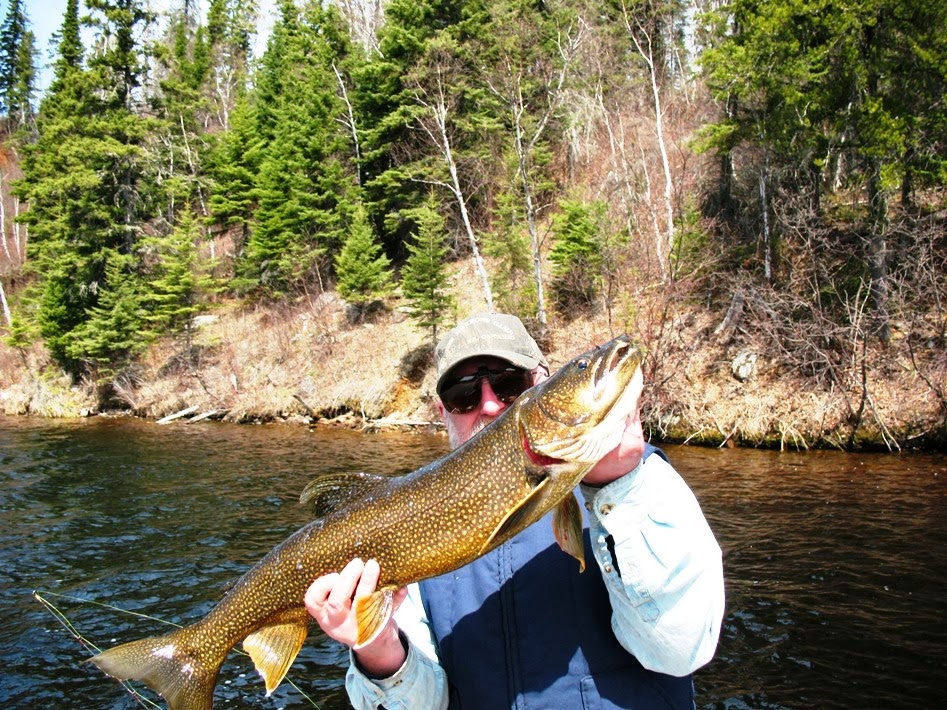
Our chocolate brown lake trout

Joe Overman hoists a beautiful brown lake trout
Red Lake seems to have several distinct populations of lake trout. The ones in Trout Bay are a chocolate brown colour. In Pipestone Bay they are silver as they are in Big Red. The fish in Big Red seem to grow the largest. Every fish we have caught over 40 pounds has come from there.
Click to go back to our website
 Click to see the latest on the blog

Wednesday, March 19, 2014

How high/flood water can change habitat for years

Dead conifers turned red after being killed by high water
About five years ago the lake level was in a flood stage for most of the summer due to extreme precipitation. The lake was probably four feet higher than our normal high water mark. The resulting flooding around the shoreline killed a lot of trees. These will stay standing for awhile but eventually will topple over into the lake and create great fish habitat.
You can sometimes find huge clouds of minnows around trees in the water. And, of course, where there are minnows, there are gamefish.
I know of one angler who was casting a small Mepps spinner when he came across a newly fallen tree in the water. He promptly caught a small pike there. Then another, then another, then another. He carefully kept his boat away from the tree so as not to scare off the fish. He kept catching pike and it seemed each one got a little bigger. Finally he got a nice pike in the slot size. At that point he had caught 16 fish from the same tree. The fishing spree ended when he hung his spinner up in the tree and had to move in to get it loose.
Click to go back to our website
 Click to see the latest on the blog

Monday, March 17, 2014

My preferred slip knot for tying up the boat


Here is the knot I like to use when tying boats up to the dock. It's quick to tie and unties with just a pull on the free end.
Click to go back to our website
 Click to see the latest on the blog

Friday, March 14, 2014

Taking stock while doing a little dock fishing

Dee Hall tests the waters off Cabin 1's dock
Sometimes it is a good idea to start every day with 10 minutes of casting from the dock before making your fishing plans. This will give you time to notice the wind direction, air temperature and cloud activity -- all factors that might influence where you go and what you will fish for.
Click to go back to our website
 Click to see the latest on the blog

Tuesday, March 11, 2014

Sit back and relax awhile

Fred Specht at one of the many yard swings and benches  in camp. Joe Overman photo
Listen to the waves' lullaby. Doug Billings photo
Don't forget when you are at camp this summer to just sit down and take it easy -- not fishing, not looking for anything -- just being quiet and listening to the sounds of nature.
We can hear loons calling just about all the time at camp. They have a bunch of different calls and it's fun to recognize which one you are listening to. In the evening and at night, loons seem to check in with each other all over the lake. It's as if they were night watchmen and calling, "It's 10 o'clock and all's well."
Different species of trees make different sounds in the wind. Jackpine seem to make the wind howl. Quaking aspen leaves clatter like wind chimes.
Mice rustle through the leaves. In the yard they are most likely meadow voles which never come into a cabin or cause any problems for humans. In the bush, they will most certainly be red-backed voles, an equally friendly critter.
Only at night are you likely to hear or see the destructive mouse species: whitefooted deer mice with their long tails, big ears and large eyes.
Waves lapping against the shore sing a lullaby.
Sea gulls keep in touch with each other as they patrol the shoreline.
Common terns and Bonaparte's gulls make a series of cracking calls.
Nighthawks make a snapping sound as they hunt bugs in the evening, high overhead.
At night, if it is really still, you can hear bats flapping when they make a tight turn. You can also hear nightcrawlers when they withdraw into their holes and rustle a leaf.
These are the sounds of peace and quiet.
Click to go back to our website
 Click to see the latest on the blog
Saturday, March 8, 2014

Finally, Here Comes the Sun!

Well, what do you know?  The temperatures in Northwestern Ontario, including Red Lake, have returned to normal for this time of year and are supposed to stay that way for at least a week!
This means it is going to get a little above freezing in the days and go below freezing at nights but not -40!
This is exactly the conditions we need for the rest of the winter and spring to set up a normal ice-out.
Just as the Beatles said:
"Little darling, it's been a long cold lonely winter
Little darling, it feels like years since it's been here
Here comes the sun
Here comes the sun, and I say
It's all right"


Where there's weeds, there's northern pike

Bill Baughman weighs pike with Bogagrip in weedy bay
When in doubt, head to the weeds!
That's always good advice when looking for northern pike. Although these fish are found just about everywhere, they are usually concentrated the most in weedy areas. The trick is to find where in the weeds they are -- in close to shore, at the edge, right in the middle, etc.-- and figure out a way to fish for them without hooking weeds the instant your lure hits the water.
The 1/2-ounce Johnson Silver Minnow with a three-inch plastic tail trailer is one lure that will thread right through the maze of aquatic vegetation. Always test this lure's single hook for sharpness and touch it up when necessary.
Mepps and Blue Fox spinners, #4 and #5, work well too because they move relatively slowly on the retrieve, giving you time to manoeuvre your rod so the lure slips around weed clumps.
My brother, Bill, shown in the photo, usually just uses a 1/4-ounce leadhead jig with a three-inch white plastic twister tail. Although this lure will readily catch weeds, removing them is easy because of the lure's single hook. Bill cranks this lure fast as soon as it hits the water, then lets it fall deeper as it moves away from the thickest weed growth.
He always uses a steel leader because he is pike fishing and these fish have a mouthful of razor-sharp teeth. Despite the leader, he catches a fair number of walleye on the same rig.
Click to go back to our website
 Click to see the latest on the blog

Thursday, March 6, 2014

KBO, as Churchill might have said

Cork is delighted to see ground showing up through the snow at the side of the driveway
Everyone I have talked with this past week, whether they are in the U.S. Midwest or here in Northwestern Ontario, is universally sick and depressed about this long winter! It just doesn't seem like it will ever end.

When things like this happen I often think of a little-known saying of Winston Churchill. "KBO," he would say at the end of every telephone conversation. "Keep Buggering On!"  In other words, hold on, keep going. It's always darkest before the dawn.

Spring will really come and soon. In fact, there are signs of it already -- longer daylight, if nothing else. No matter what the air temperature is, solar gain is melting all the darker surfaces.

We see a lot of SAD or Seasonal Affective Disorder here and right now is when it is most prevalent -- the end of winter. If you or someone you know is feeling really depressed about how winter is dragging on, don't be afraid to tell your family and friends about it. You might also want to talk to your doctor. It is a serious problem that won't get better unless you talk about it.

There are some things you can do to make yourself feel better too such as getting out of the house, visiting greenhouses or conservatories -- maybe even the mall -- or any other places with green or flowering plants. Have friends over for dinner. Go to the movies or a play. Maybe you can even take a trip to visit someone. Pick up the phone and call someone you haven't talked to for a long time.

Make up a schedule of things to do each week, even if you don't "feel" like it.

We're going to beat this winter if we just stick together.

KBO!

Wednesday, March 5, 2014

Big Canada lynx is hanging around the house

I snapped these photos of a Canada lynx walking in our driveway out the living room windows the other day. It's the first time we've actually seen this wild cat but his tracks have been all around most of the winter.
Last year we saw several family groups of lynx but not this winter. There have only been single lynx leaving tracks.
The deep snow is meaningless to lynx and their prey, snowshoe hares. Both have Dr. Seuss-like fluffy feet that keep them up near the surface.
Lynx populations go through wild 11-year cycles, the same as do snowshoe hare. The hare population has dropped since last year but there are at least a few still around. Next year may be a different story. At the low point in their cycle you can barely find a track all winter.
Although lynx eat almost nothing but hares, they have been known to kill house cats. The way this one hangs around the house makes me wonder if he might make a grab at our new chocolate lab puppy, Cork, who is about half the size of the lynx. We never let him go outside alone, just in case.
Click to go back to our website
Click to see the latest on the blog

Monday, March 3, 2014

Story of 50-inch pike now in two magazines

I've been told that the story of Bow Narrows angler Rob Frye's catching and releasing a 50-inch northern pike last summer in Red Lake is in the February issue of MidWest Outdoors magazine as well as InFisherman.
Click to go back to our website
 Click to see the latest on the blog

Sunday, March 2, 2014

Remembering Charlie Farquharson of Hee Haw

I can never look at the snow in the moonlight without thinking of the Night Before Christmas rendition by Charlie Farquharson (Don Herron) of Hee Haw.
"...the moon on the breast of the newfallen snow looked like Philadelphia Cream Cheese at 40 below."
We have a cassette tape of Charlie Farquharson's Christmas and it is absolutely priceless. I wonder how many people know that the originators of this show and many of its characters were Canadian.
Click to go back to our website 
Click to see the latest on the blog

Saturday, March 1, 2014

Worst winter in nearly a century

It has been reported that Winnipeg, Man., which is just a hop, skip and a jump from Red Lake (relatively, it's about 250 miles away), has already recorded the worst winter in 35 years and the second worst winter in 75.
Winnipeg is no stranger to cold weather. It is nicknamed Winterpeg and typically has the coldest temperatures of any city in North America. But this winter is even pushing "Peggers"  to the limit.
Thunder Bay, near where we live in Nolalu, has been getting virtually the same weather as Winnipeg and Red Lake. We are in the center of the continent and therefore always smack dab in the middle of the "Polar Vortex" that has been sitting over North America all winter.
Water lines are freezing in cities and towns all over Northwestern Ontario. It is so bad that municipalities are giving up trying to thaw them and are giving residents tanks of water to use in their homes in some communities.
The frost in areas cleared of snow, such as city streets, is now nine feet deep.
We've not had a problem here at our rural home. Our well line is only a few feet deep in places but the nearly four feet of snow on top is keeping it from freezing. 
Click to go back to our website
 Click to see the latest on the blog

Friday, February 28, 2014

Deep snow could take a toll on deer

The snow is now about chest height for whitetails such as this yearling
As the above photo taken a few days ago at our home in Nolalu shows, whitetail deer are finding it difficult to move around in the deep snow. I wouldn't be surprised if a great many of them end up dying this winter.
We now have at least three feet of the white stuff on the ground and possibly up to 40 inches. The deer have stopped moving almost entirely, restricting their activity to areas under thick conifers where the snow isn't as deep.
Winters like this are infrequent any more which is why deer have spread so widely into Northwestern Ontario. At Red Lake deer were common until the late 1960s when three consecutive winters of about four feet of snow wiped out the species for about 40 years, until they could re-establish themselves from populations near the U.S.-Canada border.
What is bad news for deer, however, will ultimately be good news for moose. These biggest of the deer don't like deep snow either but fare much better than whitetails do. If deer are reduced in numbers next year, there will be fewer of them to spread the fatal brain worm disease to moose. This parasite is almost always harmless to deer but is 100 per cent fatal to moose. It is harmless for humans.
The mild winters and shallow snow depth of the past several decades have meant deer have replaced moose in a great deal of Northwestern Ontario.
Click to go back to our website
Click to see the latest on the blog

Wednesday, February 26, 2014

Summer, glorious summer! Please hurry!

Beautiful sunsets at the end of beautiful days. Brenda Cieplik photo
Red Lake and the rest of Northwestern Ontario can boast having the most wonderful summers in the world. Warm temperatures, rarely hot, soft breezes and day after day of sunshine -- this is what we all look forward to. Our summers are so incredible, in fact, that they make us forget about the other six months of the year!
Actually, many of us enjoy the winter months here too, normally, but this is not a normal winter. It is exceptionally wicked.
We're all starting to get cabin fever now. Deep snow, below-average temperatures and relentless winds are forcing us indoors. My snowshoe trails have filled in with the last two dumps of snow that each measured 12 inches. It's a chore just to keep the driveway open.
So, I'm looking ahead to camp opening, warmer temperatures, going fishing and swimming. This latter activity can be absolutely luxurious. There is just nothing as pleasant as bobbing along in fresh water that is usually near 80 F (28 C) if the weather has been warm and not too windy.
The main dock at camp is a good place for swimming. The water here is plenty deep for diving.
My favourite, though, is to take the dog to a sand beach. The water here is warmer and it's fun for the dog to explore among the driftwood. Lots of these places barely have any sand above the waterline. I just pull the boat up to shore and step over the side onto the sand bottom.
Click to go back to our website
Click to see the latest on the blog

Tuesday, February 25, 2014

Clear and very cold for this time of year

The current scene in front of our home in Nolalu, ON
The temperatures in Northwestern Ontario are far colder than normal. The next two days in particular are expected to be 10-16 C below normal with daytime highs of only -16 C.
Click to go back to our website
 Click to see the latest on the blog

Monday, February 24, 2014

Heavy snowfall could be great for spring spawning

Ice-out at Pipestone Narrows in years past. Photo by Joe Overman
I wrote a half dozen blogs back that this year's severe winter temperatures will have little to no effect on fishing next summer. That 's true but I didn't mention anything about the impact from a large snow accumulation which seems almost certain to come true. We are just entering the heaviest period for snowfall and already we have a normal winter's accumulation on the ground, about three feet.
Depending on how fast that snow melts next spring, it could have very positive effects on northern pike and walleye populations in the future. Both species are spring spawners and benefit from seasonally high water caused by snow melt.
For pike, mildly flooded conditions around their spawning areas mean these fish will work their way right up into bushes such as Labrador tea that surround marshes. These places are normally above the water line and are entirely free of algae. Eggs that are deposited in such spots will not be smothered in algae or silt and therefore a higher percentage will develop.
For walleye, a large runoff means creeks and rivers will have higher water levels and the fish can travel further upstream, to areas that might have been high and dry and are also silt-free. There will also be a faster flow in these places, bringing more oxygen to the fertilized eggs.
Besides the amount of snow to melt, however, there are two other factors that have to align to create the perfect spring spawn. These are the actual period when the melt occurs and the temperature after spawning takes place.
Ideally, the snow will melt gradually throughout April, not like two years ago when the temperature soared to 70 F (22 C) in March and all the melt water spilled into lakes two months before the fish were ready to spawn.
Once the spawning takes place, May 1 to May 15, steadily warmer days will make the eggs develop rapidly. The fry can then depart the flooded areas before the water goes down.
So deep snow can lead to excellent fishing, with a bit of luck, in the years ahead.
Click to go back to our website
Click to see the latest on the blog

Saturday, February 22, 2014

A tall cabin under tall quaking aspens

Cabin 9 shows off its new shutters and moose antlers
This is our largest cabin, Cabin 9, which sleeps eight. It is two storys tall and has two bathrooms.
It has an enormous screened porch with an open-air deck on one end. This cabin is so well-insulated that in the fall we can heat it just by leaving the lights turned on.
Click to go back to our website
Click to see the latest on the blog

Thursday, February 20, 2014

The last of the famous Bow Narrows woodchucks

Gully and Sam, both carrot eaters
Cole treated Gully just like a puppy
The cool sidewalk felt good to a napping Gully after stuffing down carrots
Woodchucks don't eat grass but select plants like white clover and dandelions
For 50 years we had tame woodchucks at Bow Narrows Camp that lived under the cabins and in holes along the water's edge.
They liked to eat bread and would take it right from your hand. Each generation got tamer and tamer.
In that time we must have had a hundred different woodchucks and nearly 20,000 people come and go, virtually all of them feeding the 'chucks, taking their pictures, getting them to sit on their laps and petting them.
Not one person was ever bit, nor did anybody ever step in their holes and break their legs! I mention this because that is the hogwash you hear people say about woodchucks, especially the part about stepping in their holes. What a load of malarkey! Anyone who says such things doesn't know a woodchuck from a wood buffalo!
Woodchucks were the cleanest, neatest animals imaginable. I wish they still were around camp but alas, the population ended up drowning in a catastrophically wet summer about five years ago. We had such torrential downpours, day after day, that the water poured into their holes. Woodchucks actually have a plan for just such a contingency. They make their underground tunnels go upward before reaching their den. This creates a "trap" like the one under the sink, where water collects, leaving the den dry. But it couldn't save them when the rain kept coming, almost every day, for about six weeks.
One mother dragged her little ones out through the water and left them exposed on the surface before she died. Our daughter-in-law bottle-fed two of these and raised them to adulthood. One of them became incredibly tame and was adopted by our chocolate Lab, Sam, and our cook's border collie, Cole.
It was an astonishing thing to see the little woodchuck, nicknamed Gully, playing, eating and sleeping with the big dogs.
Woodchucks are strictly vegetarians and besides bread, liked to eat carrots. So did Sam but he was polite; he wouldn't take the carrot away from the little guy. However, if Gully dropped the carrot, that was a different matter entirely!
We still see the occasional woodchuck feeding on the clover and dandelions in the yard but these ones are totally wild and are extremely skittish. Still, if you do see one this summer, toss it a slice of bread or leave it next to its hole. You may start the next generation of tame woodchucks.
 Click to go back to our website
 Click to see the latest on the blog